Is It Hypocrisy or Economic Prudence for Politicians to Claim Rebates?
G'day, solar savvy Aussies! We love a good yarn down under, especially when it comes to saving a few bucks on the power bill and doing our bit for the environment. Australia is a global leader in rooftop solar, with over 3.5 million homes now harnessing our abundant sunshine. But occasionally, a story pops up that gets the nation's undies in a twist: politicians claiming solar rebates. It sparks a heated debate, often boiling down to a simple question: Is it pure hypocrisy, or just good old economic prudence?
The Hypocrisy Argument
Let's be fair dinkum, the 'hypocrisy' argument isn't pulled out of thin air. For many everyday Aussies, it smacks of a 'do as I say, not as I do' attitude. Imagine a politician publicly questioning the urgency of climate change, or even actively trying to wind back renewable energy targets, only to have a gleaming solar system humming away on their own roof, financed partly by taxpayer-funded rebates. It’s a bad look, plain and simple.
The public perception is often that politicians, already enjoying substantial salaries and perks, are somehow 'double-dipping' or benefiting from policies they themselves helped create or administer. When families are struggling with the cost of living – rising rents, grocery bills, and energy prices – seeing someone in power claim a rebate that's meant to ease financial burdens can feel like a slap in the face. It erodes trust, reinforcing the idea that there's one rule for them and another for us. Some argue that by accepting these benefits, they lose touch with the struggles of the average Australian who might not be able to afford the upfront cost of solar, even with rebates, making the system feel less equitable.
The Economic Prudence Argument
On the flip side, many argue that claiming solar rebates is simply a smart, financially sound decision – a prime example of economic prudence. After all, these rebates, like the Small-scale Technology Certificates (STCs) and various state-based incentives, are designed to encourage everyone to adopt solar power. They’re not exclusive to certain income brackets or professions; they’re universal incentives aimed at accelerating our transition to cleaner energy.
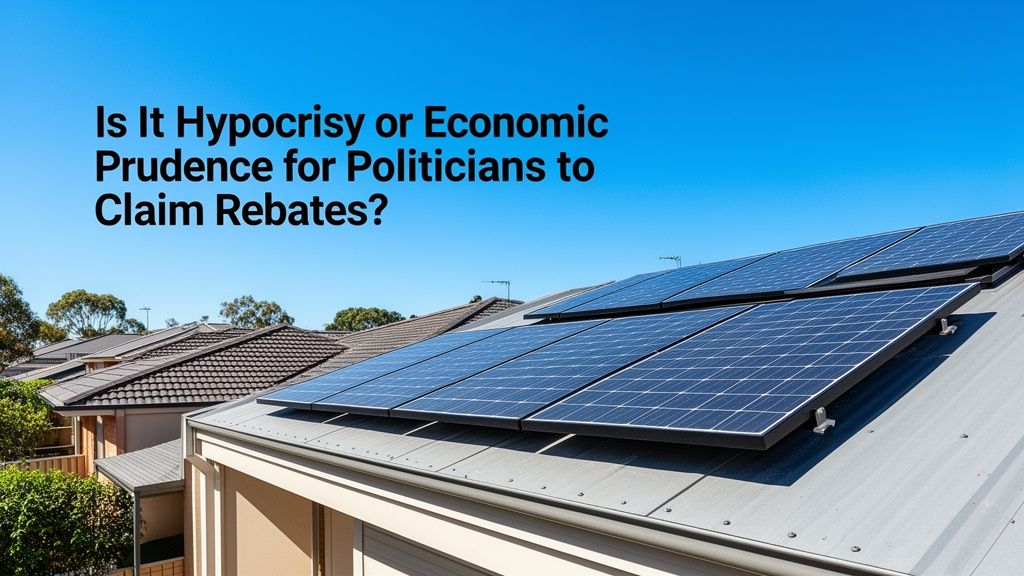
Why should politicians, as private citizens, be excluded from making a sensible investment in their own property and future? Installing solar can slash electricity bills by hundreds, if not thousands, of dollars a year. A typical 6.6kW system, after factoring in STCs, might cost an Australian homeowner anywhere from $5,000 to $8,000. With average annual savings easily topping $1,500 to $2,500, the payback period is often just 3-5 years. Not taking advantage of such an opportunity would arguably be imprudent financial management, regardless of one's occupation.

Furthermore, when politicians install solar, it normalises the technology. It sends a message that solar is a reliable, cost-effective solution for anyone looking to reduce their carbon footprint and save money. If the very people promoting these schemes aren't seen using them, it could actually undermine public confidence in the benefits of solar.
Australian Solar Context
Australia's solar journey has been incredible. Our sun-drenched continent is perfect for it, and government incentives have played a massive role in our world-leading adoption rates. The federal STC scheme alone can reduce the upfront cost of an average 6.6kW system by around $3,000-$4,000, depending on your postcode. Add to that state-specific programs – like Victoria's Solar Homes Program offering interest-free loans and further rebates, or Queensland's interest-free loans for solar and batteries – and the financial appeal is undeniable.
These schemes aren't just for the wealthy. They're designed to make solar accessible to a broader demographic, helping alleviate the burden of ever-increasing power bills for families right across the country. So, when a politician claims these rebates, they are merely participating in a system designed for public benefit, contributing to the overall renewable energy uptake and reducing their household's carbon footprint, just like millions of other Aussies.
Finding the Balance and Public Trust
Ultimately, there’s no easy answer to whether it's hypocrisy or prudence. The tension lies in the delicate balance between a politician's public role and their private life. As public figures, they are held to a higher standard of scrutiny, and rightly so. Public trust in politics is already a precious commodity, easily eroded by perceived inconsistencies.
Transparency is key. If a politician champions solar and actively works towards climate goals, then claiming a rebate aligns with their public stance and seems prudent. However, if their public actions contradict their private choices, the perception of hypocrisy is almost inevitable. It highlights the constant tightrope walk politicians must navigate between personal financial decisions and maintaining public confidence in their integrity and policies.
Conclusion
So, mate, the debate continues. Is it hypocrisy or economic prudence? Perhaps it's a bit of both, depending on the individual politician and their consistent actions. What's clear is that solar power remains a fantastic investment for Australian households, offering significant savings and environmental benefits. And while we might keep a watchful eye on our leaders, let’s ensure we’re all still making the most of that glorious Aussie sunshine!
Read More
For a comprehensive overview, check out our master guide: Read the Full Guide Here.