TL;DR: Apartment buildings face unique hurdles in Australia's energy transition due to shared ownership, complex decision-making, and financing models. However, innovative solar solutions like common area PV and bulk electricity purchasing, coupled with electrification of shared services and EV charging infrastructure, are proving effective pathways to integrate these crucial dwellings into a cleaner energy future.
Why have apartments lagged in Australia's solar adoption and energy transition?
Apartment buildings in Australia have significantly lagged behind detached houses in adopting solar power and other energy transition technologies primarily due to the complexities inherent in strata living. Unlike a standalone home where a single owner makes decisions, apartment blocks involve multiple owners sharing common property, leading to a need for collective agreement that can be slow and arduous. The initial capital outlay for a solar system, which might range from $15,000 to $50,000 for a system suitable for common areas, often requires a special levy or a loan, necessitating a super-majority vote from the body corporate. Furthermore, the perceived benefit for individual owners can be less clear if the solar only offsets common area electricity, rather than directly reducing their individual apartment's power bill. This disincentive, combined with a lack of awareness regarding viable financial models and technology options, creates a significant barrier to entry, leaving many apartment dwellers reliant on grid electricity without the benefits of onsite generation or modern electrification.
What are the primary solar solutions for apartment buildings in Australia?
The primary solar solutions for apartment buildings in Australia focus on harnessing available rooftop space to benefit residents, often through shared systems. These solutions move beyond individual panels on balconies (which are generally not viable or permitted) towards more integrated and communal approaches that navigate strata complexities. The goal is to deliver tangible energy savings, whether for common property expenses or directly to individual units, accelerating the building's contribution to Australia's broader energy transition. The chosen model often depends on the building's specific needs, strata rules, and the financial capacity and consensus of the owners corporation.
Common Area Solar PV for Shared Services
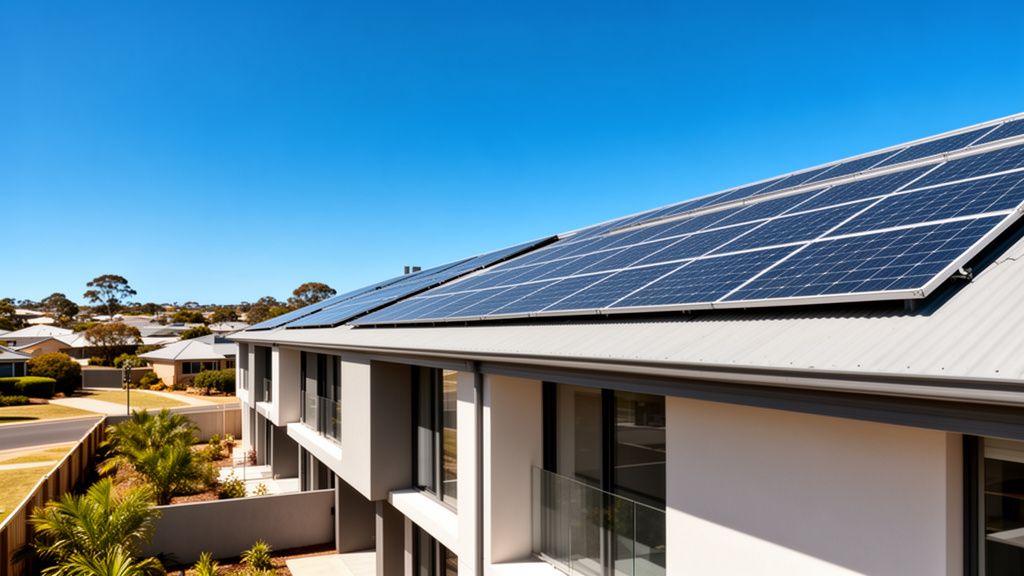
Installing a solar photovoltaic (PV) system on the common rooftop to power shared services is the most straightforward and widely adopted solution for apartment buildings. This involves routing the solar-generated electricity directly to the building's common meter, offsetting the power used by lifts, lighting in stairwells and hallways, carpark lighting, electric gates, and communal hot water systems. The financial benefits are immediately realised through reduced common area electricity bills, leading to lower strata levies for all owners. A typical 30kW system for a mid-sized apartment block might cost between $35,000 and $55,000, offering substantial annual savings that contribute directly to the building's operational budget. This approach avoids the complexities of individual metering or billing adjustments for each apartment.
Body Corporate Bulk-Buy & On-Selling Models
More advanced models see the body corporate acting as an embedded network operator, purchasing a larger solar system and potentially bulk grid power, then on-selling this electricity to individual apartments. This allows residents to benefit directly from solar generation and often at a rate cheaper than traditional retailers. Under this model, smart metering for each apartment is essential to accurately track consumption and solar usage. While more complex to set up due to regulatory requirements and meter installation, it offers the greatest potential for individual apartment owners to reduce their electricity bills and participate fully in the solar revolution. Owners can often save between 15-30% on their power bills compared to standard retail offers, making the collective investment highly appealing over the long term.
How do strata and funding models influence apartment solar projects?
Strata regulations and available funding models are critical determinants in the feasibility and success of apartment solar projects. Decision-making within a body corporate often requires a special resolution, typically needing a 75% vote in favour, which can be challenging to achieve among diverse owner interests. Beyond the vote, securing the necessary capital is another hurdle. Traditional options like special levies involve owners paying an additional lump sum, which can be unpopular. Innovative funding solutions are therefore vital to overcome these financial barriers and enable investment in renewable energy infrastructure within multi-owner properties.
Financing Solar Through Green Loans and PPAs
To circumvent the need for large upfront capital from owners, apartment buildings are increasingly utilising specialised green loans designed for strata corporations. These loans, often from ethical banks or credit unions, offer competitive interest rates and terms tailored to body corporate structures, allowing the cost of the solar system to be paid back over several years, often funded by the energy savings themselves. Another increasingly popular option is a Power Purchase Agreement (PPA), where a third-party provider installs, owns, and maintains the solar system, selling the generated electricity back to the body corporate at a fixed, competitive rate. This eliminates upfront costs entirely, transferring the maintenance burden and providing immediate savings, typically ranging from 10-20% on the portion of electricity covered by the PPA. These funding mechanisms significantly reduce financial risk and make solar projects more accessible for apartment blocks.
What non-solar electrification opportunities exist for apartments?
While solar is a cornerstone, the energy transition for apartments extends beyond rooftop panels to comprehensive electrification, optimising energy use, and integrating modern technologies. These non-solar opportunities primarily focus on transitioning away from fossil fuels and increasing energy efficiency within shared services and, where possible, individual units. Embracing these changes not only reduces a building's carbon footprint but can also lead to significant operational cost savings and improved comfort for residents, contributing to a truly sustainable living environment.

Upgrading Shared Hot Water Systems to Heat Pumps
Replacing traditional gas or electric resistance hot water systems with high-efficiency heat pump systems offers a substantial opportunity for energy savings in apartment buildings. Centralised hot water systems are often a major energy consumer in multi-unit dwellings. Heat pumps, which transfer heat rather than generating it directly, can be three to four times more energy-efficient than conventional systems, dramatically reducing energy consumption and associated greenhouse gas emissions. For a large apartment block, the annual savings on hot water bills could be thousands of dollars, making the investment, potentially ranging from $30,000 to $100,000 depending on building size, highly attractive over its lifespan. This upgrade directly contributes to electrifying the building's energy load and can be powered by any installed common area solar PV.
Planning for Electric Vehicle Charging Infrastructure
As electric vehicle (EV) adoption rapidly accelerates across Australia, integrating EV charging infrastructure is becoming a critical component of apartment buildings' energy transition. Installing shared or individually metered charging stations in common car parks allows residents to conveniently power their EVs at home. This often involves upgrading the building's electrical switchboard capacity and cabling, which is best planned proactively to avoid costly retrospective works. Solutions range from basic wall sockets for overnight charging to faster Level 2 chargers. Proactive planning ensures residents can embrace sustainable transport without having to move, making the building more future-proof and attractive. Funding for EV charging can be managed through special levies, user-pays models, or grants where available, such as those offered by some state governments.
Key Takeaways
- Apartment solar projects are achievable by focusing on common area benefits or bulk-buy on-selling models to address strata complexities.
- Strata green loans and Power Purchase Agreements (PPAs) are effective funding mechanisms to overcome upfront capital barriers for solar and electrification upgrades.
- Electrifying shared services, particularly by upgrading to heat pump hot water systems, significantly reduces a building's energy consumption and carbon footprint.
- Proactively planning and installing Electric Vehicle (EV) charging infrastructure is crucial for future-proofing apartment buildings and supporting sustainable transport.
- Engaging with knowledgeable solar and strata specialists can help navigate regulations and identify the most suitable solutions for your apartment block's energy transition.