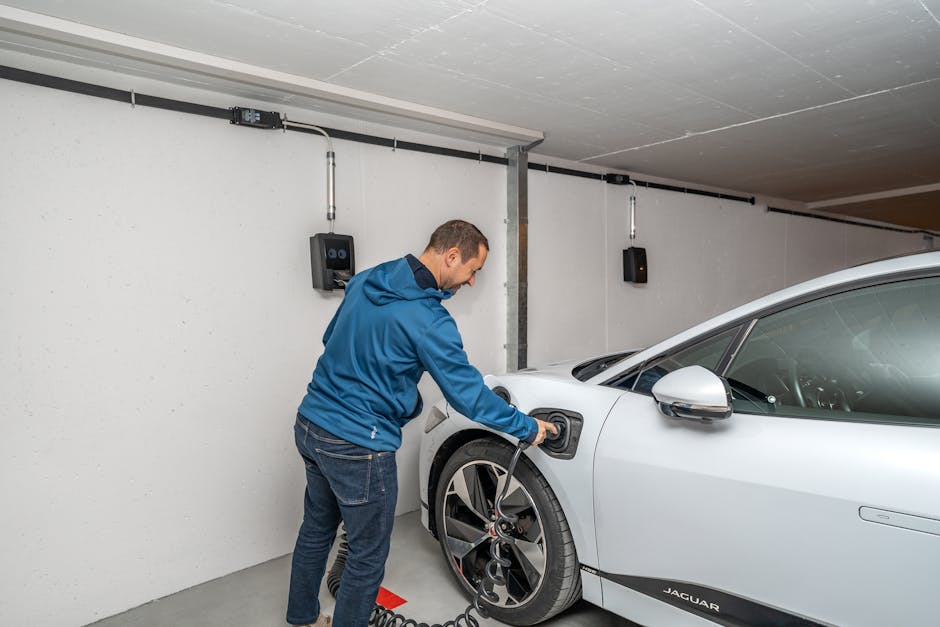
So, you've joined the EV revolution – welcome! One of the first questions new EV owners often have is, "How do I actually charge this thing?" Don't worry, it's easier than you think. This guide breaks down everything you need to know about keeping your electric vehicle powered up and ready to hit the Aussie roads.
For even more in-depth information, check out our Complete Guide.
Charging at Home: Your Personal Refuelling Station
The vast majority of EV charging in Australia happens right at home – around 80% in fact. It's convenient, cost-effective, and allows you to wake up every morning with a full "tank". You essentially have two options: using a standard power point or installing a dedicated EV Charger.
Option 1: Standard Power Point (Level 1 Charging)
Think of this as "trickle charging". Just like your mobile phone, you can plug your EV into a regular 240V power point using the charging cable that usually comes with the car (or can be purchased separately). The maximum power you'll get from this is around 2.4kW.
Pros:
- Convenient: No installation required. Just plug and play.
- Affordable: No upfront costs beyond the charging cable.
- Suitable for topping up: Ideal if you only drive short distances daily.
Cons:
- Slow: It can take upwards of 24 hours to fully charge a depleted battery.
- Limited range per hour: You'll typically only add a few kilometres of range per hour of charging.
- Not ideal for long commutes: If you regularly drive long distances, this might not be sufficient.
Important Safety Tip: Always plug the charging cable directly into the power point. Avoid using extension cords or power boards, as these can overload and create a fire hazard.
Option 2: Dedicated EV Charger (Level 2 Charging)
If you need faster charging, a dedicated home EV Charger is the way to go. These chargers, also known as Level 2 chargers, offer charging speeds from 7kW to 22kW.
Pros:
- Significantly faster: Charges 3 to 10 times faster than a standard power point.
- Increased range per hour: You can add between 30 to 80 km of driving range for each hour of charging.
- Ideal for longer commutes: Perfect for quickly replenishing your battery.
- Smart charging capabilities: Many Level 2 chargers offer smart charging features, allowing you to schedule charging during off-peak hours when electricity rates are lower.
Cons:


- Installation required: A licensed electrician must install the charger, which may require an upgrade to your switchboard and electricity supply.
- Higher upfront cost: Dedicated chargers are more expensive than using a standard power point.
Installation Considerations: A qualified electrician will assess your home's electrical system to determine if it can handle the increased load of a Level 2 charger. They may recommend upgrading your switchboard or electricity supply connection.
Charging on the Go: Public Charging Stations
While home charging is convenient, public charging stations are essential for longer trips and when you need a quick top-up while you're out and about.
Before you go:
- Plan your route: Use online maps and apps to locate public charging stations along your route.
- Check compatibility: Ensure the charging station is compatible with your EV's charging port.
- Consider costs: Public charging stations may charge per kilowatt-hour (kWh) or per minute. Check the pricing before you start charging.
At the charging station:
- Park your EV: Position your vehicle so that the charging cable can easily reach the charging port.
- Connect the cable: Plug the charging cable into both the charging station and your EV.
- Start charging: Follow the instructions on the charging station's screen. This may involve using a charging card, app, or credit card.
- Monitor charging: Keep an eye on the charging progress.
- Disconnect and go: Once charging is complete, disconnect the cable and return it to its holder.
Tips for Public Charging Etiquette:
- Be mindful of time limits: Some charging stations have time limits. Don't hog the charger longer than necessary.
- Move your car when finished: Once your car is charged, move it so that others can use the station.
- Report any issues: If you encounter any problems with the charging station, report it to the operator.
Calculating Charging Time and Cost
The time it takes to charge your EV depends on several factors, including:
- Charger power: The higher the power of the charger, the faster your car will charge.
- Battery size: Larger batteries take longer to charge.
- State of charge: Charging from empty will take longer than topping up.
To estimate charging time and cost, you'll need to know:
- Your charger's rate of charge (kW)
- Your vehicle's battery size (kWh)
- The cost of electricity (cents per kWh)
You can find a handy home charging calculator online, often on resources dedicated to green vehicles, to help you crunch the numbers.
Final Thoughts
Charging your EV is a simple and convenient process, whether you choose to charge at home or on the go. By understanding the different charging options and following these tips, you can keep your EV powered up and ready for your next adventure. Remember to consult your vehicle's owner's manual for specific charging recommendations. Happy driving!


