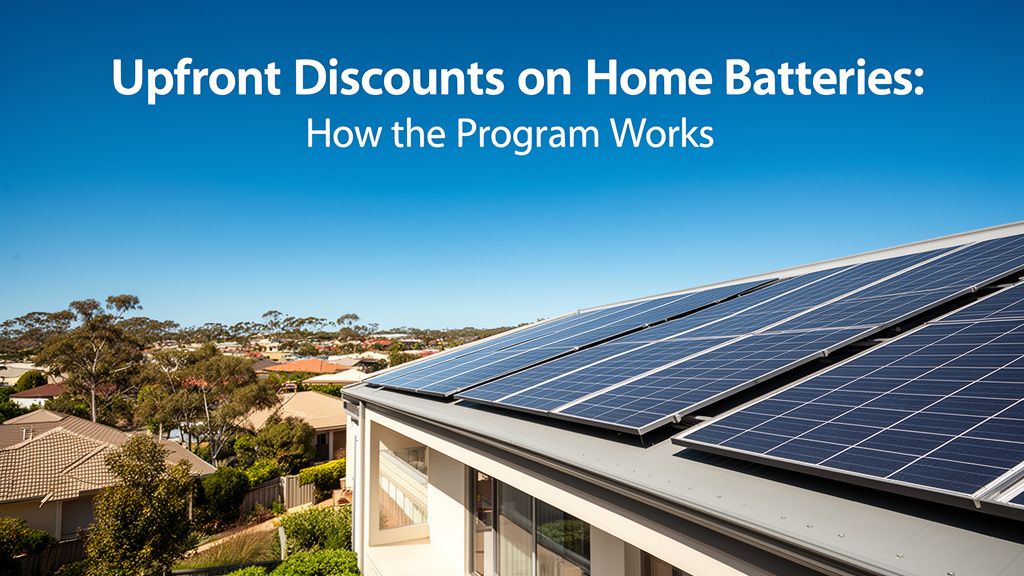
TL;DR: The Cheaper Home Batteries Program offers eligible Australian households direct, upfront discounts on new home battery systems, significantly reducing the initial purchase and installation cost. This initiative immediately lowers the financial barrier to adopting solar energy storage, making it more accessible for homeowners to maximise their solar investment and reduce reliance on the grid.
What is the Cheaper Home Batteries Program and how does it deliver upfront discounts?
The Cheaper Home Batteries Program is a federal government initiative designed to accelerate the uptake of home battery storage in Australia by providing eligible households with immediate financial relief at the point of sale. Unlike rebates or grants that require an application and reimbursement after the purchase, this program functions as an upfront discount, directly reducing the total invoice price you pay to your installer. The core mechanism involves accredited battery installers applying the discount directly to your quote, then claiming the equivalent amount from the government, streamlining the process for homeowners and making batteries instantly more affordable. This direct reduction means you pay less out of pocket, eliminating the need to wait for funds to be returned or navigate complex post-purchase claims.
The Upfront Discount Mechanism Explained
The program's key innovation is its upfront nature, where the government-funded discount is applied directly by participating installers before the customer pays. For example, if an eligible battery system costs $12,000, and a $2,000 discount is available through the program, your invoice from the installer would be $10,000. The installer then directly manages the claiming process with the program administrators. This method simplifies the financial transaction for homeowners, removing cash flow burdens and administrative hurdles often associated with government incentives. The goal is to make the decision to invest in a battery far less daunting, encouraging more households to store their excess solar generation rather than exporting it back to the grid for minimal feed-in tariffs.
Who is eligible for the Cheaper Home Batteries Program's significant savings?
Eligibility for the Cheaper Home Batteries Program is primarily based on household income, geographical location, and the specifics of the proposed battery installation. To qualify for these valuable upfront discounts, Australian homeowners typically need to meet certain income thresholds, ensuring the program targets those who stand to benefit most from the financial assistance. Generally, the program is designed for middle to low-income households, with specific annual taxable income caps applying to individuals and families, which are regularly reviewed by the government. Beyond income, the property itself must be an existing residential dwelling, and the battery system must be new, installed by an accredited professional, and meet Australian safety and performance standards.
Key Eligibility Criteria for Homeowners
To access the Cheaper Home Batteries Program, homeowners must reside in an eligible postcode, often focusing on areas identified for grid stability benefits or higher solar penetration. The property must be their primary residence, and the household's combined taxable income must fall below the specified cap. For instance, in 2024, an individual might need to earn under $90,000, or a couple under $180,000, though these figures can vary and should be checked against the most current guidelines. Furthermore, the battery system must be installed in conjunction with an existing or new rooftop solar PV system, ensuring that the battery is used to store renewable energy. The program also typically requires the battery to be connected to the internet for data monitoring and aggregation, contributing to broader grid management insights.
How do upfront battery discounts make solar energy storage more accessible for Australian homes?
Upfront battery discounts fundamentally transform the accessibility of solar energy storage by directly addressing the primary barrier for many Australian households: the high initial cost. A quality home battery system, even a modest one, can typically add $8,000 to $15,000 to the total cost of a solar installation. By providing an immediate reduction of several thousands of dollars – for example, a $2,000 to $4,000 discount – the program significantly lowers the out-of-pocket expense, making the investment decision much more palatable. This reduction can mean the difference between a homeowner being able to afford a battery and having to defer the purchase, thereby unlocking the benefits of energy independence and maximised solar self-consumption for a broader demographic. It democratises access to advanced energy technology, empowering more Australians to reduce their electricity bills and carbon footprint.
Reducing the Financial Barrier to Entry
The direct impact of an upfront discount cannot be overstated. Consider a typical 10kWh battery system costing $12,000 installed. An upfront discount of, say, $3,000 brings the immediate cost down to $9,000. This 25% reduction makes a significant difference to household budgets, especially when combined with existing solar rebates. Instead of budgeting for a hefty five-figure sum, homeowners are looking at a more manageable investment. This financial relief stimulates demand, encourages competition among battery suppliers, and ultimately helps drive down the overall cost of battery technology across the market. Moreover, by making batteries more affordable, it helps households become more resilient to rising energy prices and less reliant on the grid during peak demand periods, contributing to a more stable and sustainable energy future for Australia.
What are the long-term financial and environmental benefits of investing in a discounted home battery?
Investing in a home battery system, especially with the advantage of an upfront discount, delivers substantial long-term financial and environmental benefits beyond the immediate savings. Financially, a battery allows you to store excess solar electricity generated during the day instead of exporting it to the grid for a low feed-in tariff (often just 5-10 cents per kWh). This stored energy can then be used in the evenings when grid electricity prices are highest (sometimes 30-50 cents per kWh), drastically reducing your reliance on expensive peak-time electricity and significantly lowering your overall power bills. Over the battery's lifespan, typically 10-15 years, these daily savings accumulate into tens of thousands of dollars, effectively providing an impressive return on investment, particularly for an already discounted initial outlay.
Maximising Solar Self-Consumption and Reducing Bills
The primary financial benefit of a home battery is its ability to maximise solar self-consumption. Instead of being paid a low rate for exported power, you get to use your own generation, effectively valuing that energy at the higher retail price you would otherwise pay for grid electricity. For example, if you export 10 kWh daily at $0.08/kWh (earning $0.80) but can use that same 10 kWh from your battery instead of buying it from the grid at $0.35/kWh (saving $3.50), the daily financial benefit is multiplied significantly. This substantially reduces your payback period for the entire solar and battery system. Environmentally, by storing and using your own renewable energy, you decrease your household's carbon footprint, contribute to a more stable electricity grid by reducing demand during peak times, and lessen the need for fossil fuel-powered generation. It's a win-win for both your wallet and the planet.
Key Takeaways
- The Cheaper Home Batteries Program provides direct upfront discounts on battery systems, significantly lowering the initial cost for eligible Australian households.
- Eligibility is typically based on household income thresholds, property location, and the requirement for a new battery connected to a solar PV system.
- These upfront savings make solar energy storage more accessible, reducing the financial barrier to entry by thousands of dollars (e.g., $2,000-$4,000).
- Long-term benefits include maximising solar self-consumption, drastically cutting electricity bills, enhancing energy independence, and reducing your carbon footprint.
- Check your eligibility and explore accredited installers to take advantage of these immediate savings and invest in your home's energy future.
Read More
For a comprehensive overview, check out our master guide: Read the Full Guide Here.