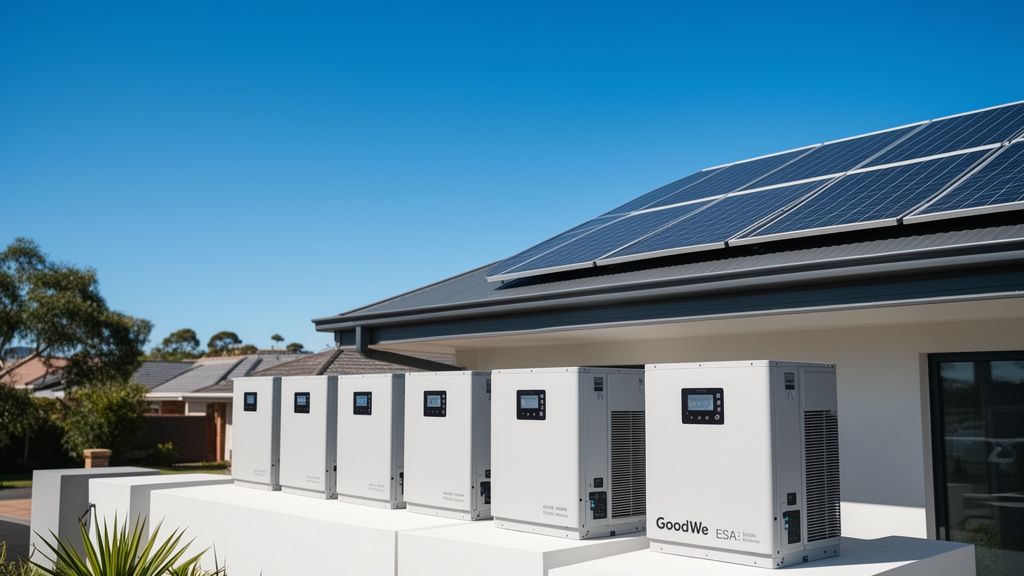
TL;DR: The GoodWe ESA stacks battery modules rather than shipping as one fixed unit, so you can start with the capacity you need now and add more later. Adding a 5.4kWh module runs roughly $3,500 to $4,500 installed, against $7,000 to $10,000 for a standalone system of the same size. The caveat: confirm which module revisions your installed system will accept before you plan an expansion.
Why Modularity Matters
Most home batteries are sold as a single fixed unit. Outgrow it and your options are to add a second complete system, with its own inverter and its own installation, or replace the first one.
The ESA stacks. Modules sit in a tower, managed by a battery management system inside the hybrid inverter, and you add to the tower rather than starting again.
That changes the buying decision. Instead of guessing what your consumption will look like in eight years and paying for it now, you buy what your evening load justifies today and extend when something actually changes.
Start Small, Extend Later
A 5.4kWh starting configuration covers a modest evening load and costs a fraction of a large system.
That lower entry point is the practical benefit. Home battery storage is expensive enough that plenty of households defer it entirely, and being able to start at a third of the cost of a large bank puts it within reach.
The trade-off is that a small battery fills quickly and then exports the rest of your surplus at feed-in rates. If your array already produces a large midday surplus, starting small leaves money on the table each day until you expand.
Mixing Module Capacities
GoodWe's modules come in several capacities, commonly 5.4kWh, 8.1kWh and 10.8kWh. The BMS balances charge and discharge across modules of differing size, so a stack does not have to be uniform.
That is useful when you expand years later. If a higher-capacity module offers better value per kilowatt-hour by the time you extend, you can add it rather than buying more of the original size.
A Worked Example
Start with two 5.4kWh modules for 10.8kWh total, enough for a typical household's evening peak.
Three years later you fit an EV Charger and your consumption climbs sharply. Rather than adding two more of the original modules, you add a single 8.1kWh or 10.8kWh unit, matching the current product range and pricing.
An additional 5.4kWh module runs roughly $3,500 to $4,500 installed. A standalone 5.4kWh system, including its own inverter and a full installation, is closer to $7,000 to $10,000. Expansion costs roughly half, because you are paying for cells and labour rather than for a second inverter.
Check the Revision Before You Plan Around It
This is the part the marketing does not cover and installers deal with regularly.
GoodWe module generations carry revision suffixes, and not every generation is interchangeable within a stack. Mixing revisions is a common cause of communication faults at commissioning, and a module that will not talk to the BMS is not adding capacity to anything.
Before you buy on the strength of future expansion, ask two questions and get the answers in writing: which module models does this specific inverter and firmware support, and how long does GoodWe expect to supply the module I am installing today?
The second question is the important one. Modular expansion is only worth what the supply chain is worth in year five, and a discontinued module with no compatible successor turns a stackable system into a fixed one.
Old Modules and New Ones in the Same Stack
Worth understanding before you expand: your original modules will have aged.
A module that has been cycling for four years holds less usable capacity than the day it was fitted, and a new module added beside it starts at full capacity. The BMS manages the difference, so the stack works, but the total you get is the sum of what each module can actually deliver rather than the sum of their nameplate ratings.
The other consequence is warranty timing. Each module carries its own warranty from its own installation date, so a stack extended twice will have modules falling out of warranty at different points. Keep the invoices and commissioning records for each stage, because the claim will be made against a specific module rather than against the system.
None of this argues against expanding. It argues against assuming an expanded stack behaves like a new one of the same nameplate size.
What Expansion Actually Buys You
Deferred cost. You are not funding capacity you will not use for years. On a battery that depreciates and warrants on cycles, buying capacity ahead of need is genuinely wasteful.
Adaptation to real changes. An EV, a heat pump hot water system, a household that grows or shrinks. Each of these shifts your evening load, and each is a reason to extend rather than a reason to have overbought.
Protection against premature obsolescence. A fixed-capacity battery that no longer meets your demand is functionally obsolete while still holding years of useful life. Adding modules avoids that outcome.
Modern batteries carry warranties in the 10 to 15 year range, so a system bought today should still be working when your circumstances change. Being able to extend it is what makes that lifespan useful rather than merely long.
What It Does Not Fix
Expansion does not lift the inverter's limits. The hybrid inverter has a maximum battery capacity it will manage and a maximum continuous output in kW, and adding modules beyond those limits achieves nothing.
If you intend to expand substantially later, size the inverter for the endpoint rather than the starting point. An inverter chosen for a 5.4kWh starter system may not support the stack you want in year six, and replacing it costs more than the margin you saved.
Ask for the maximum supported capacity and the continuous backup output at the quoting stage, and check both against where you think you are heading.
Sizing the First Stage
Size the starting capacity to your evening consumption, not your daily total.
A household using 25kWh a day but only 8kWh of it after generation stops does not need 13kWh of battery. Your retailer can supply interval data showing exactly when you consume, and that number should drive the whole design.
Then decide the endpoint and confirm the inverter supports it. Getting those two numbers right at the start is what makes the modularity worth paying for.
Key Takeaways
- ESA modules stack, so you can start at a lower capacity and extend rather than replacing a fixed unit.
- The BMS balances modules of different capacities, so a later expansion can use whatever size offers the best value at the time.
- Adding a 5.4kWh module costs roughly $3,500 to $4,500 installed, about half the cost of a standalone system of the same size.
- Confirm in writing which module revisions your inverter and firmware support, and how long the module you are buying will remain available.
- Size the inverter for where you intend to end up, because expansion cannot exceed its maximum supported capacity or output.
