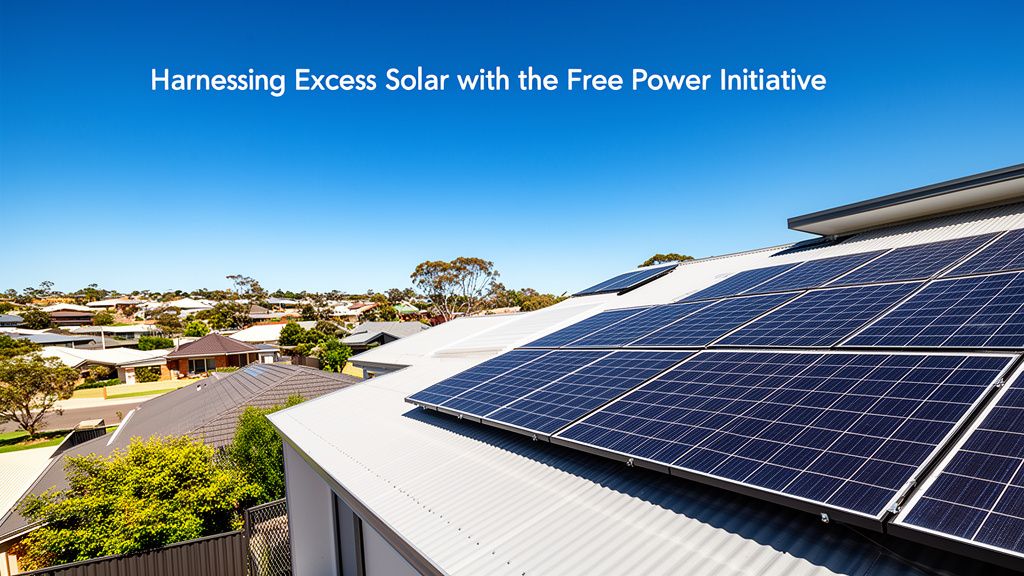
TL;DR: The Free Power Initiative allows Australian solar homeowners to virtually bank their excess solar generation, rather than selling it for low feed-in tariffs. This banked energy can then be drawn back from the grid when needed, effectively reducing reliance on expensive grid power and significantly cutting electricity bills.
What is the Free Power Initiative and how does it stop solar energy going to waste?
The Free Power Initiative is an innovative energy program designed to help Australian solar homeowners maximise the value of their rooftop solar systems by eliminating the "waste" of cheap solar exports. Typically, when your solar panels generate more electricity than your home consumes during the day, the surplus is exported back to the grid. While you receive a feed-in tariff (FiT) for this, it's often a mere fraction of what you pay to buy electricity back from the grid, particularly during evening peak hours. For instance, you might get $0.07/kWh for exporting, only to pay $0.30/kWh to import later. This disparity means valuable solar energy is undervalued. The Initiative transforms this dynamic by allowing you to store your excess generation virtually, to be used precisely when you need it, rather than losing its true value to the grid.
The Challenge of Excess Solar and Low Feed-in Tariffs
Australian homes with solar often find themselves in a peculiar situation: awash with free energy during the day, but forced to buy expensive power from the grid once the sun sets. This imbalance is largely due to declining feed-in tariffs offered by retailers across most states. A standard 6.6kW solar system can generate around 25-30 kWh per day, far exceeding the daytime consumption of many households. Exporting this valuable surplus for a paltry $0.05 to $0.10 per kilowatt-hour, only to then purchase grid power at three to six times that price later, feels like throwing money away. The traditional model makes it hard for many to truly capitalise on their investment, hindering the path to genuine energy independence and maximising savings.
Introducing the Virtual Battery Concept
The core of the Free Power Initiative lies in its "virtual battery" concept. Instead of merely exporting your excess solar and receiving a low FiT, participating retailers credit your account with the full value of the exported energy, or a significantly higher rate, which you can then draw upon later. This credit acts like a bank balance for your electricity, allowing you to essentially store your daytime surplus. When your solar system isn't generating (e.g., at night or on cloudy days), instead of pulling expensive power straight from the grid, you consume from your banked solar credits first. This eliminates the need for expensive physical battery storage for many, making it accessible to a broader range of households looking to maximise their solar investment.
How can the Free Power Initiative significantly cut your household electricity bills?
The Free Power Initiative delivers substantial savings on household electricity bills by closing the gap between the value of your exported solar and the cost of grid power. By allowing you to effectively use 100% of your generated solar energy – either directly, or by banking and drawing it back – you drastically reduce your reliance on purchasing electricity from your retailer. Instead of receiving a feed-in tariff of, say, $0.07 per kWh for exported power and paying $0.30 per kWh for imported power, the initiative enables you to save that full $0.30 per kWh you would have spent. For a typical household exporting 10-15 kWh daily, this could translate to hundreds of dollars in additional annual savings, moving the payback period of your solar system forward and improving your overall return on investment.
Maximising Your Solar Self-Consumption Value
One of the biggest challenges for solar homeowners has been maximising self-consumption, meaning using as much of the power generated by your own panels as possible. The Free Power Initiative inherently maximises your self-consumption value by treating your exported power as effectively consumed by you at a later time. Instead of just shifting your energy use to daylight hours – which isn't always practical – you gain the benefit of using your own "stored" solar energy whenever you need it, whether that's running the washing machine in the evening or heating water in the morning. This approach ensures that every kilowatt-hour your system generates works harder for you, directly offsetting high peak and shoulder tariffs that often dominate Australian household bills.
Comparing Savings to Traditional Battery Storage
While physical home battery storage offers similar benefits by storing excess solar for later use, it comes with a significant upfront cost, typically ranging from $10,000 to $18,000 for a decent sized unit. This investment can add years to the payback period of a solar system. The Free Power Initiative, however, offers a "virtual" battery solution without the hardware expense. This means you can achieve many of the financial benefits of a physical battery – reducing grid reliance and maximising solar self-sufficiency – without the considerable capital outlay or ongoing maintenance. For many Australian households, especially those on a tighter budget or with sufficient roof space for solar but not battery, this initiative provides an immediate, low-cost pathway to deeper bill reductions and a faster return on their solar investment.
Who is eligible for the Free Power Initiative and what steps are involved in joining?
Eligibility for the Free Power Initiative typically focuses on Australian homeowners with existing or newly installed grid-connected solar PV systems and a smart meter. While specific criteria may vary slightly between participating retailers, the core requirements revolve around ensuring accurate measurement of both exported and imported energy, alongside a willingness to engage with the program's terms. Most households with standard residential solar systems (e.g., 5kW to 10kW) will likely qualify, provided their electricity retailer offers the initiative in their area. The aim is to make this opportunity widely accessible, empowering more Australians to take control of their energy costs and contribute to a more sustainable energy future.
Key Eligibility Criteria for Australian Homes
To jump on board with the Free Power Initiative, there are a few straightforward criteria Australian homes generally need to meet. Firstly, you must have a grid-connected solar PV system. There aren't usually strict size limits for residential systems, but it's designed for typical household setups, say up to 10-15kW. Secondly, a smart meter (or a compatible digital meter) is essential. This allows your energy retailer to accurately track your electricity exports and imports hourly or half-hourly, which is crucial for the virtual banking system. Finally, you need to be with an electricity retailer that actively participates in the Free Power Initiative in your state or territory. It's always a good idea to check with your current provider or explore options with others to see who offers the best terms.
Simple Steps to Start Saving with Your Excess Solar
Joining the Free Power Initiative is generally a hassle-free process. Your first step should be to contact your current electricity retailer to inquire if they offer the program and what their specific terms are. If your current retailer doesn't participate, or if you find better rates elsewhere, you can explore switching to a participating provider. Once you've chosen a retailer, they will guide you through the sign-up process, which usually involves reviewing and agreeing to the program's terms and conditions. If you don't already have one, they may arrange for a smart meter installation or activation. After this, your excess solar generation will automatically start contributing to your virtual power bank, and you'll begin seeing the benefits directly on your next electricity bill, transforming your solar waste into tangible savings.
Key Takeaways
- The Free Power Initiative allows solar homeowners to virtually bank excess solar exports, getting more value than traditional feed-in tariffs.
- It significantly reduces electricity bills by offsetting expensive grid imports with your own "stored" solar power.
- The initiative acts as a virtual battery, providing similar benefits to physical batteries without the high upfront cost.
- Eligibility typically requires a grid-connected solar system and a smart meter, with participating retailers facilitating the sign-up.
- By joining, you can dramatically improve your solar system's return on investment and achieve greater energy independence.
Read More
For a comprehensive overview, check out our master guide: Read the Full Guide Here.