TL;DR: Australians from rural properties to bustling cities are increasingly choosing electric vehicles (EVs) due to significant fuel savings, environmental benefits, and growing charging infrastructure. Integrating home solar power further amplifies these advantages, making EV ownership more sustainable and cost-effective by enabling free, green charging.
What are the primary motivations for rural Australians switching to EVs?
Rural Australians are increasingly drawn to electric vehicles primarily for the substantial long-term fuel cost savings and the potential for greater energy independence, especially when paired with home solar. For families and businesses operating across large properties or frequently travelling between regional towns, the rising price of petrol and diesel at the pump hits hard. EVs offer a tangible escape from these volatile costs, allowing owners to 'fuel' their vehicles at a fraction of the price by charging from their own solar systems or cheaper off-peak grid electricity. This shift isn't just about saving a few bucks; it's about gaining control over one of the biggest household or operational expenses, providing financial predictability that traditional internal combustion engine (ICE) vehicles simply can't match.
Battling the Bowsers on the Farm
For decades, the tyranny of distance and the fluctuating price of fuel have been major headaches for Australians living outside metropolitan hubs. A tank of petrol can easily set you back $100-$150, and for those who travel hundreds of kilometres weekly, these costs quickly add up to thousands of dollars a year. Switching to an EV dramatically alters this equation. Imagine topping up your vehicle for the equivalent of $5-10 worth of electricity, often generated right on your own roof, rather than paying $2.20 per litre at a remote servo. This economic relief is a powerful motivator, freeing up capital for other farm improvements or household necessities, making the upfront investment in an EV much easier to justify for many regional Aussies.
The Role of Rooftop Solar for Remote Charging
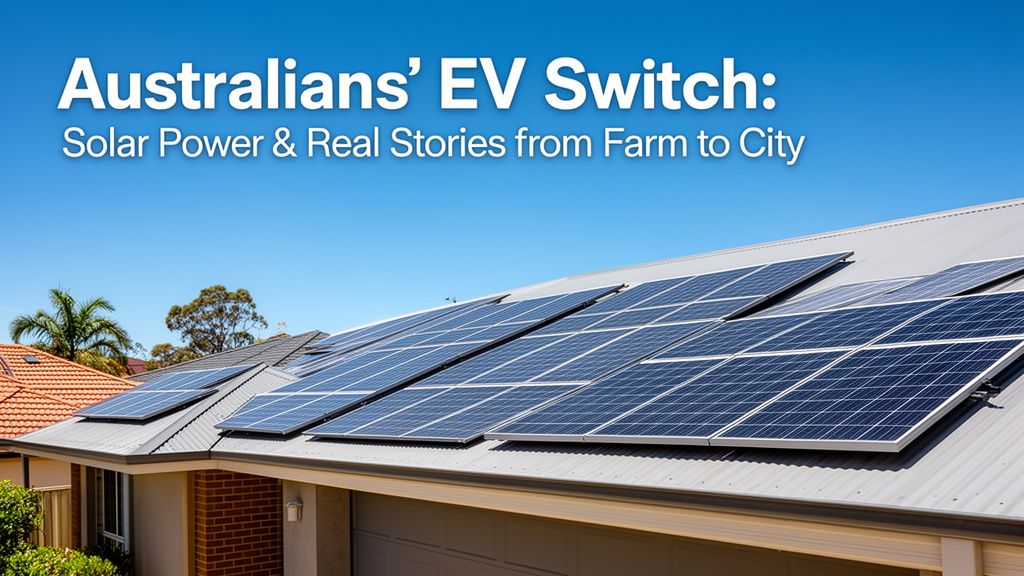
The concept of energy independence holds particular appeal for rural Australians, and combining an EV with a rooftop solar system is a game-changer. Many farms and regional homes already boast substantial solar arrays, often 10kW or more, installed to offset high electricity bills. These systems can generate abundant power during the day, perfectly timed to charge an EV at minimal or zero cost. This synergy allows rural EV owners to effectively bypass the grid for much of their charging needs, securing truly 'free' motoring for hundreds of kilometres weekly. It eliminates range anxiety stemming from limited public charging options in remote areas, as the most reliable 'charging station' is always right at home.
How are city dwellers integrating EVs into their urban lifestyles?
City dwellers are embracing electric vehicles as a seamless fit for their urban lifestyles, driven by the convenience of home charging, reduced local emissions, and often a desire to lower their carbon footprint. Navigating stop-start traffic and shorter daily commutes makes EVs particularly efficient in city environments, where regenerative braking can recoup energy. The quieter operation and instant torque also enhance the urban driving experience, contributing to a more pleasant commute. For many, an EV represents a modern, forward-thinking choice that aligns with increasingly sustainable city planning and a desire for cleaner air and less noise pollution in their communities.
Navigating City Charging Solutions
For urban Australians, the availability of diverse charging solutions is key to a smooth EV transition. While public charging networks, including fast chargers at shopping centres and dedicated charging hubs, are growing, the primary charging method for most city EV owners remains at home. Installing a dedicated wall charger (around $1,500-$2,500, including installation) in a garage or carport allows for convenient overnight charging, ensuring the vehicle is always topped up for the next day's errands or commute. For apartment dwellers, solutions like shared building chargers or accessing workplace charging facilities are becoming more common, addressing the unique challenges of multi-residential living.
The Urban Solar Advantage for EV Owners
Integrating an EV with a home solar system offers significant advantages for city residents. With typical daily commutes often falling within the range of 30-60 km, a standard 6.6kW rooftop solar system (costing roughly $5,000-$9,000 installed, depending on rebates and complexity) can easily generate enough energy to cover an EV's daily charging needs during daylight hours. This allows urban EV owners to effectively drive for free, using their own self-generated, clean electricity. Beyond the direct financial savings, which can be thousands of dollars annually compared to petrol, it provides a strong sense of environmental contribution, knowing their daily travel produces zero tailpipe emissions and is powered by renewable energy.
What financial incentives and practical considerations impact the EV switch in Australia?
The decision to switch to an EV in Australia is increasingly influenced by a mix of financial incentives and practical considerations regarding infrastructure and charging. Australian state and federal governments have introduced various schemes aimed at accelerating EV adoption, which significantly reduce the upfront cost burden. However, prospective owners must also carefully weigh factors such as vehicle purchase price, available range, and the practicalities of charging both at home and on longer journeys. These considerations combine to shape the overall feasibility and appeal of making the EV leap for different households and businesses across the country.
Unpacking Australian EV Rebates and Running Costs
Australia's EV incentives vary by state, offering tangible financial benefits. For example, some states provide stamp duty exemptions, registration discounts, or rebates of up to $3,000-$6,000 on new EV purchases below a certain price cap. Additionally, the federal government has introduced Fringe Benefits Tax (FBT) exemptions for eligible electric vehicles, making them highly attractive for novated leases and company fleets. Beyond the purchase, the running costs are remarkably lower. Servicing an EV typically costs 30-50% less than an ICE car, and 'fuelling' with electricity can be as cheap as $0.08-$0.15 per kWh from solar or off-peak grid power, compared to $0.40-$0.50 per kWh equivalent for petrol at $2.00/litre.


Assessing Home Charging Infrastructure Needs
A crucial practical consideration for any EV owner is reliable home charging. Most EVs come with a 'trickle charger' that plugs into a standard 240V power point, but this can take 20+ hours for a full charge. Investing in a dedicated Level 2 wall charger (often a 7kW or 11kW unit) dramatically speeds up charging, taking 4-8 hours for a full charge, making overnight top-ups feasible. Home electrical systems often need a professional assessment to ensure they can handle the increased load. The cost for a wall charger and installation typically ranges from $1,500 to $2,500, a worthwhile investment for convenience and to maximise solar self-consumption.
How does solar power amplify the benefits of owning an EV across different Australian settings?
Solar power significantly amplifies the benefits of owning an EV by offering unparalleled cost savings, genuine energy independence, and a truly zero-emissions driving experience, whether you're living in a rural homestead or a bustling city apartment. By harnessing the abundant Australian sunshine, EV owners can dramatically reduce or even eliminate their vehicle's fuel costs, transforming the concept of 'filling up' into a clean, virtually free daily routine. This synergy extends beyond just economics, providing a profound sense of environmental contribution and freedom from reliance on traditional fuel sources and their associated price volatility.
Maximising Savings with Solar-Powered Charging
The financial gains from charging an EV with solar are substantial. Instead of paying upwards of $100 for a tank of petrol, an EV owner with solar can charge their vehicle for effectively zero cost, using power generated right from their roof. With a typical 6.6kW solar system generating around 25-30 kWh per day, and a modern EV consuming roughly 15-20 kWh per 100 km, many Australians can cover their daily driving needs entirely with solar. This equates to annual fuel savings of $2,000 to $4,000, quickly offsetting the upfront cost of both the solar system and the EV itself, making it one of the most effective ways to reduce household expenses.
Achieving True Zero-Emissions Driving with Rooftop PV
While driving an EV always eliminates tailpipe emissions, powering it directly from a fossil-fuel-reliant grid doesn't fully achieve a zero-carbon footprint. This is where rooftop solar PV systems shine. By charging an EV with solar power, Australians can achieve true 'well-to-wheel' zero-emissions driving. Every kilometre travelled is powered by clean, renewable energy, significantly reducing an individual's carbon footprint and contributing directly to a cleaner environment. This complete alignment of sustainable transport with sustainable energy production is a powerful motivator for many Australians, transforming their daily commute into an active step towards a greener future.
Key Takeaways
- Fuel Savings are Substantial: Both rural and urban Australians save thousands annually on fuel by switching to EVs, often charging for a fraction of petrol costs, especially with solar.
- Solar Power is a Game-Changer: Integrating home solar with an EV offers free, clean charging, providing energy independence and maximising financial and environmental benefits.
- Charging is Convenient at Home: Dedicated home wall chargers make overnight top-ups easy and ensure vehicles are always ready for daily use.
- Incentives Support Adoption: State rebates, FBT exemptions, and lower running costs make EVs increasingly attractive and financially viable in Australia.
- Environmental Impact is Significant: Powering an EV with solar enables true zero-emissions driving, contributing directly to a greener future.
Read More
For a comprehensive overview, check out our master guide: Read the Full Guide Here.