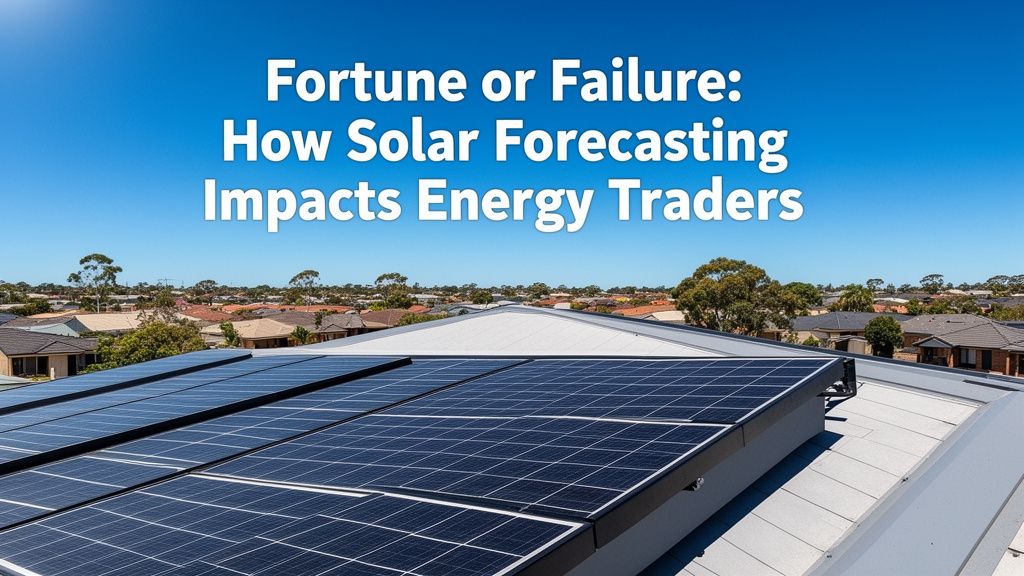
The Australian sun, a blessing for our vast land and a powerhouse for renewable energy, is also a formidable force shaping our electricity markets. With rooftop solar on over a third of Aussie homes and utility-scale solar farms proliferating across the landscape, sunshine directly translates into megawatts feeding our National Electricity Market (NEM). But what happens when that sunshine is unexpectedly interrupted by a passing cloud, a bushfire haze, or a sudden downpour? For energy traders, the difference between an accurate solar forecast and a miscalculation can mean the difference between fortune and financial failure.
Australia's Solar Revolution and Market Volatility
Australia boasts some of the highest per capita solar penetration globally. Our commitment to renewables is undeniable, with solar now a cornerstone of the NEM’s generation mix. This rapid expansion, while fantastic for emissions targets, has introduced unprecedented volatility into wholesale electricity prices. The sheer volume of solar generation can push prices down significantly, even into negative territory during periods of low demand and high output. Conversely, an unexpected drop in solar can send prices skyrocketing, particularly during peak demand periods.
For energy traders operating in this dynamic environment, understanding and predicting solar output isn't just an advantage; it's absolutely critical. They’re tasked with optimising bids and offers, managing generation assets, and securing contracts – all while staring down the barrel of an increasingly unpredictable market.
The Gold Standard: Why Accurate Forecasting is Priceless
Imagine buying electricity at $50/MWh and selling it for $150/MWh. That’s the dream. Now imagine expecting prices to plummet due to high solar, selling your generation at $20/MWh, only for a sudden bank of clouds to drive prices to $200/MWh. This is the daily tightrope walk for energy traders.
- Optimising Bids and Offers: Accurate solar forecasts enable traders to make informed decisions about their energy portfolios. If a trader anticipates high solar output across the NEM, they might lower their offers to secure sales or increase their bids to purchase cheaper electricity for their retail customers. Conversely, foreseeing a dip allows them to hold off on selling, expecting higher prices, or pre-emptively secure supply.
- Risk Management: Unforeseen fluctuations in solar generation expose traders to significant financial risk. A generator relying on solar must hedge against the risk of under-generating and being forced to buy expensive power from the spot market to fulfil contracts. Likewise, a retailer might over-commit to selling cheap power only to face unexpected high spot prices when solar underperforms. Robust forecasting is a vital tool for mitigating these risks.
- Arbitrage Opportunities: The ability to accurately predict short-term price movements opens doors for arbitrage. If a trader knows solar will unexpectedly dip in the next hour, they can buy futures contracts now at a lower price, anticipating a higher spot price later. This is where real profits are made – or lost.
- Storage Optimisation: For traders managing battery energy storage systems, forecasting is paramount. Knowing when solar generation will be high and prices low allows them to charge batteries cost-effectively. Conversely, accurate prediction of solar dips and high prices dictates when to discharge stored energy for maximum profit.
Battling the Elements: Challenges Down Under
Australia's unique geography and climate present significant challenges for solar forecasting.


- Weather Variability: From sudden afternoon thunderstorms in the tropics to vast dust storms across the outback and intermittent cloud cover, Australian weather is anything but consistent. Bushfire smoke, increasingly prevalent during our longer, hotter summers, can also significantly reduce solar irradiance, often with little warning.
- Geographic Scale: The NEM spans thousands of kilometres, with solar farms dotted across diverse climatic zones. A single forecast model rarely suffices; hyper-localised, high-resolution models are essential.
- Distributed Generation: The sheer volume of rooftop solar, largely outside the direct control or real-time visibility of central grid operators, adds another layer of complexity. Aggregating these thousands of small generators into a reliable forecast is a massive undertaking.
The Cutting Edge: Tools of the Trade
To tackle these challenges, traders and their forecasting partners are employing increasingly sophisticated technology. Satellite imagery provides real-time cloud cover data, while advanced numerical weather prediction models simulate atmospheric conditions. Artificial intelligence and machine learning algorithms are trained on vast datasets of historical weather and generation data, learning to identify patterns and predict outcomes with greater accuracy. Edge computing and real-time sensor data from solar farms further enhance the precision of these forecasts.
The Financial Stakes: Fortune or Failure
Consider a major solar farm operator whose trading desk expects high solar output for the afternoon, bidding their generation into the NEM at a competitive price, say $60/MWh. A sudden, unforecasted cloud front rolls in, reducing their output by 50MW. If the spot price for electricity jumps to $500/MWh due to the deficit, they might be forced to buy back power at a massive loss to meet their commitments. That’s a potential hit of $22,000 for every hour they're short.
Conversely, imagine a retailer expecting average solar, and suddenly an unexpectedly clear sky over South Australia drives prices negative, say -$20/MWh, due to oversupply. If they've secured power at a standard rate, they're now paying for power they can’t profitably sell into the wholesale market, incurring substantial losses.
These aren't hypothetical scenarios; they are daily realities in the NEM, illustrating precisely how critical accurate solar forecasting is for financial viability.
A Brighter, More Predictable Future
As Australia continues its journey towards a renewable-dominated energy future, the demand for ever more precise solar forecasting will only intensify. Investment in advanced meteorological models, AI-driven analytics, and real-time data integration is paramount. For energy traders, mastering solar forecasting is no longer a luxury; it’s the cornerstone of successful strategy, safeguarding against market volatility and unlocking profitable opportunities.
The sun will always shine on Australia, but knowing exactly when and how much it shines will determine who thrives in our dynamic energy market. Fortune truly favours the well-forecasted.
Read More
For a comprehensive overview, check out our master guide: Read the Full Guide Here.