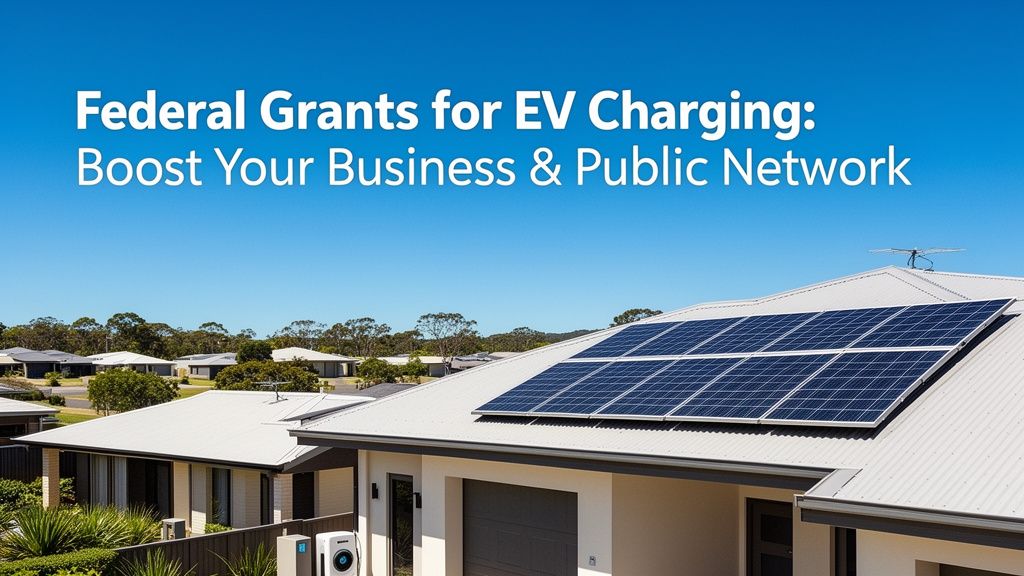
TL;DR: The Australian federal government offers significant grant opportunities for businesses and public entities to install electric vehicle (EV) charging infrastructure. These programs aim to accelerate EV adoption by expanding charging networks, reducing range anxiety, and supporting sustainable transport across urban and regional Australia.
What Federal Programs Support EV Charging Infrastructure for Businesses?
Federal programs provide crucial financial backing for Australian businesses looking to install electric vehicle (EV) charging infrastructure, effectively reducing upfront costs and accelerating the transition to a greener fleet and customer offering. These initiatives typically aim to boost the availability of charging points at workplaces, commercial premises, and tourism destinations, making EV ownership more practical for employees, customers, and visitors. For instance, the National EV Charging Network (NECN) is a key program, often administered by the Australian Renewable Energy Agency (ARENA), which targets the deployment of fast chargers along key highways and in regional centres. Businesses can leverage these grants to not only future-proof their operations but also to attract eco-conscious customers and staff, positioning themselves as leaders in sustainability. Co-funding requirements are standard, meaning businesses contribute a portion, but the grants significantly offset the investment, often covering a substantial percentage of eligible project costs, which can range from tens of thousands for smaller installations to hundreds of thousands for larger, multi-charger projects.
Targeted Support for Fleet Electrification
Many federal grants specifically target businesses looking to electrify their vehicle fleets, from delivery vans to company cars. This support can cover the installation of depot charging infrastructure, allowing businesses to charge multiple EVs simultaneously overnight or during off-peak hours, optimising operational efficiency and minimising energy costs. For example, a logistics company transitioning its fleet of delivery vehicles could apply for grants to install several 22kW AC chargers or even a few 50kW DC fast chargers at its main depot. The financial assistance makes the significant capital outlay for chargers more manageable, enabling businesses to reduce their carbon footprint, cut fuel expenses, and meet increasing corporate social responsibility demands without a prohibitive initial investment.
Enhancing Customer Experience with Workplace Charging
Beyond fleet support, businesses can also secure funding to install EV chargers for their customers and employees. This adds value, positioning the business as forward-thinking and environmentally conscious. Imagine a shopping centre offering free or paid fast charging while customers shop, or a regional hotel providing an overnight charge for tourists exploring the area. Grants make these amenities more achievable. For a business considering a couple of 7kW AC chargers for staff parking or a 50kW DC charger for customer use, federal support can reduce the installation cost from, say, $5,000-$10,000 per AC charger or $50,000-$80,000 for a DC unit, to a much more palatable figure, making the investment case significantly stronger.
How Do Grants Bolster Public EV Charging Accessibility Across Australia?
Federal grants are pivotal in expanding Australia's public EV charging accessibility, particularly by addressing critical gaps in regional areas and along major transport corridors. The goal is to create a seamless network that reduces "range anxiety" for EV drivers, encouraging greater adoption nationwide. Programs like the NECN explicitly fund the deployment of fast and ultra-fast chargers in strategic locations, including towns that might otherwise lack commercial viability for private investment alone. This concerted effort ensures that an EV driver can confidently travel from Sydney to Melbourne, or Perth to Broome, knowing reliable charging stops are available. By de-risking infrastructure projects, these grants enable local councils, landholders, and energy companies to invest in public charging, transforming Australia's transport landscape.
Expanding the National Charging Network
A key focus of federal funding is to establish a comprehensive national EV charging network, linking major cities and regional hubs. This involves funding the installation of high-power chargers, typically 50kW DC fast chargers or even 350kW ultra-fast chargers, at regular intervals along main highways and in strategic regional towns. These chargers can cost anywhere from $70,000 to over $250,000 to install, a significant barrier without federal assistance. Grants can cover a substantial portion of these costs, making it economically feasible to place chargers in locations where they are most needed, rather than just where they are most profitable. This ensures that every 150-200 kilometres, drivers have access to rapid charging, transforming long-distance travel for EVs.
Reducing Range Anxiety for All Drivers
By strategically deploying public chargers, federal grants directly combat range anxiety, a major barrier to EV adoption. This means funding chargers at public carparks, community centres, sports grounds, and popular tourist destinations, ensuring drivers have options beyond just their home or workplace. Imagine a family on a road trip knowing they can reliably charge at a servo in a regional town while grabbing a pie, or a tradie confident they can top up their electric ute at a public charger during the workday. These grants help fill the gaps, making EV ownership a practical reality for a wider segment of the Australian population, from city dwellers to those in the bush.
What Are the Eligibility Criteria for Federal EV Charging Grants?
Eligibility for federal EV charging grants typically centres on the applicant's legal structure, the project's scope, its alignment with government objectives, and the capacity to co-fund the investment. Applicants are usually required to be Australian-registered businesses, local councils, or non-profit organisations. The proposed charging infrastructure must demonstrably contribute to expanding the national EV charging network, reducing emissions, and promoting EV uptake. This often means focusing on public access chargers, high-utilisation sites, or strategically important locations lacking current infrastructure. Grants are rarely for 100% of the project cost; applicants almost always need to demonstrate financial capacity to cover a significant portion, sometimes 50% or more, of the total eligible project expenditure. Robust business cases outlining demand, operational plans, and sustainability are usually required.
Business and Organisation Requirements
Typically, applicants must be incorporated entities in Australia, such as private companies (Pty Ltd), local government bodies, or registered charities. They need to demonstrate a sound financial position and the capacity to manage the project to completion. This often involves submitting financial statements, detailed project plans, and evidence of experience in similar infrastructure projects. The grants are designed to support sustainable, long-term deployments, so the ability to maintain and operate the charging stations effectively post-installation is also a key consideration for eligibility.
Project Scope and Financial Contributions
The project's scope must align with the grant's specific objectives, such as deploying fast chargers along key highways, establishing public charging hubs in regional areas, or supporting fleet electrification for businesses. Often, there are minimum charger specifications (e.g., 50kW DC fast chargers) and requirements for public accessibility. Crucially, applicants must provide a clear breakdown of their financial contribution, demonstrating how they will fund the non-grant portion of the project. This co-contribution can be significant, potentially ranging from $25,000 for a single public DC charger project to well over $100,000 for multi-site deployments, reflecting the shared investment in building a robust EV charging ecosystem.


Why Should Australian Businesses Invest in EV Charging Now?
Investing in EV charging infrastructure now offers Australian businesses a strategic advantage, aligning them with the nation's rapid transition to electric vehicles and the growing demand for sustainable services. Beyond the direct financial benefits of federal grants, installing chargers positions a business as forward-thinking and environmentally responsible. It attracts a burgeoning segment of eco-conscious consumers and employees who prioritise sustainability. With EV sales increasing year-on-year, providing charging facilities is becoming less of a niche offering and more of an expected amenity, similar to Wi-Fi access. Furthermore, integrating EV charging with existing or planned solar power systems can create a closed-loop renewable energy solution, further reducing operational costs and carbon emissions, making the investment even more compelling and future-proof.
Attracting Eco-Conscious Customers and Staff
Providing EV charging facilities serves as a powerful draw for environmentally aware customers and helps attract and retain top talent. For retail businesses, it offers a compelling reason for EV owners to choose their location over competitors. For workplaces, it enhances employee satisfaction and supports staff in making sustainable choices for their commutes. Businesses that install chargers demonstrate a tangible commitment to sustainability, which resonates deeply with a growing demographic. This can translate directly into increased foot traffic, enhanced brand reputation, and a more engaged workforce.
Future-Proofing Your Operations with Sustainable Infrastructure
The shift to electric vehicles is irreversible, and proactive investment in charging infrastructure ensures your business remains relevant and competitive. By installing chargers now, with federal support, businesses can avoid higher future costs as demand and installation prices potentially rise. Integrating these chargers with solar power, for instance, means your business can generate clean energy directly to power your vehicles or those of your customers, reducing reliance on the grid and hedging against rising electricity prices. This foresight not only secures operational efficiency but also demonstrates leadership in the sustainable economy, preparing your business for the electrified future of transport.
Key Takeaways
- Federal grants significantly reduce the cost for Australian businesses and public entities to install EV charging infrastructure.
- Programs like the National EV Charging Network (NECN) focus on expanding public and private charging options, particularly in regional areas and along key highways.
- Eligibility typically requires applicants to be Australian-registered businesses or organisations, demonstrate financial co-contribution, and align with emissions reduction goals.
- Investing in EV charging now attracts eco-conscious customers and staff, future-proofs operations, and supports Australia's transition to sustainable transport.
- Businesses can integrate EV charging with solar power systems for enhanced sustainability and reduced long-term operational costs.
Read More
For a comprehensive overview, check out our master guide: Read the Full Guide Here.