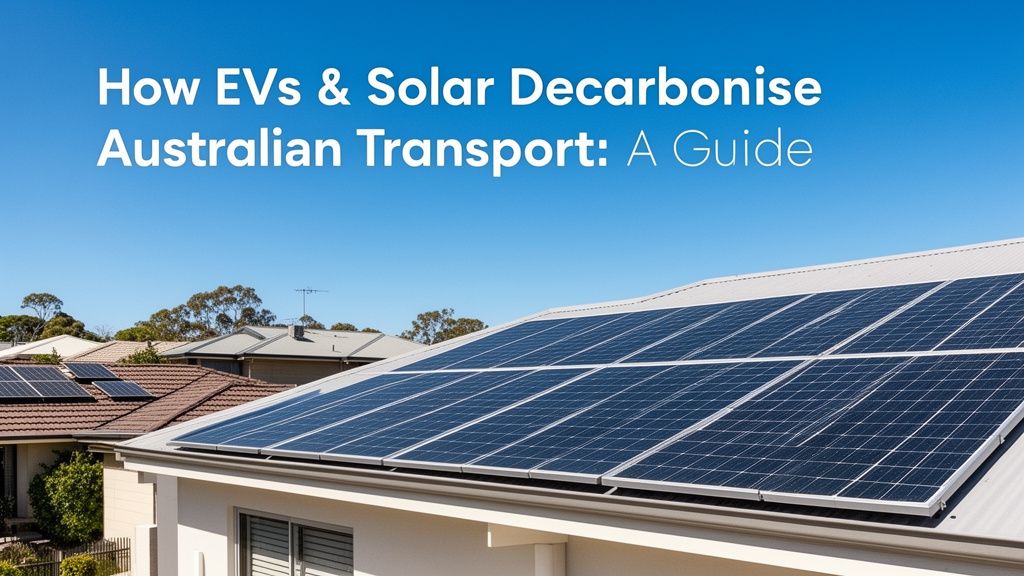
TL;DR: Electric Vehicles (EVs) are revolutionising automotive transport decarbonisation by eliminating tailpipe emissions and enabling a shift from fossil fuels to renewable energy sources like solar for charging, significantly reducing Australia's carbon footprint. This transition offers environmental benefits, substantial running cost savings for consumers, and drives innovation in renewable energy infrastructure.
How do Electric Vehicles Drastically Reduce Transport Emissions?
Electric Vehicles drastically reduce transport emissions by replacing internal combustion engines (ICE) that burn fossil fuels with electric motors powered by batteries, eliminating direct tailpipe emissions. This fundamental shift means that instead of releasing greenhouse gases and pollutants directly into the atmosphere, the environmental impact of an EV is primarily determined by the source of electricity used to charge it. When charged with Australia's increasing share of renewable energy, particularly solar and wind power, an EV's carbon footprint can be significantly lower than even the most fuel-efficient petrol car over its lifespan. The average Australian passenger vehicle travels around 13,000 km annually; switching to an EV charged with grid electricity already reduces emissions, but pairing it with a home solar system for charging offers near-zero operational emissions.
Eliminating Tailpipe Pollutants
By operating purely on electricity, EVs produce zero tailpipe emissions, which means no carbon dioxide (CO2), nitrogen oxides (NOx), particulate matter, or unburnt hydrocarbons are released directly from the vehicle. These pollutants contribute to climate change, respiratory diseases, and smog, particularly in urban centres. The removal of these direct emissions profoundly improves urban air quality and public health outcomes, creating cleaner, healthier environments in our cities and towns. This immediate benefit is tangible and measurable, directly impacting the quality of life for millions of Australians.
Shifting Energy Sources to Renewables
The true decarbonisation potential of EVs emerges when they are powered by renewable energy. While the Australian grid still relies on fossil fuels, its rapid transition towards solar and wind power means that EVs are progressively becoming greener with every new renewable energy project. For homeowners with rooftop solar, charging an EV becomes incredibly cost-effective, often turning a daily commute into a zero-emissions journey powered by the sun. This synergy between EVs and solar energy empowers individuals to take direct action against climate change and reduces their reliance on the volatile global fossil fuel market.
What Economic Benefits Do EVs Offer Australian Drivers?
Electric Vehicles offer substantial economic benefits to Australian drivers, primarily through significantly lower running costs compared to petrol cars, making them an attractive long-term investment. The most prominent saving comes from fuel, as electricity is considerably cheaper per kilometre than petrol. While a typical petrol car might cost around $1.80 per litre, translating to $0.15-$0.20 per kilometre (based on an average 8L/100km consumption), an EV often costs less than $0.05 per kilometre when charged at home during off-peak hours or, even better, for free using rooftop solar. This translates to annual fuel savings of hundreds, if not thousands, of dollars.
Reduced Fuel and Maintenance Costs
The difference in "fuel" costs is staggering. Charging an EV at home using a standard off-peak electricity rate (e.g., $0.20/kWh) for a car with 15kWh/100km efficiency would cost $3.00 per 100km. If you have a 6.6kW solar system, you could generate enough power to cover much of your daily commute for free, potentially saving over $2,000 annually compared to a petrol car. Furthermore, EVs have fewer moving parts than ICE vehicles – no oil changes, spark plugs, or complex exhaust systems – leading to substantially lower maintenance expenses over their lifespan. This simplifies ownership and reduces unexpected repair bills.
Government Incentives and Resale Value
Australian governments are increasingly offering incentives to encourage EV adoption. These can include stamp duty exemptions, reduced registration fees, and even direct rebates, such as the NSW government's $3,000 rebate for new EVs under $68,000 or the Victorian government's $3,000 rebate for vehicles under $68,740. While upfront purchase costs for some EV models remain higher than their ICE equivalents, these incentives help bridge the gap. Moreover, the strong demand for EVs and their longer lifespan are contributing to higher residual values, meaning your EV might hold its value better than a petrol car, further improving the total cost of ownership.
How Does Home Solar Supercharge the EV Revolution?
Home solar systems are pivotal in truly "greening" electric vehicle charging, offering the ultimate solution for decarbonising personal transport. By directly generating clean electricity from the sun, homeowners can charge their EVs with virtually zero operational emissions and at a fraction of the cost of drawing from the grid or public charging stations. This synergy empowers consumers to take control of their energy consumption, maximise their solar investment, and significantly accelerate the pace of decarbonisation within their own households. For instance, a typical 6.6kW solar system can generate around 25-30 kWh per day, more than enough to cover the daily charging needs of an average EV driver, which might be around 15-20 kWh for 100-130 km of travel.


Maximising Self-Consumption and Savings
Integrating an EV with a home solar system allows homeowners to maximise their self-consumption of solar energy. Instead of exporting excess solar power back to the grid for a modest feed-in tariff (often $0.05-$0.10/kWh), that energy can be used to charge an EV, effectively valuing that electricity at the higher retail import rate (e.g., $0.25-$0.35/kWh) you would otherwise pay. This dramatically increases the financial return on a solar investment. Smart EV chargers can even be programmed to charge only when solar generation is abundant, ensuring optimal use of self-generated clean power and further cutting electricity bills.
Creating an Energy-Independent Household
Pairing an EV with home solar moves a household closer to true energy independence. By generating their own vehicle fuel, homeowners become less susceptible to fluctuating electricity prices and volatile global oil markets. This level of self-sufficiency not only provides financial stability but also contributes to national energy security by reducing reliance on imported fossil fuels. With the addition of battery storage, households can further optimise their energy usage, storing excess solar to charge their EV overnight or power their home during peak demand periods, solidifying their role in a decentralised, renewable energy future.
Key Takeaways
- EVs eliminate tailpipe emissions, directly improving air quality and reducing carbon footprints, especially when charged with renewable energy.
- Australian EV drivers benefit from significantly lower running costs due to cheaper electricity "fuel" compared to petrol and reduced maintenance needs.
- Government incentives like rebates and stamp duty exemptions are making EVs more accessible and reducing upfront purchase barriers for many Australians.
- Home solar systems enable zero-emission EV charging, maximise the financial return on solar investments, and foster greater household energy independence.
- The transition to EVs, supported by solar, is a crucial step towards Australia's decarbonisation goals and a sustainable transport future.
Read More
For a comprehensive overview, check out our master guide: Read the Full Guide Here.