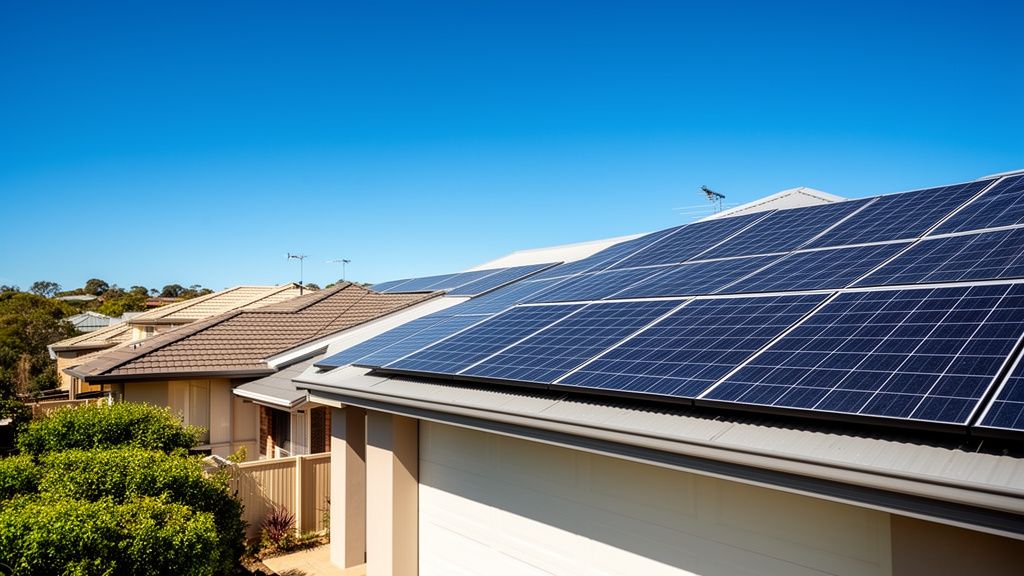
TL;DR: Australia's Solar Sharer offer allows homeowners to draw upon excess solar generation from a virtual battery, effectively providing free electricity during midday periods. This scheme helps maximise self-consumption for households with rooftop solar, reducing reliance on grid power and potentially lowering electricity bills significantly, particularly for those with high daytime usage.
What is Australia's Solar Sharer Offer, and how does it provide free midday power?
Australia's Solar Sharer offer is a relatively new energy initiative designed to help households with rooftop solar panels maximise their self-consumption by effectively storing their excess daytime generation. Instead of exporting all surplus solar power back to the grid for a low feed-in tariff (FiT), participating households can bank this power in a 'virtual battery' managed by their energy retailer. This banked energy can then be drawn upon for free during specific midday hours, typically between 10 am and 3 pm, when grid electricity prices might otherwise be higher or when the household has a sudden increase in energy demand. The core mechanism is a credit system where exported kilowatt-hours (kWh) during peak solar generation times are stored as credits, redeemable for free power during the specified window. This shifts the value proposition from a traditional FiT model to one focused on optimising direct energy use, providing a tangible benefit for households able to align their consumption with these free power periods.
How does the virtual battery work in practice?
The virtual battery isn't a physical battery installed at your home, but rather an accounting mechanism managed by your electricity retailer. When your solar panels generate more electricity than your home consumes, this surplus is typically exported to the grid. Under a Solar Sharer offer, instead of receiving a standard feed-in tariff for all of it, a portion or all of this excess generation is "banked" as credits in your account. These credits represent the energy you've effectively stored. Then, during the designated free power window (e.g., 10 am to 3 pm), any electricity you draw from the grid is first deducted from your banked credits until they are exhausted, rather than being charged at the usual retail rate. This means you're consuming your own solar energy, albeit virtually, when you need it most during the day.
What are the eligibility criteria for participating in this offer?
Eligibility for a Solar Sharer offer typically requires you to be an existing solar homeowner with a grid-connected solar PV system. The specific requirements can vary between energy retailers, but common criteria include having a smart meter capable of tracking your energy exports and imports accurately, being located within the retailer's service area, and having a solar system size that meets their minimum or maximum capacity guidelines (e.g., often between 2kW and 10kW). Some offers might also require you to sign up for a specific electricity plan or have your system professionally installed and compliant with Australian standards. It is important to check the terms and conditions with individual providers like Origin Energy, who have pioneered such schemes, as they may have unique stipulations regarding system type, age, or average daily usage.
How does the Solar Sharer Offer impact typical Australian household electricity bills?
The Solar Sharer Offer can significantly impact typical Australian household electricity bills by reducing reliance on purchasing grid power, especially during those midday hours when many households might usually be running appliances. By providing free electricity during a defined midday window (e.g., 10 am to 3 pm), it allows solar households to maximise their self-consumption of their own generated power. Instead of receiving a modest feed-in tariff (FiT) for exported energy, which might be only 5-10 cents per kWh, the banked energy is valued at the full retail rate of power you would have purchased, potentially 25-35 cents per kWh. This difference creates substantial savings for households that can shift their energy usage to align with the free power period, effectively using their 'banked' solar for activities like washing, drying, or even charging an electric vehicle. For a household paying an average of $300-$400 per quarter, optimising this free power could shave 10-20% off their bill, depending on usage patterns.
Modelling potential savings with average usage.
Consider a typical Australian household with a 6.6kW solar system, exporting around 10-15 kWh per day after morning consumption. If their retailer offers 8 cents/kWh for FiT, that's $0.80 - $1.20 in credits daily. With a Solar Sharer offer, that same 10-15 kWh is banked as virtual power. If they consume 5-10 kWh during the 10 am-3 pm window at a retail rate of 30 cents/kWh, they save $1.50 - $3.00 daily by drawing from their virtual battery instead of the grid. This effectively triples or quadruples the value of their excess solar. Over a year, this could translate to savings of $547 to $1095, significantly more than the $292 to $438 from a standard FiT. Households with high midday usage, such as those working from home or with pool pumps, stand to benefit even more from this direct consumption strategy.
Understanding the trade-offs: feed-in tariffs vs. free power.
The primary trade-off when considering a Solar Sharer offer is the often-reduced or forfeited feed-in tariff (FiT) for your exported solar energy. Traditional solar setups earn a small credit for every kWh sent back to the grid. A Solar Sharer scheme typically replaces or significantly reduces this FiT, converting your exported power into virtual credits for free midday use instead. For households with very low daytime consumption who export most of their solar and struggle to draw upon the free power window, a higher FiT might still be more beneficial. However, for the majority of solar owners, especially those capable of shifting some energy-intensive activities to the 10 am-3 pm slot, the monetary value of free electricity (saving 25-35 cents/kWh) far outweighs the few cents per kWh offered by most FiTs. It is a strategic shift from earning a small credit to avoiding a larger expense.
What are the practical considerations and steps to take before joining a Solar Sharer program?
Before diving into a Solar Sharer program, it is important to assess your current energy habits and compare offers carefully, as these programs represent a significant shift from traditional feed-in tariff models. The primary goal is to ensure that the offer genuinely aligns with your household's electricity consumption patterns and provides a greater financial benefit than your current arrangement. This includes understanding the specific hours of the "free power" window, any changes to your feed-in tariff, potential monthly fees, and the overall contract terms. Since the value of a Solar Sharer offer hinges on your ability to draw upon the free power, a thorough understanding of your typical daily energy use is central. Having solar matters, but how you use the power it generates, both directly and through the virtual banking mechanism, matters just as much.
Reviewing your current energy consumption patterns.
To determine if a Solar Sharer offer is right for you, start by scrutinising your household's electricity usage data, which can usually be accessed through your smart meter data or your current energy retailer's online portal. Pay close attention to your consumption during the proposed "free power" window (e.g., 10 am to 3 pm). Do you consistently use significant amounts of electricity during these hours, perhaps running the dishwasher, washing machine, air conditioning, or charging an EV? If your household is largely empty or uses minimal power during the day, the benefits of free midday power might be limited. Conversely, if you work from home, have school-aged children, or typically run energy-intensive appliances during these times, a Solar Sharer offer could deliver substantial savings by offsetting costly grid imports.
Comparing providers and understanding contract terms.
Not all Solar Sharer offers are created equal, so a diligent comparison of available plans from different energy retailers is essential. Look beyond the headline "free power" claim to understand the specifics. What are the exact hours of the free window? How much of your exported solar energy is banked, and at what rate? What happens to any excess solar generation that isn't used for the virtual battery or during the free window - is there still a feed-in tariff, and if so, how much? Investigate any monthly service fees or altered supply charges that might offset potential savings. Also, check the contract length, exit fees, and any conditions for changes to the free power window or feed-in tariff in the future. Websites like Energy Made Easy (energymadeeasy.gov.au) can help compare various plans available in your area.
Key Takeaways
- Assess your household's midday electricity usage (10 am - 3 pm) to determine if a Solar Sharer offer aligns with your consumption patterns.
- Understand that a Solar Sharer offer effectively trades a lower feed-in tariff for the ability to use your own 'banked' solar power for free during specific daytime hours.
- Compare different Solar Sharer providers carefully, examining the exact free power window, any associated fees, and the handling of excess solar generation beyond the virtual battery.
- Ensure you have a smart meter and a compliant grid-connected solar system, as these are common eligibility requirements for participating in these programs.
- Shift energy-intensive activities like laundry or EV charging to the designated free power window to maximise your savings and reduce grid reliance.