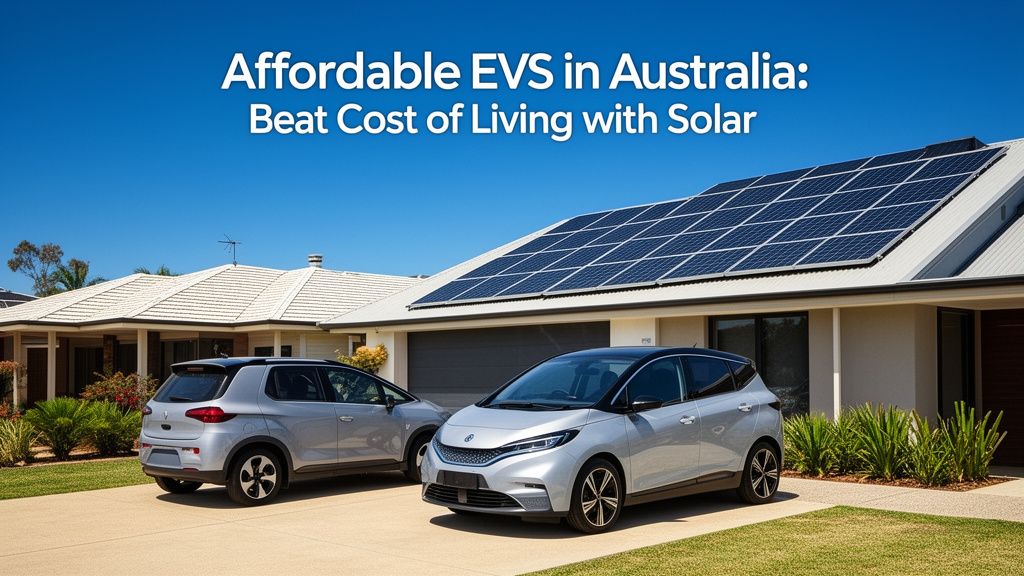
TL;DR: Surging cost-of-living pressures are driving Australian consumers towards more affordable electric vehicles as a strategic way to cut household expenses. Cheaper EV models, coupled with significant savings on fuel and maintenance, offer a compelling financial relief valve for families looking to reduce their budget.
How are rising costs making Australians rethink their transport choices?
Rising living expenses are significantly impacting household budgets across Australia, prompting many to re-evaluate discretionary spending and essential costs, including transport. With inflation affecting everything from groceries to electricity bills, the typical Aussie household is searching for ways to cut back without compromising their lifestyle too much. For many, the family car is a major outgoing, not just in terms of purchase price, but through ongoing running costs like fuel, servicing, and insurance. This relentless financial pressure is making the long-term cost of vehicle ownership a critical factor in purchasing decisions, pushing many towards options that promise substantial savings over time. The sticker shock at the petrol station, in particular, has become a frequent and painful reminder of how volatile global markets can directly impact the hip pocket.
The Pinch at the Pump: Fuel Price Volatility
Petrol prices in Australia have been consistently high and unpredictable, often fluctuating wildly between $1.80 and $2.20 per litre, sometimes even higher in regional areas. For a typical family car that might consume 10-12 litres per 100km, driving just 15,000km a year can easily amount to $2,700 to $4,000 in fuel costs annually. This significant expenditure is a non-negotiable for many, who rely on their vehicles for work, school runs, and essential errands. The constant worry about the next fuel bill is a major contributor to financial stress, leading many to eye alternatives that insulate them from these market vagaries.
Broader Cost-of-Living Squeeze: Beyond the Bowse
Beyond fuel, Australians are grappling with increased costs for housing, utilities, and groceries. Interest rate hikes have pushed mortgage repayments up significantly for homeowners, while rental markets remain tight and expensive. Electricity and gas bills have also seen substantial increases, further tightening budgets. This cumulative effect means that every dollar saved elsewhere, including transport, makes a tangible difference. Consumers are not just looking for a cheaper purchase price, but a vehicle that will actively reduce their weekly and monthly outgoings, making the shift to a more economical mode of transport a strategic financial decision rather than just an environmental one.
What financial advantages do affordable EVs offer for Aussie families?
Affordable electric vehicles present a compelling financial proposition for Australian families looking to alleviate cost-of-living pressures, primarily through drastically reduced running and maintenance costs compared to their petrol counterparts. Once the initial purchase is made, the ongoing expenses associated with an EV are remarkably lower, freeing up significant funds that can be redirected to other household needs or savings. This shift from a high-variable cost model (fuel) to a lower, more predictable one (electricity) is a game-changer for budgeting. Furthermore, state and federal incentives are sweetening the deal, making the transition even more attractive financially.
Significant Savings on Fuel and Running Costs
The most obvious saving comes from ditching petrol for electricity. Charging an EV at home, especially during off-peak hours, can cost as little as $0.20 to $0.30 per kWh. A medium-sized EV might consume 15-20 kWh per 100km. This translates to roughly $3.00 to $6.00 per 100km, a stark contrast to the $25 to $35 per 100km for a petrol car at current prices. Over a year of driving 15,000km, an EV owner could save between $3,000 and $4,500 on "fuel" alone. Public charging can be more expensive, but home charging remains the primary and most cost-effective method for most users.
Reduced Maintenance Bills and Government Incentives
EVs have fewer moving parts than internal combustion engine (ICE) vehicles, meaning significantly less maintenance. There are no oil changes, spark plug replacements, or complex exhaust systems to worry about. Brake pads also last longer due to regenerative braking. This typically translates to annual servicing costs being hundreds of dollars less than a comparable petrol car. For example, a basic EV service might cost $200-300, while a comparable ICE car could be $400-600 or more. Additionally, Australian state governments offer various incentives, such as stamp duty exemptions (e.g., up to $3,000-$5,000 depending on the state and vehicle price) and registration fee discounts, further reducing the overall cost of ownership.
Is Australia seeing a surge in budget-friendly EV options?
Australia's automotive market is witnessing a notable expansion in the range of electric vehicles available at more accessible price points, directly addressing consumer demand driven by cost-of-living concerns. Historically, EVs have been perceived as premium purchases, out of reach for many average Australian families. However, new models from a wider array of manufacturers are entering the market, offering more practical features and competitive pricing. This influx of affordable options is democratising EV ownership, making the transition from petrol a realistic consideration for a broader segment of the population, beyond just early adopters.
New Entrants and Competitive Pricing
The Australian EV landscape has seen a significant shift with brands like BYD, MG, and GWM Ora introducing models priced well under the $50,000 mark. For instance, the MG ZS EV Excite starts from around $40,990 drive-away, while the BYD Dolphin Dynamic can be had for approximately $38,890 drive-away in some states. These prices are competitive with, or even lower than, many popular petrol SUVs and hatchbacks. This competitive pricing strategy is forcing established brands to reconsider their offerings and ensures that potential EV buyers have genuine choice when working with a tighter budget.
Increased Model Availability and Accessibility
Beyond pricing, the sheer variety of affordable EV models is growing. Previously, buyers were limited to a handful of premium options. Now, Australians can choose from compact hatchbacks, small SUVs, and even some sedans that fit different lifestyle needs and budget constraints. This increased availability means that families can find an EV that suits their specific requirements – whether it's for city commuting, school drop-offs, or weekend adventures – without having to stretch their finances excessively. Coupled with improved charging infrastructure, these accessible models are paving the way for wider EV adoption across the country.


How does home solar power amplify EV cost savings for Australian households?
Integrating home solar power with an electric vehicle takes the financial benefits of EV ownership to the next level, essentially allowing Australian households to charge their cars for free from their own rooftop. For homes with an existing solar system, or those considering one, the EV acts as a powerful incentive, maximising the return on investment for solar panels by utilising excess generation directly. Instead of selling surplus solar power back to the grid for a modest feed-in tariff (often $0.05-$0.10 per kWh), homeowners can direct that clean, free energy into their EV battery, effectively eliminating their transport fuel costs altogether.
Charging for Free: The Solar-Powered EV Advantage
When you have a solar system on your roof, you're generating your own electricity. During daylight hours, when the sun is shining, your panels produce more power than your home might immediately consume. Instead of sending this excess energy back to the grid for a small credit, you can plug in your EV and charge it directly with that free, renewable power. This means your daily commute or weekend drives are literally powered by sunshine, reducing your reliance on grid electricity – and associated costs – to almost zero for your vehicle. For a 6.6kW solar system generating around 25kWh per day, easily enough to charge a typical EV for 100-150km of driving, the savings are phenomenal.
Maximising Your Solar Investment
The addition of an EV significantly enhances the value proposition of a home solar system. Without an EV, surplus solar power might only earn you a few dollars a day in feed-in tariffs. However, using that same surplus to power a vehicle that would otherwise cost $25-$35 per 100km in petrol translates into far greater tangible savings. An EV provides a large, hungry battery on wheels that can absorb and utilise a substantial portion of your solar generation, thereby shortening the payback period for your solar installation and drastically improving your overall household energy economics. It transforms your rooftop from just powering your home to powering your family's mobility too.
Key Takeaways
- Affordable EVs directly combat rising fuel prices and general cost-of-living pressures for Australian families.
- EVs offer significant ongoing savings on fuel (electricity vs. petrol) and reduced maintenance costs compared to petrol cars.
- The Australian market is seeing an increase in budget-friendly EV models from brands like MG and BYD, priced competitively.
- Integrating an EV with a home solar system allows for virtually free charging, maximising solar investment and eliminating transport fuel bills.
- Government incentives (stamp duty, registration) further reduce the total cost of ownership for electric vehicles in Australia.
Read More
For a comprehensive overview, check out our master guide: Read the Full Guide Here.


