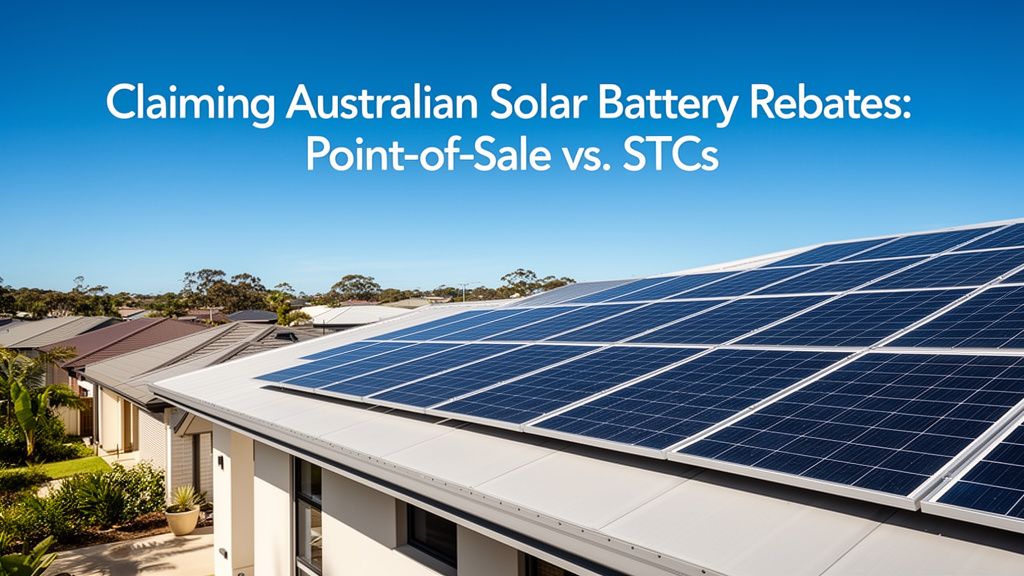
Claiming Your Australian Solar Battery Rebate: Point-of-Sale Discount vs. Selling STCs
TL;DR: Australian solar battery rebates typically come via direct point-of-sale discounts from state-specific schemes, which reduce your upfront cost significantly. While Small-scale Technology Certificates (STCs) are a federal incentive for solar PV systems, their value indirectly assists battery purchases by lowering the overall solar installation cost, freeing up funds for battery investment.
What are the two main methods for claiming Australian solar battery rebates?
Claiming a solar battery rebate in Australia primarily involves navigating two distinct mechanisms: direct point-of-sale discounts offered by specific state governments and the indirect financial benefit derived from Small-scale Technology Certificates (STCs) linked to your solar PV system. These methods serve different purposes and apply to different components of your solar energy setup, making it crucial to understand how each works to maximise your savings. Direct rebates provide an immediate reduction on the battery's purchase price at the time of installation, making the technology more accessible. Conversely, STCs are a federal incentive designed to reduce the upfront cost of your solar panels, and while not directly a battery rebate, the savings generated can effectively be reinvested into your battery storage solution. For instance, states like Victoria and South Australia have robust battery rebate programs, whereas STCs are applicable nationwide for eligible solar panel installations.
Understanding Direct State Rebates
Direct state rebates are monetary incentives provided by state governments to homeowners who install eligible solar battery systems. These schemes, such as the Victorian Solar Homes Battery Rebate or the South Australian Home Battery Scheme, typically operate as point-of-sale discounts. This means your accredited installer will apply the rebate directly to your invoice, deducting the specified amount (e.g., up to $2,900 in Victoria or up to $4,000 in South Australia, depending on battery size and specific criteria) from the total cost. The installer then claims the rebate amount back from the respective state government, simplifying the process for the homeowner by immediately reducing the upfront expense. Eligibility usually involves criteria related to household income, property value, existing solar system size, and the energy storage capacity of the battery.
The Role of STCs in Solar Battery Funding
Small-scale Technology Certificates (STCs) are a federal government incentive under the Small-scale Renewable Energy Scheme (SRES), designed to support the uptake of small-scale renewable energy systems, primarily solar PV panels. Crucially, STCs are generated based on the deemed amount of electricity a solar PV system will produce over a 10-year period, not directly on battery storage. While you cannot claim STCs for the battery itself, the significant financial value of these certificates (often bundled into the overall solar PV system price reduction by your installer) reduces the upfront cost of your solar panels. For a typical 6.6kW solar system, the STC value can be anywhere from $3,500 to $4,000, effectively making the entire solar PV installation more affordable and potentially freeing up funds in your budget to invest in an accompanying battery storage solution.
How does the Point-of-Sale Discount reduce your solar battery cost?
The point-of-sale discount mechanism directly lowers the upfront price you pay for your solar battery system by applying the rebate at the time of purchase. This method is the most straightforward and immediately tangible way to claim a battery rebate, as you see the savings reflected on your installer's invoice before you make payment. Rather than you having to apply for a rebate and wait for reimbursement, the accredited solar retailer manages the administrative process with the state government, effectively fronting the rebate amount to you. For example, if you're purchasing a $12,000 battery system and are eligible for a $3,000 state rebate, your invoice will show a net cost of $9,000, streamlining your cash flow and making battery ownership more accessible without any delays or additional paperwork on your part post-installation. This system greatly encourages rapid adoption of battery technology across eligible regions.
Eligibility for State-Specific Point-of-Sale Rebates
Eligibility criteria for state-specific point-of-sale battery rebates vary significantly but commonly include factors like household income, property value, and the existing solar PV system's size. For instance, the Victorian Solar Homes Battery Rebate requires households to have an existing solar PV system over 5kW or install one concurrently, and for the household income to be under $210,000 per annum. South Australia's Home Battery Scheme also has requirements related to energy consumption and property type. It is essential for homeowners to check the specific guidelines for their state's program, often available on government energy websites, as these rebates are often capped, can be means-tested, or require the use of a pre-approved battery product and accredited installer. Meeting these criteria ensures you qualify for the immediate financial benefit.
The Application Process for Direct Discounts
The application process for direct point-of-sale battery rebates is typically managed largely by your chosen accredited solar battery installer. Once you've selected an eligible battery system and your installer, they will guide you through the required documentation, which usually includes proof of ownership, income verification, and details of your existing or new solar PV system. The installer then submits the rebate application on your behalf to the relevant state government body, receiving pre-approval before installation. Upon successful installation and inspection, the final rebate is processed, and the discount is already reflected on your final invoice. This streamlined approach minimises the administrative burden on the homeowner, ensuring a seamless and immediate reduction in the overall battery cost without requiring you to chase up payments or forms yourself after installation.
Can Small-scale Technology Certificates (STCs) truly be considered a solar battery rebate?
Small-scale Technology Certificates (STCs) are not, in fact, a direct solar battery rebate, as they are specifically generated for the deemed electricity production of eligible small-scale renewable energy generation systems, primarily solar panels. However, their financial value significantly reduces the upfront cost of your solar PV system, which in turn can indirectly assist with the purchase of a solar battery. Think of it as a substantial discount on the power generation component of your home energy setup. By making the solar panels much more affordable, the STC savings effectively free up capital in your overall budget, allowing you to allocate more funds towards a battery storage solution. So, while STCs don't directly subsidise the battery itself, they play a crucial indirect role in making comprehensive home solar-plus-battery systems more financially viable for Australian homeowners.
Calculating STC Value for Your Solar PV System
The value of STCs is determined by several factors, including the system's deemed annual generation (based on its postcode location and capacity), the STC spot market price, and the number of years remaining until the SRES scheme ends (currently 2030, meaning a "deeming period" of 10 years for new systems). An accredited installer will typically calculate the number of STCs your solar PV system will generate. For instance, a 6.6kW system installed in Sydney might generate approximately 99 STCs. If the market price for an STC is currently around $38, the total value would be $3,762 (99 STCs x $38). Most solar installers will offer you this STC value as an upfront discount on your solar panel system, simplifying the process and ensuring you receive the benefit without needing to trade certificates yourself.
Integrating STC Savings with Battery Purchase
While STCs are applied to your solar PV system, integrating these savings with a battery purchase is a common financial strategy. When your solar installer provides a quote, the STC value is almost always factored in as an upfront discount, reducing the overall cost of your solar panels by several thousands of dollars. This substantial saving directly impacts your total investment, making the entire solar installation significantly cheaper. Homeowners can then effectively 'reallocate' these savings towards covering a portion of the battery's cost. For example, if a 6.6kW solar system costs $7,500 before STCs and $3,800 after STCs, the $3,700 saving can be seen as a direct contribution to your overall energy system budget, making that $10,000 battery system feel more like $6,300 in total new expenditure beyond the solar.
Which claim method offers the most straightforward financial benefit for your battery purchase?
For directly reducing the cost of your solar battery system, the point-of-sale discount offered by state-based schemes provides the most straightforward and immediate financial benefit. These rebates are specifically designed for batteries, directly targeting the capital cost of the storage component itself. When you receive a $3,000 rebate applied directly to your battery invoice, the impact is clear, tangible, and reduces your out-of-pocket expense instantaneously. This contrasts with the indirect nature of STC savings, which, while valuable, apply to the solar panels and require you to mentally (or budgetarily) reallocate those savings to your battery. For homeowners prioritising an immediate and unambiguous reduction in the battery's price, state-based point-of-sale rebates are unequivocally the simpler and more direct financial incentive.
Comparing Direct Financial Impact and Simplicity
The direct financial impact of a point-of-sale battery rebate is immediately apparent on your invoice, significantly reducing the cash outlay for the battery system. This simplicity is a major advantage, as you don't need to understand market dynamics or separate components. For example, a $10,000 battery system becomes $7,100 with a Victorian rebate, a clear and immediate saving. In contrast, while STCs reduce the solar PV system cost, say from $7,500 to $3,800 for a 6.6kW system, you still need to fund the entire battery cost separately unless you view the STC saving as a pool of funds for the overall project. The directness of the point-of-sale rebate provides greater certainty and less administrative complexity for the homeowner specifically focused on battery cost reduction.
Factors Influencing Your Decision
Your decision between prioritising direct battery rebates or leveraging STC savings will largely depend on your location, eligibility, and financial strategy. If you reside in a state with an active battery rebate scheme (like Victoria or South Australia), pursuing the point-of-sale discount is almost always the best first step for direct battery savings. This is because STCs are a nationwide federal scheme that you will almost certainly receive anyway when installing solar panels. Therefore, the strategic approach is often to maximise both: claim any available state battery rebate for direct battery savings and utilise the STC value to significantly reduce the cost of your solar PV system. Checking current state government websites for active schemes and eligibility criteria is paramount to making an informed decision tailored to your specific circumstances.
Key Takeaways
- State-based solar battery rebates offer direct point-of-sale discounts, immediately reducing the upfront cost of your battery system.
- Small-scale Technology Certificates (STCs) are for solar PV systems, not batteries directly, but their value significantly lowers solar panel costs, freeing up funds for battery investment.
- The point-of-sale discount is the most straightforward method for directly reducing your battery's purchase price, with the installer managing the rebate claim.
- Eligibility for state battery rebates often includes income thresholds, existing solar system size, and using approved products/installers.
- Homeowners should aim to leverage both state battery rebates (if available) and federal STC savings to maximise overall financial benefits for their solar-plus-battery installation.
Read More
For a comprehensive overview, check out our master guide: Read the Full Guide Here.