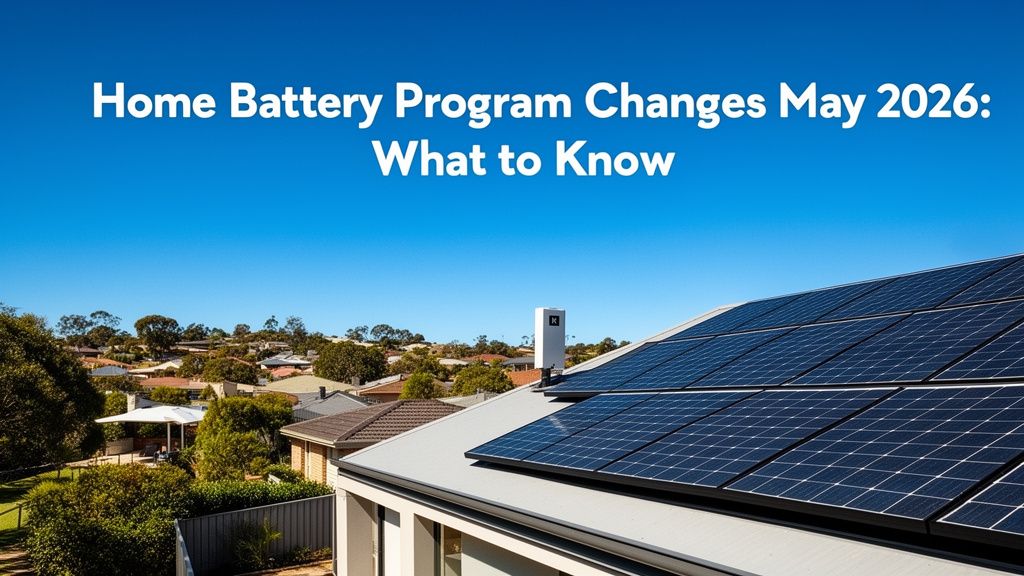
TL;DR: Significant changes to Australian home battery rebate programs are anticipated by May 2026. These changes will likely reduce current rebate amounts or alter eligibility criteria as battery technology becomes more affordable, impacting system costs and payback periods for homeowners. Acting on current offers before these shifts could provide better value.
What is the current home battery rebate landscape in Australia?
Australia's home battery rebate landscape currently relies heavily on state-specific initiatives, primarily Victoria's Solar Homes Program. This program offers eligible Victorian homeowners a rebate of up to $2,950 on approved battery systems, contingent on their property having a solar PV system of at least 5kW and meeting specific income thresholds. For example, a household income below $210,000 annually qualifies for the full rebate. Western Australia also runs a smaller trial program, the Clean Energy Future Fund, which has offered grants for battery storage, though on a more limited scale and often tied to specific projects or communities. Most other states do not have direct, broad-based battery rebates for residential customers, leaving the initial investment entirely up to the homeowner.
Currently, the upfront cost of a typical 10kWh home battery, like a Tesla Powerwall 2 or an LG Chem RESU, ranges from $10,000 to $15,000 installed, varying by installer and location. With Victoria's rebate, this cost drops significantly, making the investment more accessible for many households. Without a rebate, the payback period for a battery can stretch to 10-15 years, heavily depending on electricity consumption patterns, feed-in tariffs (which are often below 5c/kWh), and the homeowner's ability to shift high-energy usage into periods of solar generation. These state-led rebates help drive early adoption and reduce this financial hurdle, particularly for households seeking greater energy independence and resilience against grid outages.
What potential changes are expected for home battery programs by May 2026?
By May 2026, Australian home battery programs will likely see significant shifts in rebate structure and eligibility, driven by evolving market conditions and government policy. The primary driver for these changes is the ongoing reduction in battery manufacturing costs. Over the past five years, the cost of battery cells has dropped by over 50%, and this trend is expected to continue. As the technology matures and becomes more mainstream, governments often recalibrate their incentives to prevent over-subsidisation. It is probable that current fixed rebate amounts, such as Victoria's $2,950, will be reduced or phased out, mirroring the trajectory of solar panel rebates which decreased over time as solar became more affordable.
Another likely change involves stricter eligibility criteria. Future programs might target specific demographics, such as low-income households, social housing residents, or those in bushfire-prone areas where energy resilience is a safety priority. We might also see a shift towards performance-based incentives, where a rebate is linked to a battery's participation in a Virtual Power Plant (VPP) or its ability to provide grid services, rather than just an upfront installation subsidy. This approach encourages homeowners to use their battery in ways that benefit the broader grid, moving beyond individual energy independence. Federal government involvement could also increase, potentially offering national programs that standardise incentives, but this remains speculative. These changes reflect a move towards smarter, more targeted energy policy.
How will these changes affect homeowners considering a battery?
Homeowners considering a battery system will need to carefully evaluate the financial implications of program changes expected by May 2026, especially regarding upfront costs and payback periods. If current rebates are reduced or removed, the initial out-of-pocket expense for a 10kWh battery could increase by several thousand dollars. For instance, a Victorian homeowner currently receiving a $2,950 rebate would face that much higher cost if the program ends or shrinks. This increase directly extends the payback period, making the investment less attractive solely on financial returns. A battery system that breaks even in 8 years with a rebate might take 12 years or more without it, assuming all other factors remain constant.
Moreover, changes in eligibility could exclude many middle-income households who currently qualify for assistance. If future programs focus on lower income brackets or specific regional areas, a broader segment of the population might lose access to financial support. This means the decision to install a battery becomes more reliant on the household's ability to manage the full capital cost or to achieve significant savings through smart energy management and participation in VPPs. The market will adapt, with installers potentially offering more flexible financing options, but the direct government incentive will be diminished. Homeowners prioritising energy independence, grid resilience, or environmental benefits will still see value, but the financial calculus will become tougher without generous rebates.
What should you do now if you want a home battery?
If you are considering a home battery, acting now to understand current rebate offers and future-proof your system can save you money before anticipated changes in May 2026. For Victorians, this means exploring the Solar Homes Battery Rebate eligibility and obtaining quotes from authorised installers. Securing a rebate approval before any changes are announced locks in the current subsidy level. Even in states without direct rebates, evaluating your energy consumption patterns now helps identify the right battery size and determine potential savings. You can then compare these savings against the current installed cost.
Furthermore, ensure your existing solar PV system, or any new one you plan, is "battery-ready." This involves selecting an inverter that is hybrid-capable, meaning it can manage both solar PV generation and battery storage smoothly. Many modern inverters offer this functionality, which avoids costly upgrades later. Discussing Virtual Power Plant (VPP) compatibility with installers is also wise. VPPs allow you to share your battery's stored energy with the grid during peak demand, potentially earning credits or payments, and these schemes are likely to become more prominent as grid stability becomes a bigger focus. Seeking advice from a Clean Energy Council (CEC) accredited installer provides accurate, tailored information about system design, costs, and current incentives relevant to your specific location and energy needs.
Key Takeaways
- Current home battery rebates, like Victoria's Solar Homes Program, will likely change by May 2026.
- Anticipate reductions in rebate amounts or stricter eligibility criteria as battery costs continue to fall.
- Homeowners should act now to secure existing rebates before these changes take effect.
- Ensure your solar system is "battery-ready" with a hybrid inverter if you plan for future battery installation.
- Investigate Virtual Power Plant (VPP) opportunities to maximise battery value and potential earnings.