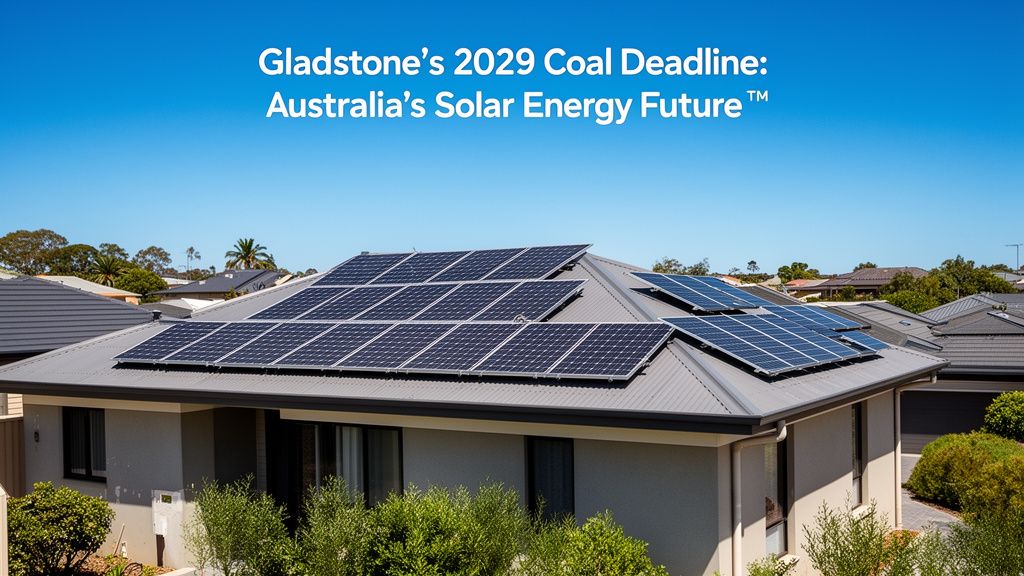
Gladstone, a major industrial hub in Queensland, faces a significant energy transformation. By 2029, its publicly owned coal-fired power stations will begin to shut down, marking a hard deadline for the region and a crucial step for Australia's energy future. This shift requires immediate action to replace traditional generation with clean energy sources.
TL;DR: Queensland's publicly owned coal-fired power stations in Gladstone will start closing by 2029, accelerating Australia's transition to renewable energy. This deadline necessitates rapid investment in solar, wind, and battery storage to maintain grid stability and create new economic opportunities in green industries.
What is the significance of the 2029 deadline for Gladstone's coal power? The 2029 deadline signals the start of the end for publicly owned coal-fired power in Gladstone, a region historically central to Queensland's energy production. The Queensland Government's Energy and Jobs Plan outlines this timeline, targeting the full phase-out of state-owned coal power stations by 2035. Specifically, units at the Callide B power station are scheduled for closure starting in 2029. This is not just a plan; it is a firm commitment to decarbonise the energy grid. Gladstone currently relies heavily on these large-scale generators. Their retirement requires a massive, coordinated effort to bring online equivalent or greater renewable generation capacity, along with robust storage solutions and updated transmission infrastructure. The deadline pushes the entire state to accelerate its move towards a cleaner energy future, ensuring grid reliability throughout this significant transition period.
How does the deadline affect Queensland's energy grid? The planned retirement of coal units means a substantial amount of baseload power leaves the grid. Callide B, for example, has a capacity of 420 megawatts. Losing this generation without adequate replacement would destabilise the grid and risk blackouts. The Queensland Energy and Jobs Plan directly addresses this by setting ambitious targets: 70% of Queensland's energy will come from renewables by 2032, rising to 80% by 2035. Achieving this requires not only building new solar and wind farms but also significant investment in new transmission lines, like the CopperString 2.0 project, and large-scale battery storage. Queensland Hydro's Borumba Pumped Hydro project also plays a major part in this, providing long-duration storage to balance the intermittency of solar and wind. These projects are essential for a stable and reliable energy supply post-coal.
How will renewable energy replace coal power in Gladstone and beyond? Renewable energy, primarily large-scale solar and wind farms, combined with substantial battery storage, will form the backbone of the new energy system, replacing the outgoing coal power. Queensland already has excellent solar resources across its vast inland areas and good wind potential in various regions. Major projects like the MacIntyre Wind Farm (over 1000 MW) are already under construction, and numerous other solar and battery projects are planned or underway across the state. These utility-scale installations generate electricity efficiently and feed it directly into the state's transmission network. Battery energy storage systems (BESS) are also critical; they store excess solar and wind power generated during peak production times and release it when demand is high or renewable output drops, ensuring a continuous supply. Pumped hydro further strengthens this storage capability.

What role will rooftop solar play in this transition? Rooftop solar, both residential and commercial, significantly contributes to decentralising power generation and reduces the overall load on the grid, complementing large-scale projects. Thousands of Australian households and businesses have already installed solar panels, collectively adding gigawatts of capacity. A typical 6.6kW residential solar system in Queensland, costing between $5,000 and $9,000 after rebates, can offset 60-80% of a home's daytime electricity usage. For businesses, larger systems, perhaps 30kW or 50kW, costing $30,000 to $60,000, can drastically cut operational costs. This distributed generation means less energy needs to travel long distances from centralised power stations, improving grid efficiency. As more homes and businesses adopt solar, the collective impact lessens the demand for grid power, making the transition away from coal smoother and more affordable for everyone.
What are the economic opportunities for Gladstone shifting to clean energy? Gladstone's shift to clean energy creates substantial economic opportunities, establishing new industries and generating new jobs in the region. The existing industrial infrastructure, skilled workforce, and port facilities make Gladstone an ideal location for green manufacturing and export hubs. Industries like green hydrogen production, critical minerals processing, and even battery component manufacturing are already attracting investment. For example, the Central Queensland Hydrogen Project aims to produce green hydrogen for export, using renewable energy. This new industrial landscape requires different skills, leading to job creation in renewable energy project development, construction, operation, and maintenance, as well as in related manufacturing and processing sectors. Training and retraining programs will be essential to equip the existing workforce for these new roles.
How can local businesses and residents participate in the solar transition? Local businesses and residents in Gladstone can actively participate in the solar transition by installing solar PV systems on their premises, investing in renewable energy projects, or retraining for new green jobs. For homeowners, installing a solar system reduces electricity bills significantly, providing a solid return on investment, often within 3-5 years. Businesses can likewise achieve considerable savings and improve their sustainability credentials. Queensland offers various incentives and loans, like those available through the Queensland Clean Energy Hub, to make solar more accessible. Local solar installers and electrical contractors will see increased demand, creating local employment. Engaging with community energy initiatives or considering energy efficiency upgrades also contributes to the broader goal of reducing reliance on fossil fuels and embracing a cleaner, more prosperous energy future for Gladstone.
Key Takeaways
- Gladstone's 2029 deadline for coal plant closures is a firm commitment to a renewable energy future for Queensland.
- New utility-scale solar, wind, and battery storage projects are essential to replace outgoing coal generation and maintain grid stability.
- Rooftop solar on homes and businesses will play a vital role in decentralising power and reducing overall grid demand.
- Gladstone can become a hub for green industries like hydrogen production and critical minerals processing, creating new jobs.
- Local residents and businesses can financially benefit from installing solar and contribute to the region's clean energy transition.
Read More
For a comprehensive overview, check out our master guide: Read the Full Guide Here.