Australia's New Solar Panel Recycling Pilot Program Explained
In late 2025, the Australian Government announced a landmark initiative: a national solar panel recycling pilot program designed to make it easier and cheaper for households and businesses to recycle end-of-life solar panels. It's the most concrete step yet toward addressing Australia's growing solar waste challenge.
But what does the program actually involve? Who's eligible? And how do you use it? Let's break it down.
For the full picture on solar panel recycling in Australia, see our Complete 2026 Guide.
Why a Pilot Program?
Australia has been grappling with the solar waste problem for years. With over 3.6 million rooftop solar systems installed and the first generation of panels reaching end of life, the volume of waste is growing rapidly. Yet recycling rates have remained stubbornly low — around 20–25% nationally as of early 2026.
The core barriers have always been:
- Cost — recycling is significantly more expensive than landfill for individual homeowners.
- Access — recycling facilities are concentrated in metro areas, leaving regional Australians with few options.
- Awareness — many people simply don't know that solar panels can (and should) be recycled.
The pilot program is designed to tackle all three barriers simultaneously.
How the Program Works
The pilot operates as a subsidised collection and recycling network, funded jointly by the Federal Government (through ARENA and the Department of Climate Change, Energy, the Environment and Water) and participating state governments.
Here's the structure:
Collection Points
The program has established a network of authorised collection points across participating states. These include:
- Council transfer stations and e-waste facilities — upgraded to accept solar panels.
- Participating hardware and solar retailers — selected Bunnings, solar wholesalers, and electrical suppliers have signed on as drop-off locations.
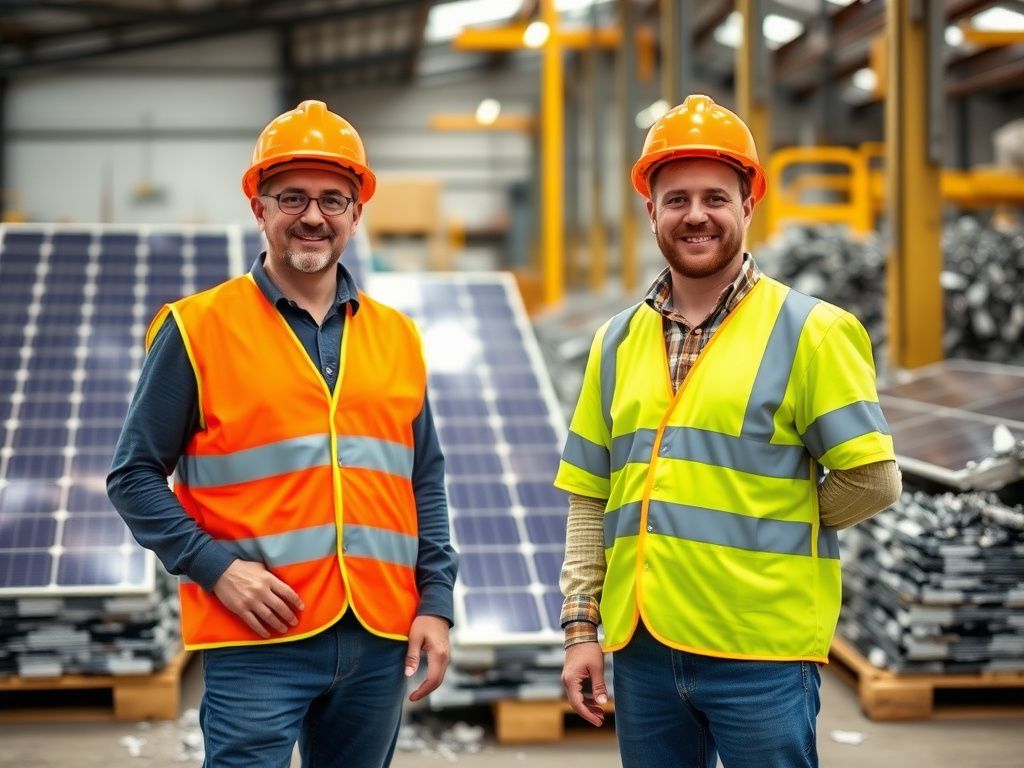
- Dedicated recycling hubs — facilities operated by accredited recyclers like PV Industries, Sircel, and Elecsome.
As of February 2026, collection points are operating in New South Wales, Victoria, Queensland, and Western Australia, with South Australia expected to join by mid-2026.
Subsidised Costs
For residential customers (households), the pilot offers:
- Free drop-off for up to 10 panels per household per financial year at participating collection points.
- Reduced-cost collection for larger volumes or where drop-off isn't practical — typically $10–15 per panel including transport, compared to $25–35 at market rate.
Commercial and industrial customers can also access the program, though subsidy levels are lower (typically 30–50% off market recycling rates).
Accredited Recyclers
All panels collected through the program are processed by nationally accredited recyclers who meet minimum material recovery standards. The accreditation scheme, developed in consultation with industry and environmental groups, requires:
- Minimum 85% material recovery rate by weight.
- Proper handling and disposal of hazardous components (lead, cadmium).
- Transparent reporting on volumes processed and materials recovered.
- Compliance with relevant state environmental regulations.
Who's Behind It?
The pilot is a collaborative effort involving:


- Federal Government — ARENA provides the primary funding, with policy oversight from the Department of Climate Change, Energy, the Environment and Water.
- State Governments — NSW, Victoria, Queensland, and WA have co-funded collection infrastructure and regulatory support.
- Industry bodies — the Clean Energy Council and the Australian Solar Recycling Association have been instrumental in program design.
- Recycling operators — PV Industries, Sircel, Elecsome, and several smaller operators are the backbone of the processing network.
How to Use the Program
If you're an Australian homeowner with old solar panels to dispose of:
- Check eligibility — Visit the program's website (linked through your state environment department) to confirm your area is covered.
- Find a collection point — Use the online map to locate your nearest participating drop-off site.
- Prepare your panels — Panels should be intact (not shattered) and free of mounting hardware. Remove any racking or brackets before drop-off.
- Transport and drop off — Take your panels to the collection point during operating hours. You'll need to provide basic details (name, address, number of panels) for tracking purposes.
- Get a receipt — You'll receive a recycling receipt confirming responsible disposal. Keep this for your records.
If you can't transport the panels yourself, you can arrange subsidised collection through the program's logistics partners. This is particularly useful for regional homeowners or anyone with a large number of panels.
What Happens After Drop-Off?
Once collected, panels follow a standardised recycling pathway:
- Sorting and inspection — panels are assessed for reuse potential. Working panels may be diverted to second-life programs.
- Deframing — aluminium frames are removed and sent to aluminium recyclers.
- Glass-cell separation — the laminated panel is processed to separate glass, silicon, and polymer layers.
- Material recovery — glass, silicon, copper, silver, and other metals are recovered and returned to commodity markets.
- Residual disposal — the small percentage of non-recyclable material (mostly polymer backsheet) is disposed of in accordance with environmental regulations.
Early Results and Challenges
The pilot launched in November 2025, and early results are encouraging:
- Over 50,000 panels collected in the first three months across all participating states.
- High public engagement — drop-off events have been well-attended, particularly in metro areas.
- Regional gaps — collection point density in rural and remote areas remains a challenge. The program is exploring mobile collection events and partnerships with regional councils to address this.
- Awareness still growing — despite media coverage, many homeowners remain unaware of the program. Targeted advertising and installer partnerships are being ramped up.
What This Means for the Future
The pilot is explicitly designed as a precursor to the mandatory national product stewardship scheme expected to launch in 2027. Data gathered during the pilot — on volumes, costs, logistics, and recovery rates — will directly inform the design of the permanent scheme.
The end goal is a self-sustaining system where the cost of recycling is built into the price of new panels (via a small stewardship levy), ensuring every panel sold in Australia has a funded end-of-life pathway.
The Bottom Line
Australia's new solar panel recycling pilot is a significant step forward. It makes recycling more accessible and affordable for everyday homeowners, and it's building the infrastructure and data needed for a permanent national scheme.
If you have old panels sitting in the garage or about to come off your roof, now is the time to act. The program is live, the costs are low, and you'll be contributing to a genuinely circular solar economy.
Check the Complete 2026 Guide for more on the broader recycling landscape.