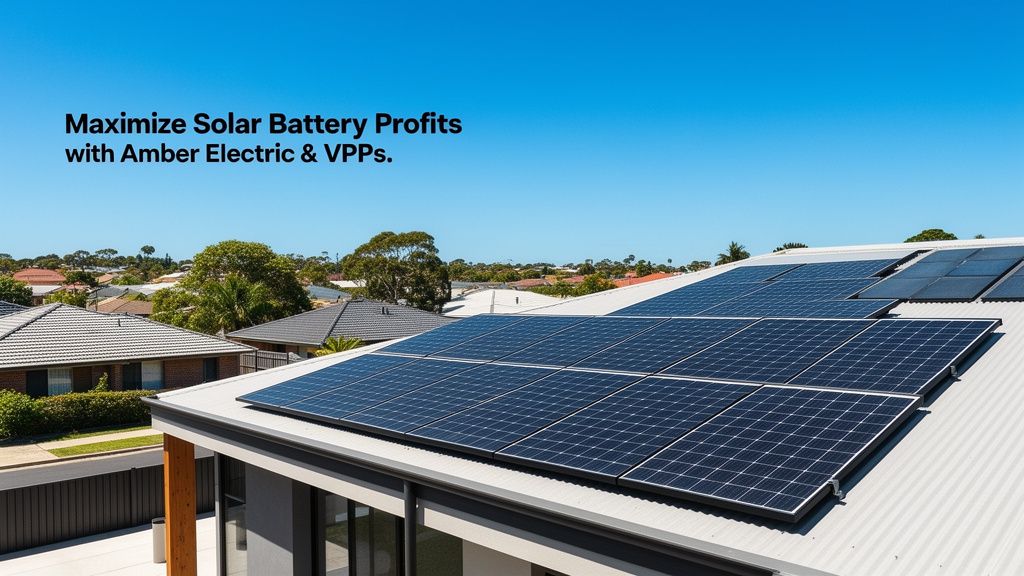
TL;DR: Amber Electric offers Australian solar battery owners access to wholesale electricity prices, enabling dynamic buying and selling to maximise profits. When combined with Virtual Power Plant (VPP) programs, batteries can earn additional revenue by supporting grid stability, but this advanced strategy introduces risks from market volatility and potential battery degradation.
What is Amber Electric and how does its real-time pricing work for solar batteries?
Amber Electric is an energy retailer offering wholesale electricity pricing directly to consumers, enabling solar battery owners to buy power when prices are low and sell when prices are high, potentially boosting their savings and earnings. Unlike traditional retailers with fixed tariffs, Amber passes through the National Electricity Market (NEM) spot price, which fluctuates every five minutes, along with a flat subscription fee. This direct exposure to the wholesale market transforms a passive solar battery into an active trading asset, where strategic charging and discharging based on price signals can unlock significant financial benefits beyond just self-consumption. For instance, if wholesale prices drop to $0.05/kWh overnight, you can charge your battery cheaply, then discharge it to the grid when prices spike to $1.00/kWh during peak demand, essentially buying low and selling high.
The Basics of Wholesale Pricing
Wholesale electricity prices in Australia's NEM are determined by supply and demand, changing every five minutes. These prices can range dramatically, from negative figures (e.g., -$0.10/kWh, meaning you get paid to consume) during periods of high renewable generation and low demand, to extreme highs (e.g., $15/kWh or more) during heatwaves, system faults, or unexpected outages. Amber Electric provides real-time price alerts and forecasts through its app, empowering customers to make informed decisions about when to charge their battery from the grid, export excess solar, or draw power from their battery for home use, directly capitalising on these market fluctuations.
Arbitrage Opportunities for Battery Owners
For battery owners, the primary benefit with Amber Electric is the ability to perform energy arbitrage. This means strategically buying electricity from the grid when wholesale prices are exceptionally low (often overnight or mid-day when solar is abundant) to charge your battery, and then selling that stored energy back to the grid when prices are high (typically during evening peaks). A well-managed 10kWh battery, for example, could be charged for as little as $0.50 and potentially discharged for $10.00 or more during a price spike, creating substantial revenue. This strategy requires active monitoring, or increasingly, smart automation, to capture the most profitable windows throughout the day.
How do Virtual Power Plants (VPPs) enhance battery profitability with Amber Electric?
Virtual Power Plants (VPPs) significantly enhance battery profitability by aggregating individual home batteries into a collective network, allowing them to provide grid services and earn additional revenue beyond simple energy arbitrage. A VPP is essentially a "fleet" of distributed energy resources, like residential solar batteries, that can be centrally controlled to act as a single, larger power plant. By participating in a VPP, your battery can be dispatched by the VPP operator (often Amber Electric or its partners) to either import or export power at specific times, not just for your own profit, but to help stabilise the grid during periods of imbalance. This orchestration allows homeowners to earn incentives for contributing to grid reliability.
VPPs as a Grid Stabilisation Tool
VPPs play a crucial role in maintaining grid stability, particularly as more intermittent renewable energy sources integrate into the NEM. When the grid experiences sudden drops in supply or surges in demand, VPPs can rapidly discharge their aggregated battery power to inject electricity into the network, preventing blackouts and maintaining frequency. Conversely, they can absorb excess generation by charging batteries. For this vital service, VPP participants receive payments, often a fixed annual fee or per-event payments, adding another layer of income on top of traditional solar savings and Amber's wholesale arbitrage. This incentivises battery owners to make their storage available for grid support when it's most needed.
Revenue Stacking for Battery Owners
Participating in a VPP with Amber Electric enables "revenue stacking," where your battery earns money from multiple sources simultaneously. Beyond avoiding high retail electricity prices and performing arbitrage on wholesale prices, VPP payments provide a third income stream. For example, a homeowner might save $1,500 annually on electricity bills through self-consumption and arbitrage, and then earn an additional $300-$600 annually by allowing their battery to participate in grid services through a VPP. This combination dramatically improves the financial return on investment for a solar battery, making the payback period potentially shorter and the overall profitability higher, provided the associated risks are managed.
What are the key strategies for optimising battery profits with Amber Electric and VPPs?
Optimising battery profits with Amber Electric and VPPs primarily involves leveraging automation and smart charging algorithms to react instantaneously to fluctuating wholesale electricity prices and grid service requests. Manual management of a battery to capture five-minute price changes is impractical and inefficient. Therefore, sophisticated software that integrates with your battery system and Amber's real-time data feeds is essential. This automation allows the battery to charge when prices are negative or extremely low (e.g., less than $0.05/kWh) and discharge when prices are high (e.g., above $0.50/kWh), all while ensuring sufficient power remains for household needs or VPP obligations.
Automated Smart Charging and Discharging
The most effective strategy involves setting up automated rules or using a smart battery management system that integrates with Amber Electric's API. These systems can autonomously monitor wholesale prices and forecasts, then initiate charging or discharging cycles to maximise profit. For example, the system might be programmed to prioritise charging from your solar panels, then from the grid if prices are below a certain threshold (e.g., $0.02/kWh). It would then automatically export power to the grid when prices exceed a higher threshold (e.g., $0.80/kWh), always leaving a buffer (e.g., 20% capacity) for evening household use or in case of a power outage. This hands-off approach ensures you capitalise on fleeting price spikes and dips without constant manual oversight.

Integrating Solar Generation for Maximum Benefit
Integrating your solar PV generation intelligently with your battery and Amber's real-time pricing is crucial for maximum benefit. First, your battery should always prioritise charging directly from your solar panels whenever possible, as this is the cheapest (free) energy source. Any excess solar generation, after meeting household demand and battery charging needs, can then be exported to the grid at the current wholesale price, which can be particularly lucrative on sunny days when demand is high. Smart systems can dynamically adjust the export rate, holding back power if prices are low and releasing it when prices improve, effectively optimising both self-consumption and export revenue. This holistic approach ensures every electron generated and stored contributes to the highest possible profit.
What significant risks are associated with maximising battery profits through Amber Electric and VPPs?
Maximising battery profits through Amber Electric and VPPs carries significant risks, including exposure to extreme wholesale price volatility, accelerated battery degradation, and the complexity of managing an actively trading energy asset. While the potential for high returns is appealing, the Australian energy market can be unpredictable, leading to outcomes that might erode expected profits. Homeowners need to fully understand these downsides before committing to such an advanced energy strategy, as mismanaging these risks can diminish the financial benefits or even lead to unexpected costs. The trade-off for higher potential earnings is a higher degree of market exposure and operational complexity.
Exposure to Wholesale Market Volatility
The primary risk is direct exposure to the wholesale electricity market, which is incredibly volatile. While high prices can be highly profitable, negative prices (e.g., -$0.15/kWh) mean you pay to consume or export electricity. If your battery system isn't managed correctly, it could charge from the grid when prices are negative, costing you money, or export your precious stored energy when prices are also negative. Prolonged periods of low wholesale prices or unexpected market events can significantly reduce the profitability of your arbitrage strategy, meaning expected returns might not materialise, or even result in higher costs than a traditional fixed-rate plan if not managed correctly.
Battery Health and Warranty Concerns
Another significant risk is accelerated battery degradation due to frequent cycling. Actively trading your battery means it will likely undergo more charge and discharge cycles than if it were simply used for self-consumption. Most battery warranties are tied to a number of cycles or a throughput of energy (e.g., 10,000 cycles or 40 MWh), beyond which performance guarantees may diminish. More frequent cycling to chase profits could shorten the effective lifespan of your battery or void parts of its warranty sooner, leading to earlier replacement costs that could offset some of your earned profits. It's crucial to understand the balance between aggressive trading and preserving battery longevity.
Key Takeaways
- Amber Electric provides access to real-time wholesale electricity prices, enabling solar battery owners to strategically buy low and sell high.
- Virtual Power Plant (VPP) participation adds another revenue stream by having your battery contribute to grid stability in exchange for incentives.
- Automated smart charging and discharging systems are crucial for effectively optimising battery profits from fluctuating wholesale prices.
- Direct exposure to the volatile wholesale electricity market can lead to unpredictable earnings and potential losses if not carefully managed.
- Frequent cycling of your battery for profit maximisation can accelerate degradation and potentially impact your battery's warranty.
Read More
For a comprehensive overview, check out our master guide: Read the Full Guide Here.