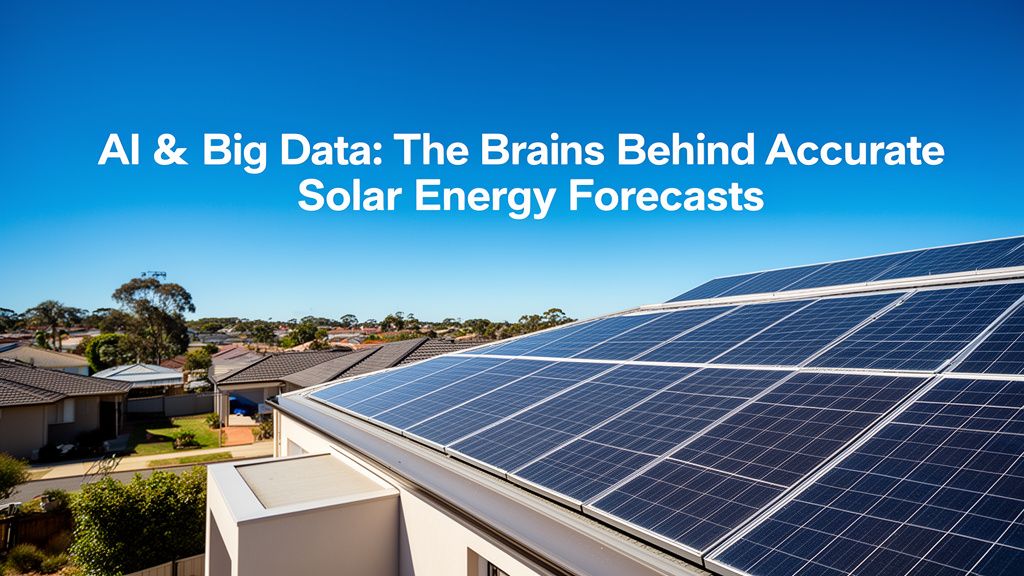
Beyond the Barometer: AI & Big Data Predicting Australia's Solar Output
G'day, sunshine seekers! Here in Australia, we absolutely love our solar power. From the bustling suburbs of Sydney to the vast, sun-drenched outback, panels are soaking up our abundant rays, helping us power our homes and businesses. We're world leaders in rooftop solar adoption, and it’s a fair dinkum ripper of an achievement. But for all its brilliance, the sun can be a bit of a tricky customer. One minute it's blazing, the next a stray cloud rolls in, or a dust storm whips up, suddenly dimming the output from your panels. So, how do we, as a nation heavily reliant on solar, predict exactly how much power our vast solar network will generate from one moment to the next? The answer, mate, lies in the clever combination of Artificial Intelligence (AI) and Big Data.
The Challenge of the Unpredictable Sun
Imagine running a massive electricity grid like Australia’s without a clue about how much power will be coming in from millions of solar panels in the next hour, let alone tomorrow. Traditional weather forecasts, while helpful, just don't cut it for the granular, minute-by-minute predictions needed to keep the lights on. Factors like the exact density of cloud cover, ambient temperature (which affects panel efficiency), the angle of the sun, and even local humidity can drastically alter solar output. For a country as geographically diverse as ours, experiencing everything from tropical cyclones up north to scorching heatwaves in the south, these variables are constantly in flux. Relying on guesswork or outdated models would be like navigating the Nullarbor with a paper map from the 70s – a recipe for disaster. This is where AI and the mountains of Big Data step in as the ultimate navigators.
Enter AI: The Smart Predictor
Think of AI as the brain of the operation, learning from experience just like a seasoned surfer learns to read the waves. Specifically, it's often machine learning algorithms – a subset of AI – that are doing the heavy lifting. These smart systems are fed colossal amounts of information and taught to identify complex patterns and relationships that would be invisible to the human eye. They can discern how a particular type of cloud passing over a specific region at a certain time of day usually impacts solar generation, or how a slight temperature increase might reduce efficiency. Unlike static models, AI constantly learns and refines its predictions, becoming more accurate with every bit of new data it processes. It’s like having a super-smart meteorologist who’s also an expert in solar physics, working around the clock.
Big Data: The Fuel for the Brain
AI is brilliant, but it's only as good as the data it’s fed. This is where "Big Data" comes into play. We’re talking about absolutely massive volumes of information, collected from countless sources across our sunburnt country. This includes real-time satellite imagery showing cloud movements in incredible detail, historical weather data from thousands of stations, readings from smart meters in homes and businesses, sensor data directly from solar farms and rooftop installations, grid load data, and even highly localised temperature and humidity sensors. The sheer scale and variety of this data – often measured in petabytes – allow AI models to build incredibly nuanced and detailed pictures of current and future solar conditions. It’s the raw material that allows the AI to develop its uncanny predictive abilities, ensuring our forecasts are fair dinkum accurate.


How the Magic Happens (The Nitty-Gritty, Simplified)
So, how does this dynamic duo actually work its magic? Essentially, the AI algorithms crunch through the Big Data, identifying correlations between weather events, geographical factors, time of day/year, and actual measured solar output. For instance, the system might learn that a particular type of fluffy white cloud over Brisbane typically reduces solar generation by 15% for 20 minutes, whereas a dense grey cloud over Melbourne might cause a 70% drop for an hour. Using historical performance, real-time data, and advanced statistical models, the AI then creates incredibly precise forecasts, often predicting solar output for specific regions or even individual solar farms every 5 to 15 minutes for the next few hours or days. This granular accuracy is absolutely crucial for maintaining a stable power supply.
Why This Matters to You, Mate!
Even if you’re just a homeowner with a few panels on your roof, these advanced forecasting methods indirectly benefit you heaps. A stable grid means fewer blackouts and brownouts, ensuring your appliances keep humming. For those with home batteries, smarter grid management influenced by these forecasts can help optimize energy flow, potentially leading to better tariffs or more efficient use of your stored solar power. It ensures that when your neighbour cranks up the air-con on a scorching arvo, the grid can handle it, thanks to the brainy tech working behind the scenes.
Benefits for the Big End of Town
For major players like the Australian Energy Market Operator (AEMO), big solar farms, and energy retailers, AI and Big Data are game-changers. AEMO uses these highly accurate forecasts to balance supply and demand across the National Electricity Market, reducing the need to fire up expensive and carbon-intensive "peaker" plants as backup. This saves us all money and helps us transition to a cleaner energy future. Solar farm operators can better predict their output, allowing them to sell power more effectively into the market and schedule maintenance without guesswork. Retailers can make smarter purchasing decisions, knowing more precisely when and how much solar energy will be available. It’s all about efficiency, reliability, and integrating more renewables without blowing a fuse!
The Future is Bloody Bright (and Smart)
Australia is uniquely positioned to leverage these technologies. With our abundant sunshine and our ambitious renewable energy targets, AI and Big Data are not just helpful – they're essential. As we continue to integrate more solar, wind, and battery storage into our grid, the sophistication of these forecasting tools will only grow. We’ll see further integration with virtual power plants (VPPs), smart homes, and electric vehicle charging infrastructure, creating a truly intelligent and resilient energy system. We’re not just chasing the sun; we're using the smartest tech available to harness its power like never before. So next time you enjoy a cold tinnie under the Aussie sun, remember the clever brains working overtime to keep your solar power flowing seamlessly, day in and day out. It’s a true blue testament to Australian innovation!
Read More
For a comprehensive overview, check out our master guide: Read the Full Guide Here.