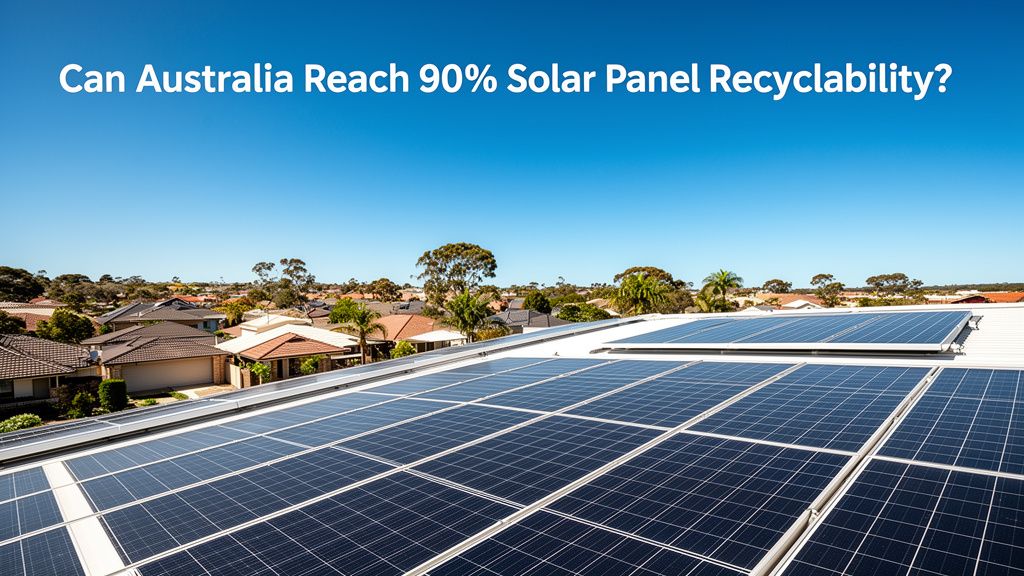
TL;DR: Australia can realistically aim for 90% solar panel recyclability by 2030, but it requires significant investment in advanced recycling infrastructure, robust policy frameworks like product stewardship, and continuous innovation in panel design and material recovery. This will create jobs and reduce environmental impact, moving towards a true circular economy.
What Challenges Stand in the Way of High Solar Panel Recyclability in Australia?
Achieving high solar panel recyclability in Australia faces several substantial hurdles, primarily stemming from logistical complexities, economic disincentives, and technological limitations inherent in current recycling processes. Australia’s vast geographical spread makes collecting end-of-life solar panels from regional and remote areas an expensive logistical nightmare. Moreover, the current cost of recycling panels often outweighs the relatively low value of recovered materials, especially when compared to cheap landfill options, creating a financial barrier for recyclers and consumers alike. The technology itself for efficiently separating and recovering high-purity materials like silicon, silver, and copper is still evolving and requires significant capital investment. Without a clear market for these recovered materials or a mandatory framework, the motivation for comprehensive recycling remains limited.
Logistics and Collection Barriers Across a Wide Continent
The sheer scale of Australia’s geography presents immense challenges for efficient solar panel collection and transport. Panels are installed everywhere from bustling cities to isolated outback stations, making a centralised collection system impractical and costly. Transporting heavy, fragile solar panels over long distances adds significantly to the recycling price tag, potentially costing upwards of $50-$100 per pallet for interstate transit, which can include dozens of panels. Currently, there’s no unified national collection network, meaning many panels end up in general waste or landfills simply due to lack of accessible recycling points or prohibitive individual transport costs for homeowners and businesses. This fragmented approach hinders the aggregation of sufficient volumes needed to make advanced recycling operations economically viable.
Economic Viability and Technology Gaps in Material Recovery
The economic equation for solar panel recycling in Australia is currently unfavourable compared to disposal. While landfill fees might be around $100-$200 per tonne (or roughly $1-$5 per panel), the cost of advanced recycling can sit anywhere from $10-$25 per panel, depending on the technology and recovery rates. This disparity creates a strong disincentive. Furthermore, existing recycling technologies often struggle to efficiently recover high-purity materials from complex panel structures. Traditional methods might only recover glass and aluminium, missing valuable silicon, silver, and copper. Investing in state-of-the-art thermal, mechanical, and chemical separation processes is crucial for higher recovery rates and making recycling financially attractive, but this requires substantial upfront capital, potentially millions of dollars for a large-scale facility.
How Can Government Policy Drive Greater Solar Panel Recycling Rates?
Government policy is undeniably the most powerful lever Australia has to significantly increase solar panel recycling rates, primarily through implementing mandatory product stewardship, offering financial incentives, and investing in critical recycling infrastructure. Without clear regulatory direction, the market alone is unlikely to overcome the existing economic and logistical barriers to a circular economy for solar. Policy can shift the financial burden and responsibility onto manufacturers and importers, encouraging them to design more recyclable products and fund end-of-life solutions. Furthermore, targeted government funding can kickstart new recycling industries and research into more efficient technologies, creating a robust ecosystem for sustainable solar.
Implementing Mandatory Product Stewardship Schemes
Mandatory product stewardship schemes are crucial for shifting responsibility for a product’s entire lifecycle, including end-of-life management, onto manufacturers, importers, and retailers. This would ensure that the cost of recycling is factored into the initial price of solar panels, creating a 'producer pays' model that internalises the environmental cost and incentivises better design. A national scheme, similar to Australia’s existing e-waste recycling program (MobileMuster or TechCollect), could establish collection points, set recycling targets, and ensure adequate funding mechanisms are in place. This would provide the necessary financial stability and volume certainty for recyclers, moving away from voluntary programs that often struggle with scale and consistent participation.
Providing Financial Incentives and Infrastructure Investment
Direct government financial incentives and strategic infrastructure investment are vital to bridge the current economic gaps in solar panel recycling. Subsidies or grants could be offered to companies developing and operating advanced recycling facilities, helping to offset high capital costs and make operations more competitive against landfill. For example, a grant of $5-10 million could support the establishment of a state-of-the-art regional recycling plant. Furthermore, funding for research and development (R&D) into more efficient and cost-effective recycling technologies, perhaps through partnerships with universities and industry, is essential. This includes supporting pilot projects that demonstrate new separation techniques or automation, paving the way for scalable solutions and reducing reliance on manual labour, which can be expensive in Australia.
What Role Does Innovation Play in Achieving a 90% Recycling Target?
Innovation is paramount to achieving a 90% solar panel recyclability target, as it addresses both the technical complexities of material recovery and the foundational design of the panels themselves. Current recycling processes are often labour-intensive and don't efficiently recover all valuable materials, but new advancements in mechanical, chemical, and thermal separation technologies promise higher purity yields and reduced processing costs. Equally important is the concept of "design for circularity," where panels are intentionally engineered from the outset to be easily disassembled and their components readily reused or recycled. These twin pillars of innovation—improved recycling techniques and smarter product design—are essential for transforming the linear "take-make-dispose" model into a truly circular economy for solar energy.
Advancements in Separation and Recovery Technologies
Breakthroughs in separation and recovery technologies are critical for extracting the maximum value from end-of-life solar panels. Current methods might recover bulk materials like glass and aluminium, but advanced techniques are needed for high-value components. For instance, specialised delamination processes using heat or chemicals can separate silicon cells from the EVA encapsulant, allowing for the recovery of pure silicon, silver, and copper. Pyrolysis, a thermal treatment, can also effectively recover glass and metals while reducing organic components. Investment in automated sorting systems and robotics can further improve efficiency and reduce the labour costs associated with manual disassembly, making recycling more economically attractive. These technologies are crucial for turning waste panels into valuable secondary raw materials, reducing the need for virgin mining.


Designing Panels for a Circular Future
The concept of "design for circularity" is about fundamentally rethinking how solar panels are made, with their end-of-life recycling in mind. This involves designing panels with modular components that are easy to disassemble, using fewer different types of materials, or opting for materials that are easier to separate and recycle. For example, developing encapsulants that can be easily dissolved or peeled away, rather than rigidly bonded EVA, would significantly simplify material separation. Standardising panel sizes and connection types could also streamline collection and processing. Manufacturers could explore using recyclable backsheets and frames, or even incorporate recovered materials directly into new panel production, closing the loop. Promoting research and development in this area, potentially through government grants or industry partnerships, would drive innovation towards panels that are inherently easier and cheaper to recycle.
What are the Economic Benefits and Costs of a Robust Solar Panel Recycling Industry?
A robust solar panel recycling industry in Australia offers significant economic benefits, including the creation of new green jobs, enhanced resource security, and the development of innovative local industries, alongside the initial investment costs. While there will be upfront costs associated with establishing new recycling facilities and refining processes, these are outweighed by the long-term gains. Recycling reduces Australia's reliance on imported virgin raw materials, mitigating supply chain risks and price volatility. Furthermore, it avoids the escalating costs and environmental damage associated with landfilling hazardous materials, making it a sound long-term economic and environmental decision. The sector can also position Australia as a leader in sustainable energy technology and resource management.
Creating New Jobs and Local Industries
Developing a comprehensive solar panel recycling industry in Australia has the potential to create a new wave of local jobs across various skill levels. This includes roles in logistics and collection, disassembling and sorting, and skilled technicians operating advanced recycling machinery. We could see hundreds, potentially thousands, of direct and indirect jobs created in collection centres, processing plants, and research facilities across the country. Furthermore, it fosters the growth of ancillary industries that process and utilise the recovered materials, such as specialised glass manufacturers or metal refiners. This local economic activity reduces dependence on international markets for critical resources and builds sovereign capability in the clean energy supply chain, turning waste into a valuable resource and keeping wealth within the Australian economy.
Reducing Reliance on Virgin Resources and Mitigating Environmental Impact
A strong solar panel recycling industry significantly reduces Australia's reliance on virgin raw materials, contributing to resource security and price stability. By recovering valuable metals like silicon, silver, copper, and aluminium, we lessen the need for energy-intensive mining operations and their associated environmental impacts. This shift also crucially mitigates the growing environmental burden of solar panels ending up in landfills. Landfilling panels not only wastes valuable resources but also poses a risk of heavy metals leaching into the environment over time. Recycling prevents this pollution, conserves energy, and reduces greenhouse gas emissions associated with both mining new materials and manufacturing new components from scratch, aligning perfectly with Australia's broader environmental and climate change goals.
Key Takeaways
- Establish Mandatory Product Stewardship: Australia needs a national 'producer pays' scheme to fund and coordinate solar panel recycling, ensuring manufacturers are responsible for end-of-life management.
- Invest in Advanced Recycling Infrastructure: Government and industry must co-invest in local, state-of-the-art facilities capable of efficiently recovering high-value materials like silicon and silver.
- Incentivise Design for Circularity: Encourage solar panel manufacturers to design panels that are easier to disassemble and recycle, reducing future processing costs and increasing material recovery rates.
- Create Green Jobs and Resource Security: A robust recycling industry will generate new employment opportunities across logistics, processing, and manufacturing, while also securing critical resources locally.
- Prioritise Research and Development: Support R&D for more efficient, cost-effective recycling technologies and innovative panel designs to continuously improve recovery rates and economic viability.
Read More
For a comprehensive overview, check out our master guide: Read the Full Guide Here.