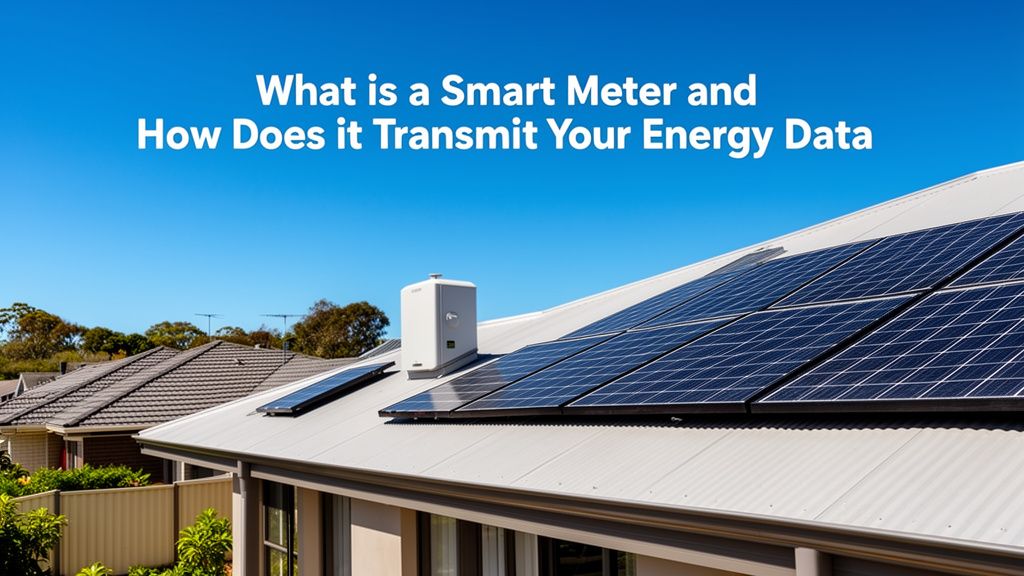
In the sunny land of Australia, where rooftop solar panels are becoming as common as backyard barbies, understanding how your home's energy consumption and generation are tracked is more important than ever. Enter the smart meter, an important piece of technology that is changing how we interact with the electricity grid. If you have recently had solar installed, moved into a new build, or simply heard the buzz, you might be wondering: "What exactly is a smart meter, and how does it transmit my energy data?" Let us break it down, Aussie style.
What is a Smart Meter?
Forget those old, clunky electricity meters with the spinning dials or simple digital readouts that only recorded your total usage. A smart meter is a sophisticated, digital device designed to measure and record your electricity consumption, and if you have solar, your electricity generation and export, much more frequently. Instead of monthly or quarterly readings, a smart meter typically records data in 30-minute intervals.
Think of it as an intelligent brain for your home's energy. Unlike its predecessors, a smart meter has two-way communication capabilities. This means it can send your energy data back to your energy distributor and retailer, and it can also receive information, such as tariff updates or remote disconnections and reconnections, though this is typically only done by authorised personnel. This constant, detailed flow of information is what makes it smart and very useful for modern energy management, especially for solar households keen on optimising their system. In states like Victoria and New South Wales, smart meter installation is mandatory for new connections or meter replacements, while other states are seeing a gradual, voluntary rollout.
How Does a Smart Meter Transmit Your Energy Data?
The magic of a smart meter lies in its ability to wirelessly transmit your energy data securely and efficiently. Unlike the old days where a meter reader had to physically visit your property, smart meters use advanced communication technologies to send your usage and generation statistics directly to your energy provider. Here is a look at the primary methods used in Australia:
Mobile Network Technology
This is by far the most common and reliable method for smart meter data transmission. Much like your mobile phone, smart meters often contain a small modem that uses 3G, 4G, or increasingly, 5G cellular networks.
- How it works: The meter records your energy data in those precise 30-minute intervals. At regular times (e.g., daily or multiple times a day), this accumulated data is encrypted and sent wirelessly over the mobile network.
- The Journey: This data is first received by your local energy distributor (like Ausgrid in NSW, Energex in QLD, or Powercor in VIC). The distributor then processes this raw data and makes it available to your energy retailer (such as AGL, Origin, or EnergyAustralia), who uses it for billing and to provide you with insights into your usage.
Powerline Communication (PLC)
While less prevalent for newer installations compared to mobile networks, some smart meters, particularly in older deployments, use powerline communication (PLC).
- How it works: With PLC, data signals are sent directly over the existing electricity lines that bring power to your home. The meter encodes the data onto the power lines at a different frequency than the electricity itself.
- The Journey: This data travels along the power lines to a local data concentrator or collection point within your neighbourhood, which then aggregates the data from multiple meters and forwards it to the energy distributor, often via a fibre optic or mobile network connection.
Radio Frequency (RF) Mesh Networks
Some smart meter deployments use a mesh network architecture, which is highly efficient in densely populated areas.
- How it works: In an RF mesh network, individual smart meters communicate wirelessly with each other, forming a mesh. Each meter acts as both a transmitter and a receiver, passing data along from one meter to the next until it reaches a designated gateway meter.
- The Journey: This gateway meter, which often uses a mobile network or fibre connection, then sends the collective data from its section of the mesh to the energy distributor. This method creates a self-healing network, as data can find alternative routes if one meter goes offline.
Regardless of the technology used, the fundamental process ensures that your energy consumption and generation data are captured accurately, encrypted for security, and transmitted reliably to enable precise billing and advanced energy management.
Benefits for Australian Solar Households
For Australian homes with solar panels, smart meters are a game-changer.
- Accurate Billing and Feed-in Tariffs: No more estimated bills! Your smart meter precisely measures how much electricity you import from the grid and how much surplus solar electricity you export. This ensures you are correctly credited for your solar feed-in tariff (which might be around $0.05 to $0.15 per kWh, depending on your retailer and state).
- Optimised Time-of-Use (TOU) Tariffs: Smart meters enable retailers to offer Time-of-Use tariffs. This means electricity prices vary depending on the time of day. For example, peak rates might be $0.40/kWh during the evening, shoulder rates around $0.25/kWh during the day, and off-peak as low as $0.15/kWh overnight. With a smart meter, you can strategically shift your high-energy usage (like running the dishwasher or charging an EV) to off-peak times, reducing your import costs and maximising your solar self-consumption.
- Better Solar and Battery Management: Access to detailed 30-minute interval data helps you understand your energy patterns. You can see exactly when you are importing from the grid versus when your solar is covering your needs or exporting. This data is very useful for sizing a battery storage system or optimising its operation to store cheap off-peak power or surplus solar for peak evening usage.
- Grid Stability: For the energy network operators, smart meters provide real-time visibility into grid demand and supply, which is especially important in managing the increasing penetration of rooftop solar and maintaining a stable, reliable electricity supply across Australia.
Are Smart Meters Safe and Secure?
Concerns about data privacy and security are understandable. Rest assured, smart meters in Australia operate under strict regulatory frameworks. The data transmitted is encrypted, safeguarding your personal energy information. Furthermore, smart meters adhere to Australian and international safety standards, with emissions well below established limits.
The Australian Rollout and What to Expect
As mentioned, smart meters are already mandatory in Victoria and New South Wales for new connections or replacements, and their rollout is ongoing voluntarily in Queensland, South Australia, and other regions. If you are getting solar installed, it is highly likely your old meter will be upgraded to a smart meter as part of the process, often with no direct upfront cost from the installer or distributor.
Conclusion
Smart meters are a necessary component of Australia's modern energy landscape, particularly for homes embracing solar power. By accurately measuring and wirelessly transmitting your energy data, they pave the way for precise billing and innovative tariffs, and they give you the insights needed to make informed decisions about your energy consumption. Embracing this technology means stepping into a more efficient, cost-effective, and sustainable energy future right here in Australia.
