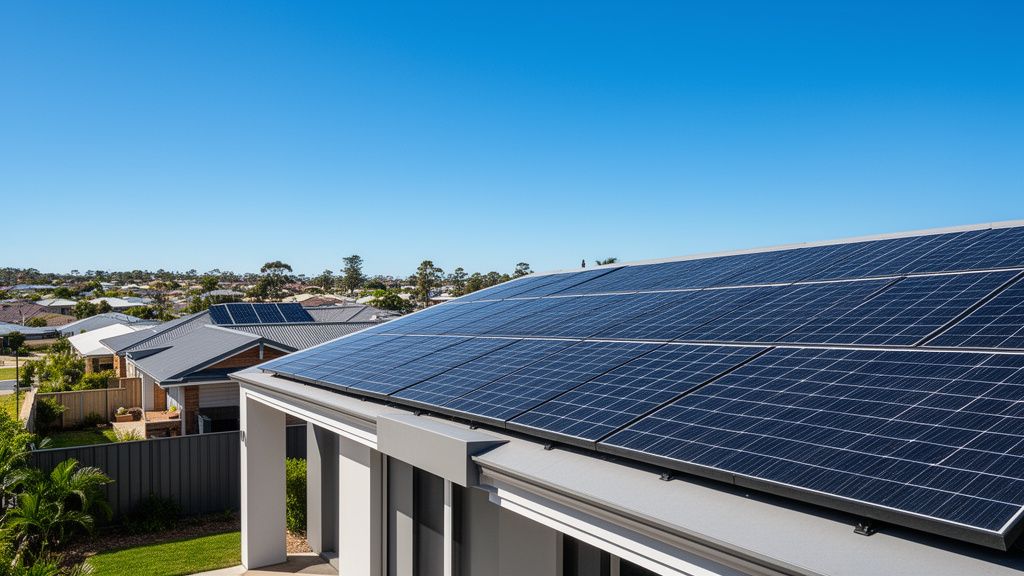
TL;DR: German glass-glass panels with a 30-year product and performance warranty, which is the longest in the market by a wide margin. Efficiency is good rather than class-leading at 20.5% to 21.5%. Expect $10,000 to $15,000 for a 6.6kW system. You are buying longevity, not peak output.
What makes Solarwatt panels different from other premium brands?
Glass on both sides instead of glass on the front and a plastic backsheet.
That is the whole proposition and it is a bigger deal than it sounds. A conventional panel has a polymer backsheet that degrades under UV and heat over decades, eventually admitting moisture. Moisture ingress and the cell corrosion that follows is one of the main reasons panels fail before their warranty expires.
Two sheets of tempered glass laminating the cells removes that failure mode. It also makes the panel stiffer, which reduces the micro-cracking that comes from flexing under wind load and thermal cycling. Micro-cracks are invisible, they accumulate, and they are what turns a 25-year panel into a 15-year panel.
Solarwatt has been in Dresden since 1993 with research, development and manufacturing in Germany. That matters here because a 30-year warranty is only worth what the company is worth in year 29, and a manufacturer with three decades of continuous operation is a better bet than most.
What the glass-glass build actually buys you
Better resistance to hail and wind, because the sandwich is stiffer and both faces are tempered glass.
Better fire performance, because there is no combustible backsheet.
Better moisture exclusion over decades, which is the durability argument that justifies the 30-year term.
The trade-off is weight. Glass-glass panels are heavier than glass-backsheet equivalents, which matters on older roofs and on tile roofs with marginal structure. Have your installer confirm the roof can carry it before you commit.
How do Solarwatt panels perform in Australian conditions?
Efficiency across the Vision series runs 20.5% to 21.5%, with outputs typically 370W to 420W depending on model.
That is solid rather than exceptional. REC's Alpha series and Maxeon's panels reach higher. If your constraint is roof area, Solarwatt is not the panel that squeezes the most capacity onto a small roof.
A 6.6kW system needs roughly 16 to 18 Solarwatt panels against 20 to 22 of a lower-efficiency module, so it still saves area over budget panels. It just is not the leader.
The number that matters more here
The temperature coefficient is around 0.32% per degree above 25C.
Australian roof surfaces routinely reach 50 to 70C. At a 60C cell temperature, a 0.32% coefficient costs you around 11% of rated output. That is competitive, though heterojunction panels from REC and others do better at around 0.26%.
Where Solarwatt wins is not the loss on any given hot day but the loss over thirty years. A panel that resists moisture and micro-cracking degrades more slowly, and the compounding matters more than a small difference in temperature coefficient.
Structural ratings
The Vision series is rated to 5,400 Pa snow load and 2,400 Pa wind load.
The snow figure is irrelevant almost everywhere in Australia. The wind rating is not, particularly in cyclone-exposed areas of Queensland and the Northern Territory, and in coastal regions where uplift on an exposed roof is the main structural concern. Ratings well above what your site requires are margin, and margin is what stops a panel failing in the one storm that exceeds the design case.
Is a 30-year warranty actually worth paying for?
Solarwatt offers 30 years on both product and performance, guaranteeing at least 87% of nominal output at year 30.
For comparison, most manufacturers offer 10 to 25 years on product, and typical 30-year performance guarantees where they exist sit around 80% to 85%. Solarwatt is ahead on both terms.
Whether it is worth paying for depends on two things.
How long you will own the house. A 30-year warranty on a system you sell in six years transfers to the buyer and does very little for you. It is worth most to someone in a house they intend to keep.
Whether the manufacturer survives. LG made excellent panels with excellent warranties and left the solar business in 2022, which stranded a lot of Australian claims. Solarwatt's thirty-year German operating history is reassuring and not a guarantee.
Making a claim in practice
Solarwatt maintains an authorised distribution network in Australia, so a claim goes through your installer to local support rather than to Germany directly.
That is better than brands with no local representation, and it still means your installer is the first point of contact. An installer who has been trading for fifteen years and will be there in another ten matters more to a warranty claim than any clause in it. Ask how long the business has operated and whether it has actually processed a Solarwatt claim before.
Note also that the panel warranty is not a system warranty. Your inverter will carry 5 to 12 years depending on model, and it is the component most likely to need replacing first. A 30-year panel behind a 10-year inverter is still a system with a 10-year service event in it.
What does a Solarwatt system cost in Australia?
For a 6.6kW system with a quality string inverter such as a Fronius or SolarEdge, expect $10,000 to $13,500 in the capital cities after the STC discount.
Optimisers or microinverters, which suit complex or shaded roofs, push that to $13,000 to $15,000 and above.
Those figures move with roof complexity, storey height, switchboard condition and installer overheads more than with the panel itself. Get three quotes from Clean Energy Council accredited installers, and make sure they are quoting comparable inverters, because that is where quotes most often differ without it being obvious.
Is the premium justified?
It depends what you are optimising for, and it is worth being direct about this.
If you want the shortest payback period, no. A good mid-tier N-type panel from Jinko or Trina with a 25-year warranty delivers similar generation for several thousand dollars less, and the extra five years of warranty does not recover that gap in cash terms.
If you want the system to still be producing well in 2056 with minimal intervention, and you intend to be in the house to see it, Solarwatt has the strongest argument in the market. The lower degradation and the removal of the backsheet failure mode mean more total kilowatt-hours over the life of the array, and the warranty term reflects genuine confidence rather than marketing.
The panel suits a long-horizon owner. It does not suit someone optimising a five-year return.
Key Takeaways
- Solarwatt makes German glass-glass panels, which removes the backsheet as a failure mode and resists the micro-cracking that shortens conventional panel life.
- Efficiency of 20.5% to 21.5% is good but not class-leading; if roof area is your constraint, higher-efficiency panels exist.
- The 30-year product and performance warranty guaranteeing 87% output is the longest available, against a typical 80% to 85% elsewhere.
- Expect $10,000 to $13,500 for a 6.6kW string-inverter system, or $13,000 to $15,000 with optimisers or microinverters.
- Glass-glass panels are heavier, so have the installer confirm your roof structure, and remember the inverter will still need replacing long before the panels do.