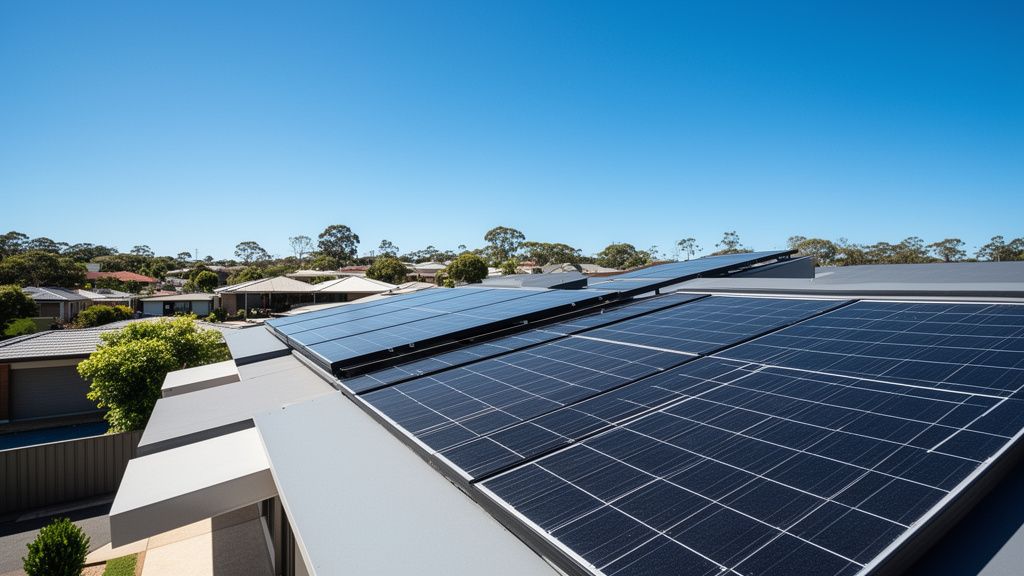
TL;DR: Singlet fission is an advanced quantum process that could significantly boost solar panel efficiency by converting one high-energy photon into two lower-energy excitons, effectively doubling the usable energy from blue light and potentially pushing efficiency limits beyond 33%. This "dream technology" is currently in the research phase but holds promise for making solar power even more cost-effective and widespread across Australia.
What Is Singlet Fission and How Could It Revolutionise Solar Panels?
Singlet fission is a quantum mechanical process where a single high-energy photon absorbed by a material creates two excited electron-hole pairs (excitons) instead of one, potentially doubling the energy harvest from a portion of the solar spectrum. Traditionally, when a silicon solar cell absorbs a high-energy photon (like those from blue or ultraviolet light), it generates a single electron-hole pair, but a significant amount of the photon's excess energy is lost as heat. Singlet fission materials, however, have the unique ability to take that single high-energy exciton and split it into two lower-energy excitons, each capable of generating an electron. This effectively means that for every high-energy photon absorbed, you get two electrons instead of one, leading to a much more efficient conversion of sunlight into electricity, a bloody ripper for our sunny continent.
The Quantum Leap Beyond Silicon
Traditional silicon photovoltaic cells are fantastic, but they have a fundamental limitation: they're optimised to convert a specific range of photon energies efficiently. Higher energy photons, like those in the blue and UV spectrum, contain more energy than needed to create an electron-hole pair in silicon. The "extra" energy is wasted as heat, which paradoxically also makes the panel less efficient. Singlet fission acts as a clever energy multiplier, capturing this previously wasted energy by effectively harvesting twice the electrical charge from these high-energy photons, giving silicon cells a much-needed boost.
Harvesting More Light with Each Ray
Imagine each high-energy sunlight particle hitting your panel and delivering double the bang for its buck. That's the core promise of singlet fission. By converting one high-energy exciton into two, the technology essentially "down-converts" the energy, matching it better with the bandgap of conventional silicon cells. This allows for a much more thorough and efficient utilisation of the solar spectrum, particularly the bluer end, which current panels often struggle to capture optimally. It is like turning one strong wave into two perfectly surfable ones, getting more out of the ocean's power.
How Does Singlet Fission Promise to Smash the Solar Efficiency Ceiling?
Singlet fission promises to smash the solar efficiency ceiling by effectively converting a single high-energy photon into two excitons, which can then generate two electrons, thereby capturing more energy from the high-energy (blue and UV) parts of the solar spectrum that are often wasted in traditional silicon panels. The theoretical maximum efficiency for a standard single-junction silicon solar cell, known as the Shockley-Queisser limit, is around 33.7%. This limit assumes that each photon creates only one electron-hole pair and that any excess energy above the material's bandgap is lost as heat. Singlet fission directly addresses this limitation by allowing a single photon to produce two electron-hole pairs, fundamentally changing the energy conversion dynamics.
Beyond the Shockley-Queisser Limit
The Shockley-Queisser limit has been a long-standing barrier in solar efficiency research. It defines the maximum theoretical efficiency achievable by a single-junction solar cell under standard conditions. Singlet fission offers a pathway to bypass this limit because it redefines the "one photon, one electron" assumption for high-energy light. By effectively getting two electrons from a single blue photon, singlet fission layers integrated into existing silicon cells could theoretically push combined efficiencies into the area of 44% or even higher, a truly remarkable prospect that could see panels deliver significantly more grunt from the same footprint.
More Power from the Same Rooftop
For Australian homeowners, this means more power generation without increasing the physical size of their solar array. A panel with 40% efficiency, compared to a standard 20% efficient one, would generate twice the electricity from the same rooftop space. This is a massive boon for urban areas where roof space is limited, or for those wanting to maximise their energy independence. It translates to fewer panels needed for the same desired output, lower installation complexity, and potentially a faster payback period, making solar an even more attractive investment down under.
What Are the Current Challenges and Timelines for Singlet Fission Technology in Australia?
Despite its immense potential, singlet fission technology currently faces significant challenges, including identifying stable and efficient materials that exhibit the effect, integrating these materials into existing solar cell architectures, and scaling up manufacturing processes, meaning it is still largely a laboratory-stage technology with commercialisation likely a decade or more away. Researchers are primarily focused on organic semiconductor materials, like pentacene and tetracene derivatives, which show promising singlet fission characteristics but often lack the long-term stability required for practical outdoor solar applications. Australian universities and research bodies, such as UNSW and CSIRO, are actively involved in this advanced research, pushing the boundaries of solar efficiency.
The Quest for the Perfect Material
The biggest hurdle lies in finding materials that exhibit efficient singlet fission and are also stable, affordable, and easily manufacturable. Many of the organic molecules that show strong singlet fission effects are prone to degradation when exposed to oxygen, moisture, or prolonged sunlight - not ideal for a technology meant to sit on Aussie rooftops for 25 years! Scientists are exploring various molecular designs and encapsulation techniques to overcome these stability issues, working towards a "dream material" that can handle our harsh sun.
Integrating a Quantum Leap into Existing Tech
Once suitable materials are found, the next challenge is integrating them into existing silicon solar cell technology. This typically involves applying a singlet fission layer as a thin film on top of a conventional silicon cell, creating a "tandem" cell structure. This integration requires precise engineering to ensure efficient energy transfer between the layers without introducing new performance losses. Developing cost-effective and scalable manufacturing processes for these complex multi-layered cells is a monumental task that will require significant investment in research and development before we see them in your local solar shop.
Will Singlet Fission Make Australian Solar Power Even More Affordable?
While singlet fission technology is still in its early research phase and would initially involve higher costs, its potential to significantly increase power output per panel could eventually lead to a lower cost per watt, making solar power even more affordable and accessible for Australian homes and businesses in the long term. Currently, a decent 6.6kW solar system in Australia might set you back between $5,000 and $8,000 before any government rebates. If singlet fission panels could push efficiency much higher, say from 20% to 35% or more, you would need fewer panels to achieve the same or greater energy output, drastically cutting down the overall system cost per kilowatt-hour over its lifetime.
Boosting Output, Reducing Footprint
The beauty of super-efficient panels is that they generate more power from less space. For many Aussie homes, particularly those with smaller roofs or complex rooflines, maximising power output from a limited area is very important. Singlet fission could mean that a 5kW system that currently requires 15-20 panels might only need 10-12 panels. This reduction in the number of panels needed saves on material costs and simplifies installation, potentially lowering labour charges and making solar viable for properties that previously did not have enough suitable roof space.
Future Investment Returns for Aussie Homes
For the savvy Australian homeowner, a lower cost per watt and higher overall system efficiency directly translates to faster payback periods and significantly higher returns on investment. Imagine a solar system that could generate 50% more electricity from the same footprint, feeding more power back into the grid and earning you more feed-in tariff credits. This could accelerate the typical 3-5 year payback period even further, making solar an absolute no-brainer. While it is a fair way off, singlet fission promises a future where solar energy is environmentally sound and also an incredibly dinky-di financial winner for every household.
Key Takeaways
- Singlet fission is a quantum process that creates two electron-hole pairs from a single high-energy photon, boosting solar panel efficiency.
- This technology has the potential to push solar cell efficiencies beyond the current Shockley-Queisser limit of approximately 33.7%, possibly reaching over 40%.
- Current challenges include finding stable and efficient singlet fission materials and effectively integrating them into existing silicon solar cell architectures.
- While still in the research phase, singlet fission promises to make solar power more affordable per watt in the long term by significantly increasing power output per panel.
- Commercialisation of singlet fission technology is likely still a decade or more away, but it represents a major leap forward for solar energy.