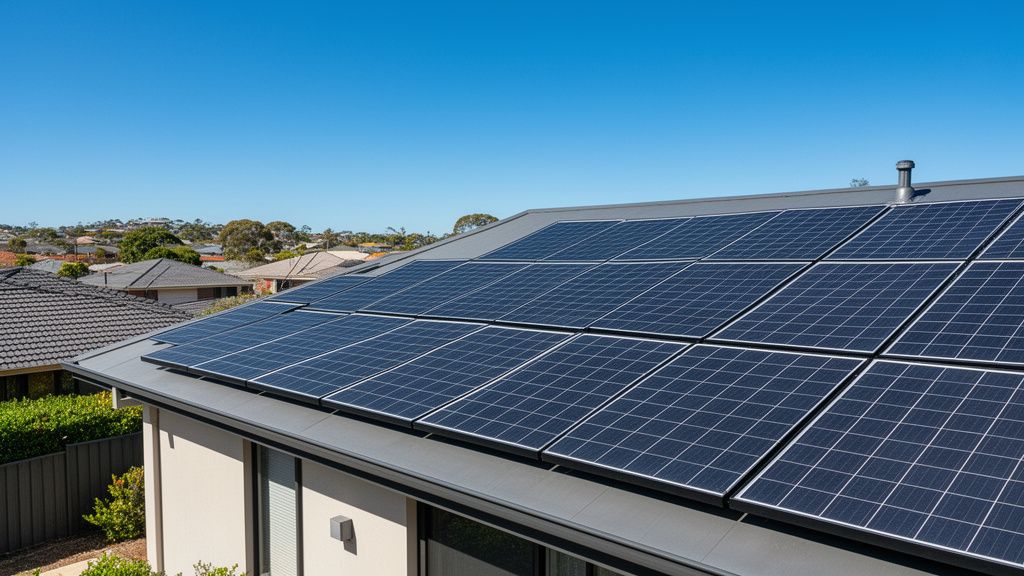
TL;DR: Pure-RX for a roof too small to fit the system you want. Pure-R for most households that want heterojunction performance without paying for the last percentage point. TwinPeak 5 when roof space is not the constraint and the money is better spent elsewhere. The panel choice matters less than most quotes imply.
The Technology Split
Two different cell technologies across the three ranges, and that is the line everything else follows.
Alpha Pure-RX and Pure-R use heterojunction cells, 132 half-cut, in a design that suppresses internal losses and holds output better as the panel heats. Heterojunction also performs better in weak light, so generation starts earlier and finishes later in the day.
TwinPeak 5 uses monocrystalline PERC, typically 120 half-cut cells in a dual-array layout. PERC is mature, well proven, and cheaper. The split-array design limits how far shade on one part of the panel drags down the rest, which matters on roofs with a chimney, a vent or an afternoon tree.
The Pure-RX differs from the Pure-R in cell density and module architecture rather than in the underlying technology. It is the same idea, packed tighter.
Why Heterojunction Matters Here Specifically
Not for the efficiency headline. For the temperature behaviour.
Every panel loses output as it heats, and a roof in an Australian summer runs far above the 25C at which panels are rated. Heterojunction cells lose less per degree, so the gap between an HJT panel and a PERC panel widens exactly when your system is generating most.
That is the real argument for the Alpha series, and it is a different argument from the one about roof space.
Efficiency and Output
Alpha Pure-RX: above 22% efficiency, output above 430W per panel. A 6.6kW system needs roughly 15 or 16 panels instead of 18 to 20 of a lower-wattage alternative.
Alpha Pure-R: around 21.5% to 22%, output commonly 400 to 420W.
TwinPeak 5: around 20% to 21%, output typically 375W to 395W.
The practical meaning of that spread is entirely about area. If your usable north, north-east and north-west roof will take twenty panels comfortably, the Pure-RX buys you nothing you will use. If it will take fifteen and you want 6.6kW, or you are aiming at 10kW on a constrained roof, the higher-wattage panel is what makes the system possible.
Measure the roof before you decide. Installers do sometimes quote the highest-efficiency panel by default, and it is a straightforward question to ask how much usable area you actually have.
Cost
For a typical 6.6kW system, expect the Alpha series to add $500 to $1,500 over a TwinPeak 5 system, depending on installer and panel wattage.
In absolute terms, an Alpha system including inverter and installation typically runs $6,500 to $10,000 for 6.6kW after STCs. A TwinPeak 5 system sits closer to $5,500 to $8,500.
That range is wide because the panel is not the biggest variable. Roof type, storey height, inverter choice and switchboard condition move the total more than the panel does. Two quotes for the same panel can differ by two thousand dollars for reasons that have nothing to do with the solar panels on the roof.
Warranties
All three carry 25-year product and 25-year performance warranties, which is rare across a full manufacturer range.
The difference is in the guaranteed endpoint. The Alpha series typically guarantees 92% of nominal output at year 25. TwinPeak 5 guarantees around 86%.
Over 25 years that six-point gap is real but modest, and worth less than the price difference on most roofs.
The Labour Warranty Is the Underrated Part
REC offers a 25-year labour warranty through certified REC Solar Professionals, covering removal, replacement and reinstallation.
That is the clause that matters when something fails in year twelve. A replacement panel is cheap; a day of scaffolding, access and an electrician is not, and most warranties leave you paying for it.
It requires a certified installer. If no REC-certified installer operates near you, this advantage does not apply and the case for choosing REC over a comparable mid-tier brand weakens.
Which One for Which House
Choose the Pure-RX when roof area is your binding constraint: a small or complex roof, high consumption, or a target system size that will not otherwise fit. That is the only situation where the top of the range earns its price.
Choose the Pure-R for most households that want heterojunction temperature performance and are not squeezed for space. It is the sensible default in this range.
Choose the TwinPeak 5 when roof area is not the constraint. It is a well-proven panel with the same 25-year cover, and the money saved is often better put into a larger array or a better inverter than into a higher-efficiency panel you do not need.
Before You Decide
Ask three questions of any quote: how much usable roof area do I have, is this installer REC-certified, and what would the same system cost with a strong mid-tier N-type panel instead.
That last one keeps everyone honest. Jinko and Trina N-type panels have narrowed the performance gap and carry 25-year warranties of their own. REC is still the better panel; it is no longer a different category, and the premium has to justify itself against a specific alternative rather than against nothing.
Key Takeaways
- Pure-RX and Pure-R use heterojunction cells; TwinPeak 5 uses PERC. The temperature coefficient, not the efficiency headline, is what heterojunction buys you in Australia.
- Efficiency only matters when roof area is your constraint. Measure the usable roof before paying for density you will not use.
- Expect the Alpha series to add $500 to $1,500 on a 6.6kW system, with total costs of $6,500 to $10,000 against $5,500 to $8,500 for TwinPeak 5.
- All three carry 25-year product and performance warranties; the Alpha series guarantees 92% output at year 25 against roughly 86% for TwinPeak 5.
- The 25-year labour warranty is the most valuable clause and it requires a certified REC installer, so check one operates near you.
