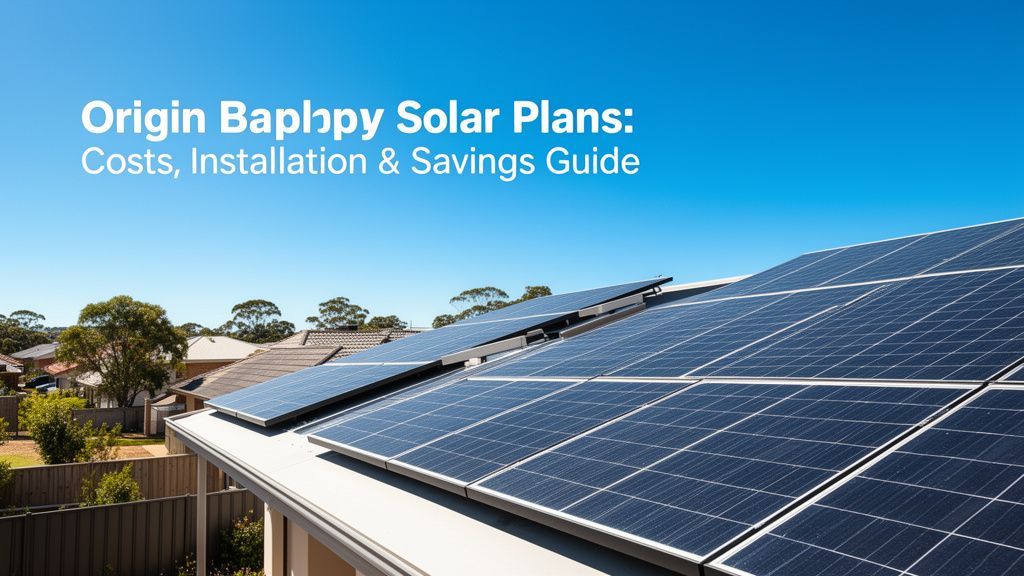
TL;DR: Origin sells and installs solar as a retailer rather than as a specialist installer, which buys you a single point of contact and costs you the ability to compare installers. A 6.6kW system runs $6,000 to $9,000 after STCs. Get two independent quotes before signing, because that is the number Origin's price has to beat.
What solar systems does Origin Energy sell?
Grid-connected systems from 5kW to 10kW and above, with optional battery storage, using panels and inverters from established manufacturers.
The 6.6kW system is the common choice for Australian families, typically 15 to 18 panels at current wattages. It generates enough to cover a large share of daytime consumption and sits under the 5kW inverter limit most distributors allow without additional approval.
Panels come from manufacturers such as Trina and JinkoSolar, with inverters from Fronius or Sungrow. Those are solid mid-to-upper-tier components rather than premium ones, which is appropriate for the price point and worth knowing if you were expecting otherwise.
Installed in Sydney after the STC discount, expect $6,000 to $9,000 depending on components and roof complexity.
What about a battery?
Origin offers integrated battery storage through partnerships with Tesla and Sungrow among others.
A residential battery adds $8,000 to $15,000 before the federal Cheaper Home Batteries discount, which cuts roughly 30% off eligible installed costs at the point of sale.
Whether it earns that back depends almost entirely on how much power you use after dark. Size it to your evening consumption rather than your daily total, and ask Origin for the interval data from your own account before accepting a recommended capacity. They hold it, and it is the number the whole design should be built around.
How does Origin's installation process work?
Consultation, design, paperwork, installation, connection. Origin coordinates the lot, which is the main thing you are buying.
Consultation and design
An assessment of roof space, orientation, shading and your consumption history, followed by a system design specifying panel count, inverter and any storage.
Ask two specific questions at this stage. What is the azimuth of each roof face they intend to use, and what does the shading analysis show across the year rather than on the day of the visit? A quote that cannot answer both has not been designed properly.
Origin handles council approvals where needed and the grid connection application with your distributor. That paperwork is genuinely tedious and having someone else do it has value.
Installation and activation
Installation is carried out by accredited installers in Origin's network, not by Origin employees. That distinction matters: the workmanship is the subcontractor's, and your first call in year four will be to whoever Origin sends.
Ask who the installing company is before you sign, then look them up. A retailer's brand does not tell you anything about the crew on your roof.
After installation the distributor connects the system and Origin handles activation. Check your first bill carefully to confirm export is being credited at the rate your plan specifies.
What are the financial benefits?
Two sources, and they are not equal.
Bill savings and feed-in credits
The larger saving is self-consumption. Every kilowatt-hour you generate and use is a kilowatt-hour you did not buy at 25 to 35 cents.
A 6.6kW system in Queensland might save a household $1,200 to $2,000 a year depending on consumption pattern and tariff. Households home during the day save at the top of that range; households out until six save at the bottom, because more of their generation gets exported instead of used.
Exported surplus earns a feed-in tariff, typically 5c/kWh to 10c/kWh. That is four to six times less than what you avoid by self-consuming, which is why shifting the dishwasher, washing machine and pool pump into daylight hours matters more than the feed-in rate on your plan.
Rebates and payback
Small-scale Technology Certificates reduce the upfront cost automatically, applied by the installer rather than claimed back. On a 6.6kW system that is roughly $3,000 to $4,000 off, depending on the current certificate price and your zone.
That discount steps down each year, so waiting has a running cost.
State rebates apply on top in some jurisdictions, mostly for batteries rather than panels. Ask directly whether your quote includes both federal and state support.
Payback typically runs 3 to 7 years on a solar-only system, against a panel lifespan beyond 20 years. Batteries are slower, usually 7 to 12 years.
Should you buy solar from your energy retailer?
The honest answer is that it depends on what you value.
In favour: one contract, one point of contact, paperwork handled, and a company that will still exist in ten years, which is more than can be said for a fair number of solar installers.
Against: you are not choosing your installer, you are not comparing installer pricing, and retailer-sold systems are frequently not the cheapest available for the same components.
The way to resolve it is straightforward. Get Origin's quote, then two quotes from Clean Energy Council accredited local installers for a comparable system, specifying the same panel and inverter tier. If Origin is within a few hundred dollars, the convenience is worth it. If it is two thousand dollars more, it is not.
Key Takeaways
- Origin sells 5kW to 10kW systems with mid-to-upper-tier components; a 6.6kW system runs $6,000 to $9,000 after STCs.
- Batteries add $8,000 to $15,000 before the federal discount, and should be sized to evening consumption using your own interval data.
- Installation is done by subcontracted accredited installers, so ask which company and look them up before signing.
- Self-consumption saves 25 to 35 cents per kilowatt-hour against a feed-in tariff of 5c/kWh to 10c/kWh, so shifting load into daylight matters more than the export rate.
- Always get two independent quotes for a comparable system. Convenience is worth a few hundred dollars, not a few thousand.
Read More
For a broad overview, check out our master guide: Read the Full Guide Here.