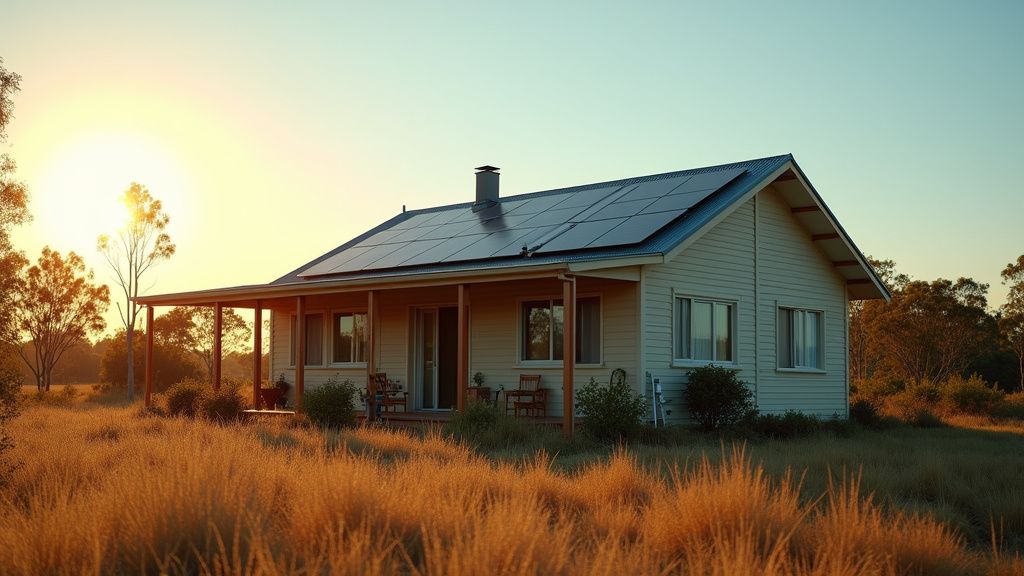
Solar blankets replaced folding hard panels for most touring setups because they weigh less than half as much, pack flatter, and do not shatter when something falls on them in the back of the ute. What they give up is the ability to sit at a decent angle, and that costs more output than most people realise.
This covers how they work, what to look for, and how to get the rated output rather than half of it. If you want specific compact models, start with the Complete Guide to 120W blankets.
Blankets Against the Alternatives
Hard-Frame Folding Panels
Two hinged banks of solar panels in an aluminium frame behind sheet glass. They work, they angle properly on built-in legs, and they are heavy and fragile.
Older units ran over 25kg. Modern ones are lighter and thinner but still fold to a large footprint and still have glass to break. On a fixed campsite they are fine. In a vehicle packed to the roof, they are the thing you stop bringing.
Solar Blankets
Multiple smaller banks of cells, typically arranged 2x5 or 3x4, coated in PET or ETFE rather than glass, stitched into a canvas outer.
The advantages are real: often less than half the weight of a hard panel, much smaller folded, and far more tolerant of being dropped, stood on or jammed behind a seat. Deployment takes seconds.
The disadvantage is angle. A blanket lies flat on a bonnet, a roof rack or the ground, and flat is the wrong angle for most of the day. Cells produce most when facing the sun squarely, and the difference between flat and correctly angled can be a third of your output.
Solar Mats
Three or four banks of cells on a semi-flexible baseboard, same coatings, fewer folds, and often with built-in legs.
That last point is the reason they exist. A mat can be angled like a hard panel while weighing closer to a blanket. They pack bulkier than a blanket and much smaller than a hard frame. If your priority is output per day rather than space in the vehicle, a mat is usually the better buy.
The Regulator Does the Real Work
A blanket produces variable DC that cannot go straight to a battery. The charge controller between them decides whether your battery is charged properly or slowly destroyed.
Look for multi-stage charging, typically five or six stages, with a program that matches your battery chemistry. AGM, gel, wet cell and lithium all want different charge profiles and different absorption voltages.
Lithium is where cheap regulators fail. Many older controllers have no lithium program at all, and running a lithium battery on an AGM profile either undercharges it permanently or holds it at a voltage that shortens its life. If you have a lithium setup, or expect to move to one, confirm the regulator supports it before you buy the kit.
MPPT controllers extract meaningfully more than PWM ones, particularly in weak light and when the panel is cold. On a 200W blanket the difference is worth the price gap.
Getting the Rated Output
Angle is the single biggest lever, and it is the one blankets make hardest.
Aim for 15 to 40 degrees to the ground, tilted toward the sun, and adjust it through the day. That is not a precision exercise; getting roughly right beats lying flat by a wide margin.
Practical ways to do it:
- Drape it over an awning arm, which gives a usable angle with no extra gear.
- Prop the back edge on a camp chair, a jerry can, a length of firewood, or camping poles.
- Use the windscreen or bonnet if you park with the nose toward the sun.
- Bungee cords and rope through the blanket's eyelets will hold almost any improvised angle.
Two other things cost output. Shade on any part of the blanket drags down the whole string, so watch for a shadow creeping across it from a tree or an awning as the sun moves. And heat reduces output, so a blanket lying flat on hot dark bodywork produces less than the same blanket propped up with air moving under it.
Move it two or three times a day and you will see the difference on the regulator display.
What to Check Before Buying
Wattage against your actual load. Work out what you run and for how long. A fridge, lights and device charging is a different proposition to a fridge plus an inverter for a coffee machine. Undersizing is the most common mistake, and it shows up on day three of a trip when the battery has not recovered.
Coating. ETFE over PET where the budget allows. Better light transmission, better UV and heat resistance, and it stays clear rather than yellowing. In Australian conditions that gap widens over a few seasons.
Stitching and canvas. The failure point on cheap blankets is usually the stitching around the cell banks or where the cable exits. Check both before you buy.
The regulator. Multi-stage, correct chemistry support, and ideally MPPT. A good blanket with a poor regulator is a poor kit.
Cables and connectors. Enough cable length to position the blanket where the sun is rather than where the vehicle is. Anderson plugs on decent quality connectors; generic MC4 knock-offs are the most common failure point on budget kits.
Folded size and weight. Check the actual figures against the space you have, not the marketing photo.
Looking After It
Roll rather than fold sharply, because creases break cell interconnects in the same spot every time. Keep the cable clear of pinch points. Wipe it down after dusty or coastal trips, since salt film is corrosive as well as opaque. And test it in the driveway before you leave, which takes thirty seconds and beats finding a fault four hundred kilometres from a hardware store.
Looked after, a decent blanket holds most of its rated output for a decade. Most of the ones that come back underperforming were never faulty, just dirty, badly angled, or losing volts through a corroded plug.
