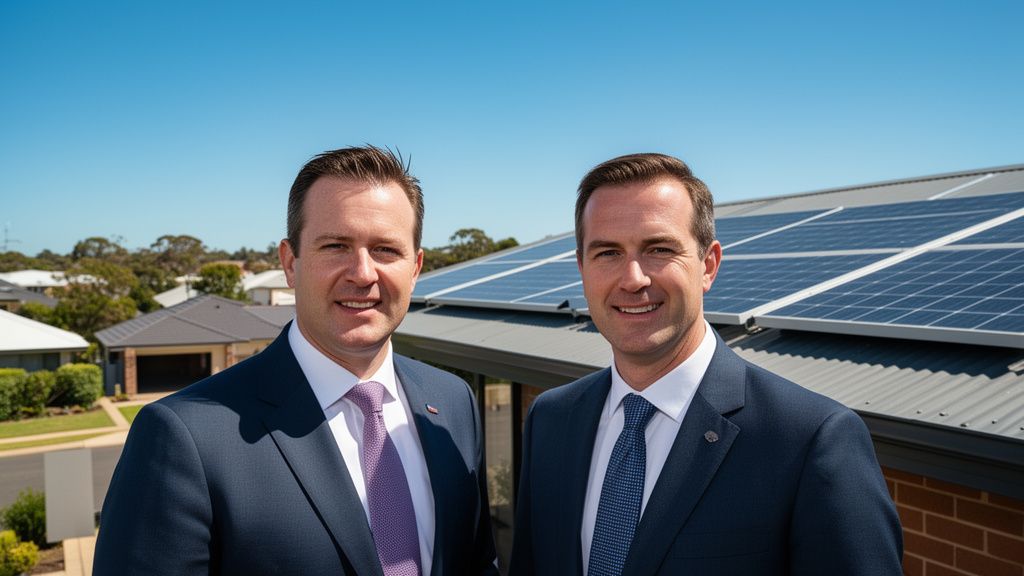
Australian Solar: When Politics Meets Personal Power
G'day, fellow Aussies! If you're anything like us, you've probably felt the pinch of soaring electricity bills and are keen to find smarter ways to power your home. Solar energy has become a beloved fixture across our sunburnt country, with over three million Australian homes now boasting rooftop panels. A big driver behind this incredible uptake is the Small-scale Renewable Energy Scheme (SRES), a government initiative designed to make solar more affordable. Today, we're looking into the cases of Nationals MPs Matt Canavan and Kevin Hogan, who, like many other Australians, have taken advantage of the SRES scheme.
Understanding the SRES Scheme: Your Solar Savings Sidekick
Let's quickly demystify the SRES scheme. It's not a direct cash rebate, but rather a mechanism that creates Small-scale Technology Certificates (STCs). When you install an eligible solar power system (up to 100 kW), you're granted a certain number of STCs, calculated based on your system's size, location, and its deemed electricity generation. Each STC has a monetary value, which fluctuates. Your solar installer typically applies this STC value as an upfront discount on your system's price. For a typical 6.6 kW residential solar system, this could mean roughly 90 to over 100 STCs. With STC values often sitting around $35-$40 each, that's an upfront discount of $3,150 to $4,000 off your installation cost, a significant saving that makes solar accessible. It's a scheme that has helped propel Australia to global leadership in per capita solar adoption.
The Political Lens: Scrutiny and Public Perception
In Australia, public figures, particularly politicians, are often under intense scrutiny regarding their personal finances and any benefits from taxpayer-funded schemes. When a politician who has been critical of renewable energy or government subsidies is revealed to have personally benefited from such a scheme, it inevitably sparks debate. This raises questions about hypocrisy, transparency, and the optics of their actions.
Matt Canavan: A Case of Conflicting Signals?
Senator Matt Canavan, a prominent Nationals figure, is well-known for his strong advocacy for the coal industry and his often-sceptical stance on aggressive climate action and renewable energy targets. He has frequently expressed concerns about the cost and reliability of renewables. Yet, reports have confirmed that Senator Canavan himself installed a solar system on his Queensland property and claimed the associated STC discount under the SRES scheme. For many, this presents a perceived contradiction. While every Australian is entitled to access the SRES scheme, his public position makes his personal choice conspicuous. A substantial solar system, perhaps 6.6 kW or larger, on a home in regional Queensland (Zone 3) could generate approximately 90-100 STCs. At an average STC price of $38, that's an upfront saving of around $3,420 to $3,800. On top of that, ongoing savings on electricity bills could easily be hundreds, if not over a thousand, dollars annually. Financially savvy, his decision still invites questions about consistency between private actions and public statements.
Kevin Hogan: A Quiet Beneficiary
Another Nationals MP, Kevin Hogan, representing the regional NSW electorate of Page, has also reportedly used the SRES scheme for his own property. Hogan's public profile on climate and renewables is generally less vocal and more nuanced than Canavan's, but as a member of a party that often expresses reservations about aggressive climate policies, his participation still warrants mention. Like any Australian homeowner, Hogan's decision to install solar panels is a sensible financial one. A 6.6 kW system in his electorate (Zone 4) would yield around 80-90 STCs. At $38 per STC, that's an upfront discount of roughly $3,040 to $3,420. And of course, the long-term benefit of reduced electricity bills for his family. While less controversial than Canavan's case, it shows that even those within political parties that might hesitate on broader renewable energy policy can see the clear personal and economic advantages of solar power.
Beyond the Headlines: Is it Wrong for MPs to Go Solar?
This brings us to a hard question: Is it wrong for Matt Canavan, Kevin Hogan, or any other MP to use a government scheme like SRES? On one hand, the scheme is open to all eligible Australians. MPs are taxpayers and homeowners too, facing the same rising energy costs as everyone else. To deny them access would be discriminatory. Their use of the scheme could even be seen as an endorsement of its effectiveness. However, the optics are undeniably tricky. When politicians publicly express reservations about the very schemes they then personally benefit from, it can erode public trust. It creates an impression of different rules for different people, or worse, that they do not genuinely believe their own rhetoric. The perceived hypocrisy can overshadow the scheme's positive intent, particularly when public funds are involved. It is not about their individual right to install solar, but about the integrity of their public discourse concerning these policies.
The Australian Homeowner's Unwavering Choice
Ultimately, the political theatre surrounding these cases should not distract from the fundamental truth: installing solar is a smart choice for Australian homes and businesses. It is an investment that pays dividends through lower electricity bills, increased property value, and a reduced carbon footprint. The SRES scheme remains a practical mechanism in making this transition affordable for millions. Whether you are a staunch renewable advocate or a sceptical battler just trying to cut down expenses, the sun shines equally on us all. The benefits of harnessing that sunshine are clear, tangible, and universally appealing.
Get Your Own Slice of Australian Sunshine
So, while the political discussions continue, the real story for Australian families remains the same: solar power offers a path to energy independence and significant savings. If Matt Canavan and Kevin Hogan, despite their political stances, can recognise the financial benefits of the SRES scheme and go solar, perhaps it is an even clearer signal for every other Aussie homeowner. Do not let political debates cloud your judgment on a decision that is genuinely good for your hip pocket and the environment. Explore your solar options today and join the millions of Australians enjoying the power of the sun!
