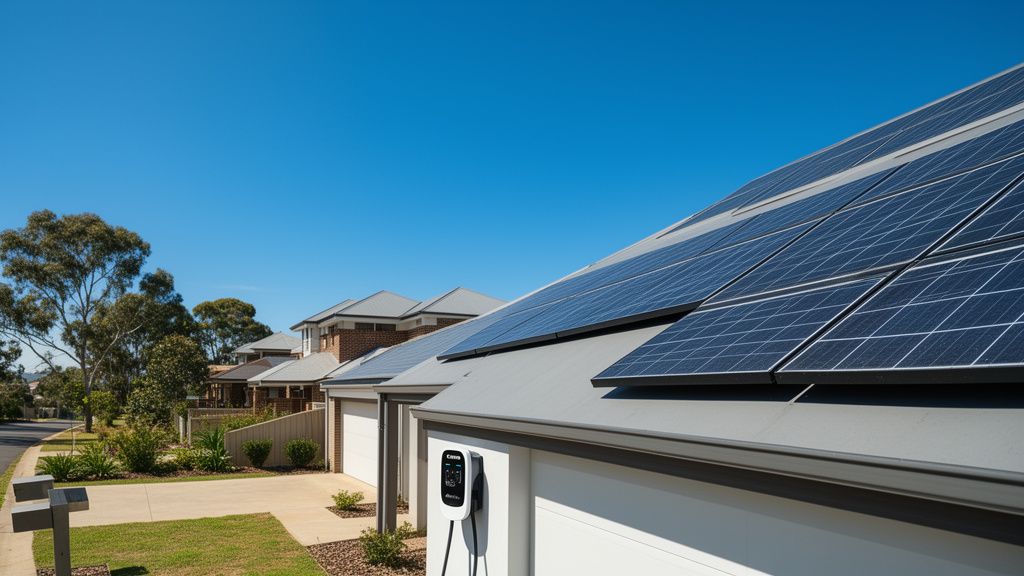
TL;DR: A well-built three-phase charger from a serious electronics manufacturer with real Australian support, available in 11kW and 22kW. It schedules charging but does not follow your solar output in real time, which is the feature most Australian solar households actually want. Good choice if you charge overnight on off-peak; the wrong choice if the point is soaking up your midday surplus.
What You Get
A three-phase AC charger in 11kW or 22kW configurations, with a companion app, DC fault current detection built in, and an optional 4G-equipped Smart variant.
Three-phase matters here. On single-phase supply, which is what most older Australian houses have, you are limited to about 7kW regardless of what the charger is rated for. Check what your switchboard actually has before you shortlist a three-phase unit, because upgrading to three-phase supply is a five-figure job in some streets.
The App
Scan a QR code and you get live charging status, power draw, and session history from your phone.
The useful function is scheduling. Set the charger to start at 10pm and stop at 7am and you charge entirely on off-peak rates, which on a time-of-use tariff is the difference between roughly 14c and 48c per kilowatt-hour. Over a year of commuting that is a substantial number.
You can also dim the LED display, which sounds trivial until you have a charger throwing light across a bedroom window all night.
Safety
Built-in DC fault current detection means the charger handles DC residual current internally rather than requiring an expensive Type B RCD at the switchboard.
That is worth real money at installation time. A Type B RCD can add several hundred dollars to the job, and chargers without integrated detection need one. Factor it in when comparing quotes, because a cheaper charger requiring extra switchboard protection is often not cheaper.
The Smart Variant
The Smart model adds a 4G Micro-SIM slot and RFID card authentication.
The 4G connection means the charger does not depend on your home Wi-Fi. In a detached garage, at the far end of a rural property, or anywhere the signal drops out, that removes the single most common cause of a charger falling off its monitoring platform and missing firmware updates.
RFID authentication matters in strata buildings and shared parking, where you need to control and account for who is drawing power. For a single household with a driveway, it is a feature you will never use.
The Company Behind It
Delta Electronics has been in power electronics since 1971, is headquartered in Taiwan, and builds power supplies, industrial automation and infrastructure hardware at very large scale.
That matters for a device bolted to your wall for a decade. A charger from a company with deep power electronics experience is a different proposition to one from a startup two funding rounds old, and the EV charging market has produced plenty of the latter.
Australian Support
This is the strongest single argument for the Delta.
Delta operates Australian subsidiaries with offices in Sydney and Melbourne, handling sales, technical support and warranty claims locally. There is an Australian website with a knowledge base and an online portal for replacement requests.
The practical difference shows up in year three, when something fails. A local warranty pathway means a replacement unit and a local technician. The alternative, which plenty of imported chargers offer, is an email address in another timezone and a shipping argument.
Ask your installer how many Delta units they have fitted and whether they have processed a warranty claim on one. That answer tells you more than any brochure.
Where It Falls Short
No Solar Load Balancing
This is the significant limitation for an Australian solar household.
The charger cannot see your home's real-time energy flows. It does not know when your solar panels are producing a surplus, and it will not modulate its draw to match. It charges at the rate you set, when you tell it to.
Chargers with solar diversion do something different: they monitor export at the meter and ramp charging up and down to consume only surplus generation, so the car is charged with power that would otherwise have been exported at 5c to 8c per kilowatt-hour.
The gap between that and buying grid power is the whole economic case for charging an EV at home on solar. Scheduling charging for the middle of the day approximates it, badly, because your generation varies with cloud cover and your household load varies with what everyone is doing.
You can close the gap with a third-party energy meter or a home energy management system. That is extra hardware, extra cost, and another integration to go wrong. If solar-aware charging is the reason you are buying a charger, look at units that do it natively.
Price
Mid-to-high for an AC charger in the Australian market.
Some of that is justified by build quality and the local support network, both of which are real. But by the time you add the 4G Smart variant and the external hardware for solar integration, the total sits well above chargers that include solar diversion out of the box.
Ingress Protection
The IP rating is adequate for a sheltered installation and lower than the IP65 some competitors offer.
If the charger is going on an exposed external wall facing coastal weather or western sun, that difference will show up over a decade. Under a carport or inside a garage it is irrelevant.
Who Should Buy It
Buy the Delta if you have three-phase supply, you charge overnight on an off-peak tariff, and you value a manufacturer with genuine local warranty support. The Smart variant is the right pick where Wi-Fi is unreliable or the charger is shared.
Look elsewhere if your main reason for a home charger is consuming your own solar surplus. That is a specific capability, this unit does not have it, and adding it afterwards costs more than choosing a charger that already does.
Key Takeaways
- Three-phase AC charger in 11kW and 22kW, well built, from a manufacturer with fifty years in power electronics.
- Integrated DC fault current detection avoids a separate Type B RCD, which is a real saving at installation.
- Australian offices in Sydney and Melbourne mean local warranty and support, which is the strongest reason to choose it.
- No native solar load balancing. It schedules charging but cannot follow your surplus in real time.
- Check you have three-phase supply before shortlisting it, and check the IP rating against where it will actually be mounted.
