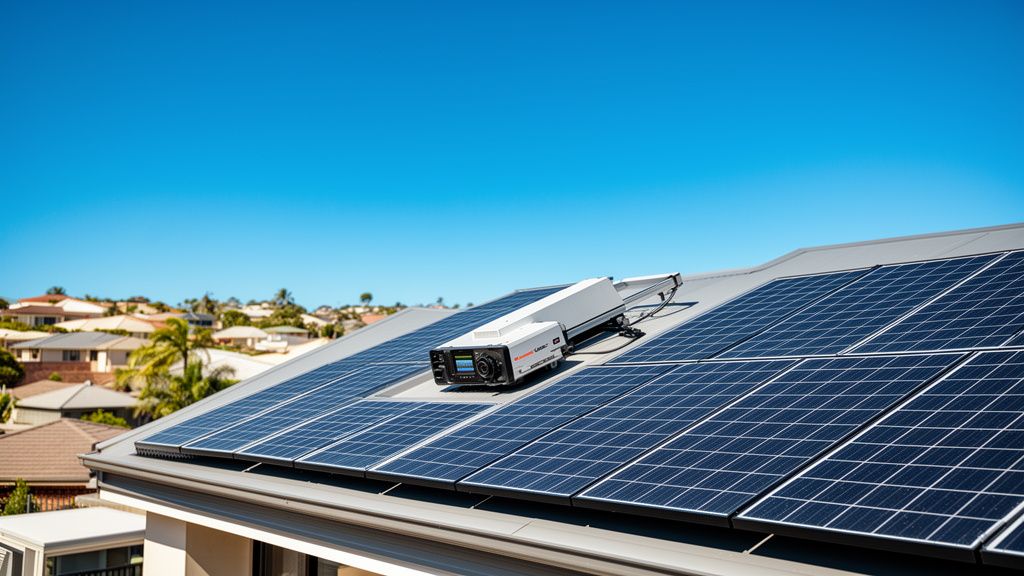
TL;DR: An isolation device is a red switch near your battery that cuts it out of the system entirely. It is mandatory under AS/NZS 5139:2019, costs $50 to $150, and is what makes the battery safe to work on or shut down in an emergency. Check yours exists.
What is a Solar Battery Isolation Device and Why Is It Essential for Australian Homes?
An isolation device, also called a battery isolator or disconnect switch, manually cuts the battery out of the rest of the electrical system. It is a prominent, clearly labelled switch, usually red, mounted close to the battery.
It exists because a battery is not like the rest of your solar. Shut down the inverter and the panels stop feeding the house, but the battery is still full and still live. Without an isolator, battery storage remains an energised hazard no matter what else is switched off.
Protecting Technicians During Maintenance
Anyone servicing your battery uses the isolator to make the job safe. With the battery disconnected there is no current to arc, which removes the electrocution and arc flash risk. Without one, a technician is working on a live DC system, and DC does not stop at dusk or under cloud the way people assume.
Ensuring Homeowner Safety in Emergencies
In a house fire, first responders cut the power. A battery with no isolator stays energised and complicates that considerably. In a flood, being able to shut the battery down before water reaches it prevents short circuits and further damage. Both are situations where you want a switch you can reach in the dark.
What Australian Standards and Regulations Mandate the Inclusion of Isolation Devices?
AS/NZS 5139:2019, "Electrical installations - Safety of battery energy storage systems (BESS) for use with power conversion equipment", is the governing standard. It requires readily accessible, clearly marked DC isolators on all battery systems. Any accredited Australian installer works to it as a matter of course.
Compliance with AS/NZS 5139:2019
The standard sets the type, the location and the labelling. A DC isolator must sit in an accessible spot near the battery, be clearly identified, and be capable of safely disconnecting the battery's stored energy.
It exists because high-voltage DC behaves differently to household AC. AC crosses zero volts a hundred times a second, which helps a switch break the arc. DC does not, so a DC isolator has to be built specifically for the job. An AC switch in that position is a fire waiting to happen.
Why Ignorance Isn't an Excuse for Installers
Applying AS/NZS 5139:2019 is a licence condition, not a preference. An installer who omits the isolator is in breach of regulation and has left a hazard in your house.
Use a Clean Energy Council (CEC) accredited installer, and expect them to show you the device and demonstrate it during handover.
How Does an Isolation Device Affect Solar Battery System Performance or Cost?
Neither, meaningfully. An isolator is a low-resistance switch: closed, it passes current with negligible loss.
The device costs $50 to $150 against a battery system of $8,000 to $15,000 for a typical household. It is a rounding error on the quote.
Minimal Impact on System Efficiency
Closed, it passes current. It does not reduce output, slow charging, or throttle discharge. Modern isolators are built to standards that keep them from becoming a bottleneck.
The Small Investment for Big Safety Returns
Any reputable installer includes it as standard, because it is a compliance requirement rather than an upsell. A quote that has left it out has left out something mandatory, which tells you what else might be missing.
How Can You Verify Your Solar Battery Installation Includes a Proper Isolation Device?
Go and look. You want a clearly identifiable switch, usually red or with a red handle, mounted near the battery, labelled "Battery Isolator", "DC Isolator" or similar. One position connects, the other disconnects.
Asking Your Installer and Checking Documentation
Ask where it is, how it works, and have them operate it in front of you during commissioning.
Then check the paperwork. Your handover pack should include a system diagram showing the isolator, and an electrical certificate of compliance, a Certificate of Electrical Safety in Victoria or the equivalent in your state. That certificate is the legal confirmation the install meets the standard.
What to Look For and How to Ensure Compliance
Accessibility is the part people miss. In an emergency you or a firefighter need to reach it fast, without moving panels or finding a tool. Labelling should be readable in poor light.
If something looks wrong, get a second opinion from another CEC-accredited electrician, or check the Clean Energy Council battery installation guidelines.
Key Takeaways
- An isolation device is mandatory on every Australian solar battery system and cuts the battery out manually.
- It is what makes the battery safe to service, and what lets you or emergency services shut it down.
- AS/NZS 5139:2019 requires an accessible, clearly labelled DC isolator. DC needs a purpose-built switch because it does not self-extinguish an arc the way AC does.
- Cost is $50 to $150 with no measurable effect on performance.
- Verify it visually, check it appears on your system diagram and compliance certificate, and make sure you can reach it in a hurry.