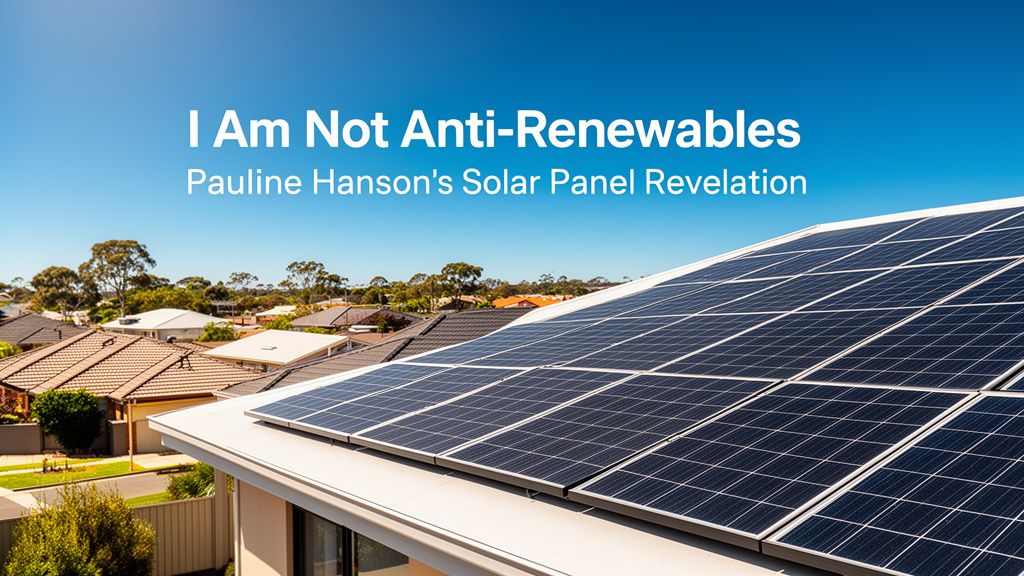
Pauline Hanson has been reported as saying she is not anti-renewables, that she has solar panels on her own home, and that she gets money back on her power bill.
Whatever you make of the politics, the reasoning behind that position is the same reasoning that has put solar on more than three million Australian roofs. It is not an environmental argument. It is a bill.
Why the Politics Stopped Mattering
Rooftop solar in Australia crossed a threshold some years ago: it became cheaper than not having it.
Once a technology pays for itself in under a decade and then produces free electricity for fifteen more, the question of who supports it politically becomes largely irrelevant to the purchase decision. People install it because the arithmetic works.
That is why solar uptake maps poorly onto voting patterns. Queensland and South Australia, hardly ideologically uniform, have among the highest per-capita rooftop solar penetration in the world. Regional electorates frequently out-install inner-city ones, partly because they have the roof space and partly because they pay the highest bills.
The Arithmetic Behind It
An Australian household can face quarterly bills of $400 to $600 or more, and considerably more than that in a hot summer or a cold Victorian winter.
A 6.6kW system costs roughly $5,000 to $10,000 installed after Small-scale Technology Certificates, which are applied by your installer as a discount rather than claimed back afterwards.
Against a typical bill, that system saves $1,000 to $2,000 a year depending on how much of the generation you actually use yourself, which puts payback somewhere between three and seven years. The panels then keep producing for another fifteen to twenty.
The Number That Decides Where You Land
Self-consumption, not generation.
Every kilowatt-hour you generate and use avoids paying 25 to 35 cents for grid power. Every kilowatt-hour you export earns a feed-in tariff of 5 to 10 cents. That is a four to sixfold difference for the same electricity.
A household with someone home during the day lands at the top of the savings range because it consumes its own generation as it happens. A household out until six exports most of the midday peak and buys back expensive power in the evening, landing at the bottom.
This is the single most useful thing to understand before buying, and it is what determines whether your payback is four years or eight. Moving the dishwasher, washing machine and pool pump into daylight hours costs nothing and moves that number more than any component choice.
What Else You Get
Some insulation from price rises. Retail electricity prices have moved one direction for a long time. A system fixes part of your consumption at today's cost.
Property value. Homes with solar attract more interest and generally sell for more, though the premium varies and a poorly installed system on an ageing inverter can be a liability rather than an asset.
Lower peak demand. Distributed rooftop generation reduces strain on the network at the hours it is most stressed, which benefits people who do not have solar as well.
Very little maintenance. Panels are built to sit on a roof for twenty-five years. The inverter is the component that will need replacing first, usually somewhere between year eight and year fifteen, and that is the cost people forget to budget for.
Blackout resilience, but only with a battery. Solar alone shuts down when the grid fails, by law. Battery storage with a properly wired essential-loads circuit is what keeps the lights on, and that is a separate and larger purchase.
What to Do About It
The economics are strong and they are not uniform, so do the work rather than taking a national average.
Get three quotes from Clean Energy Council accredited installers, specifying the same panel and inverter tier so you are comparing like with like. Prices for identical systems routinely differ by two thousand dollars.
Ask about your roof specifically. The azimuth of each usable face and a shading analysis across the year, not on the day of the visit.
Look at your own consumption pattern. Your retailer holds interval data showing when you actually use power. That determines system size and whether east-west beats north on your house.
Treat rebates as time-limited. Federal certificate values step down annually and state schemes close when funding caps are hit.
Solar is not confined to residential rooftops either. Commercial solar follows the same logic on a larger scale, and businesses with heavy daytime consumption often see faster payback than households do, because they use nearly all of what they generate.
The Point
A political figure not associated with environmental advocacy saying they have solar because it lowers their bill is not a contradiction. It is what a mature technology looks like.
The interesting question is no longer whether solar is worth having. It is whether it is worth having on your particular roof, with your particular consumption pattern, at the price you have been quoted. Those are answerable questions and the answers are specific to you.
