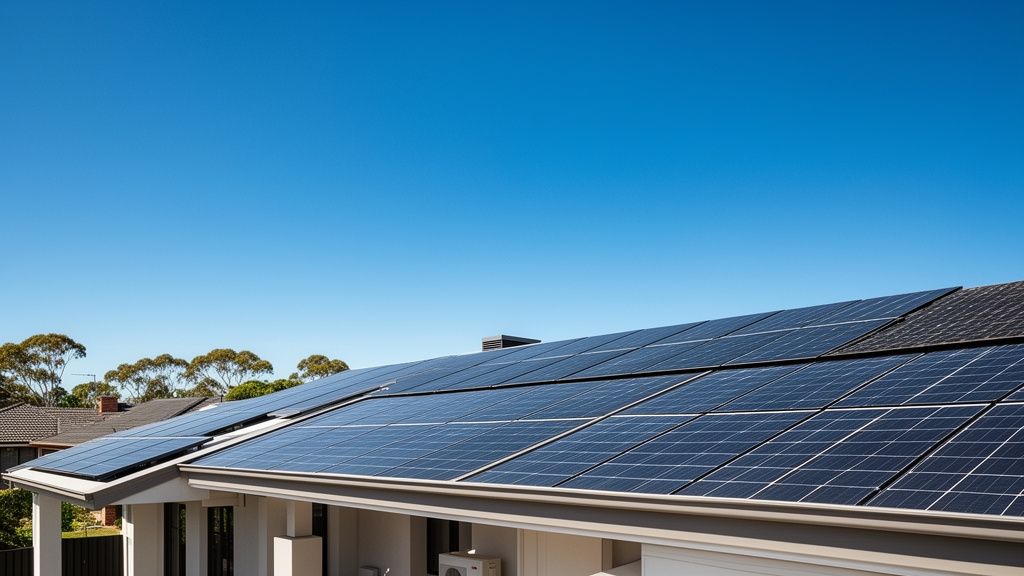
TL;DR: Three things decide whether a GoodWe ESA install performs: panels wired in series to land the string voltage where the inverter wants it, bypass switches placed so the system can be isolated safely, and the unit mounted close to the main switchboard to keep voltage drop and cable costs down. Get those right and the Solar Battery does what you paid for.
What is a GoodWe ESA System and Why is Its Installation So Critical?
A GoodWe ESA pairs a hybrid inverter with battery storage, so surplus generation is held for the evening instead of exported for a few cents. That is more moving parts than a grid-tie setup: the unit juggles power from the solar panels, the battery, the grid and the house at once, and every connection and placement decision affects how well it does that. A system in this class runs $12,000 to $20,000 for a 10kW hybrid inverter and 10kWh battery, which is enough money that the install quality matters as much as the hardware.
Understanding the Key Components of a GoodWe ESA
The hybrid inverter sits at the centre, managing DC from the solar panels and the battery and converting it to AC for the house. Around it: a lithium-ion battery bank, a smart meter reading the energy flows, AC and DC isolators, and often an energy management layer on top. A typical build pairs a GoodWe ET Plus series hybrid inverter with a GoodWe Lynx Home F battery.
The Undeniable Importance of Professional Solar Installation
This is not DIY territory. An accredited electrician who works with battery storage knows the wiring diagrams, the sizing rules and the safety requirements in AS/NZS 5033 for PV arrays and AS/NZS 5139 for battery installations. An amateur install voids warranties, creates a fire risk, and can attract penalties for non-compliance. Use a Clean Energy Council (CEC) accredited installer, which is also what qualifies the job for rebates.
How Does Series Connection Impact GoodWe ESA System Performance?
Wiring panels in series adds their voltages together, and GoodWe hybrid inverters are built for that: the MPPT range typically runs 80V to 850V DC. Series strings put the array voltage inside that window, which is where the inverter converts most efficiently. It also helps in weak light and partial shade, because a higher DC voltage carries through losses that would drop a low-voltage string below the tracker's start-up threshold.
Advantages of Series Wiring for Voltage Matching
Higher string voltage means lower current for the same power, and current is what costs you. Resistive losses rise with the square of the current, so halving it cuts those losses to a quarter. Less energy burnt as heat between roof and inverter, and thinner cable will do the job, provided it is rated for the voltage.
Critical Considerations for Panel String Sizing
String length is set by three inverter limits: maximum DC input voltage, minimum MPPT voltage, and maximum input current per tracker. Temperature moves panel voltage in both directions, up when it is cold and down when it is hot, and Australian conditions cover a wide range of both. The string has to stay inside the inverter's limits at the coldest morning of the year and still make start-up voltage on the hottest afternoon. Get it wrong on the cold side and the over-voltage damages the inverter, which is a repair running into thousands.
Why are Bypass Switches Essential for GoodWe ESA Installations?
Bypass switches give you a way to make the system safe to touch. Panels generate whenever there is light and a battery holds charge whether or not the grid is up, so without isolation points there is no safe state to work in. AS/NZS 5033 and AS/NZS 5139 set out where these isolators go and what they must do, both for servicing and for emergency shutdown.
Prioritising Safety and Isolation Requirements
DC from solar panels will kill you, and it does not stop at dusk or under cloud. A battery bank holds its energy regardless. Compliant isolation means DC isolators for the array and the battery, and an AC isolator between the inverter and the main switchboard, so nothing can be re-energised while someone has their hands in it.
Types of Isolation and Their Strategic Placement
Each panel string needs a DC isolator near the array on the roof and another beside the inverter. The battery bank needs its own. An AC isolator goes on the inverter's output so it can be cut from the switchboard. Every one has to be labelled, reachable without tools, and rated for the voltage and current it will actually see. An isolator nobody can find in an emergency is not an isolator.
Why is the GoodWe ESA's Proximity to the Main Switchboard Critical?
Distance costs you twice: in voltage drop and in cable. Every metre of AC cable between the inverter and the main switchboard adds resistance, and resistance turns generation into heat instead of power in your house. AS/NZS 3000 caps how much drop is allowed, so a long run also risks failing inspection.
Minimising Voltage Drop and Power Losses
A long run of thin cable can lose 2-3% of everything the system makes, every day, for the life of the install. Over 25 years that compounds into hundreds or thousands of dollars of generation you paid for and never received. Keeping the inverter within 5-10 metres of the switchboard removes the problem rather than engineering around it.
Impact on Installation Costs and Regulatory Compliance
Distance also shows up on the quote. Longer runs need thicker copper to stay inside the drop limit, plus the labour to pull and secure it, which adds hundreds to thousands of dollars. Miss the AS/NZS 3000 limits and the install does not pass inspection, which means rectification work and a delay before you can connect and start saving anything.
Key Takeaways
- Series wiring puts string voltage inside the inverter's MPPT window, which is where it converts most efficiently and copes best with shade.
- String length must hold inside the inverter's limits across the full temperature range, or a cold morning takes out the inverter.
- Bypass switches are what make the system safe to work on, and AS/NZS 5033 and 5139 dictate where they go.
- Mounting close to the main switchboard cuts voltage drop, cable cost and compliance risk in one decision.
- Use a CEC-accredited installer. It is what keeps the warranty, the compliance and the rebate eligibility intact.