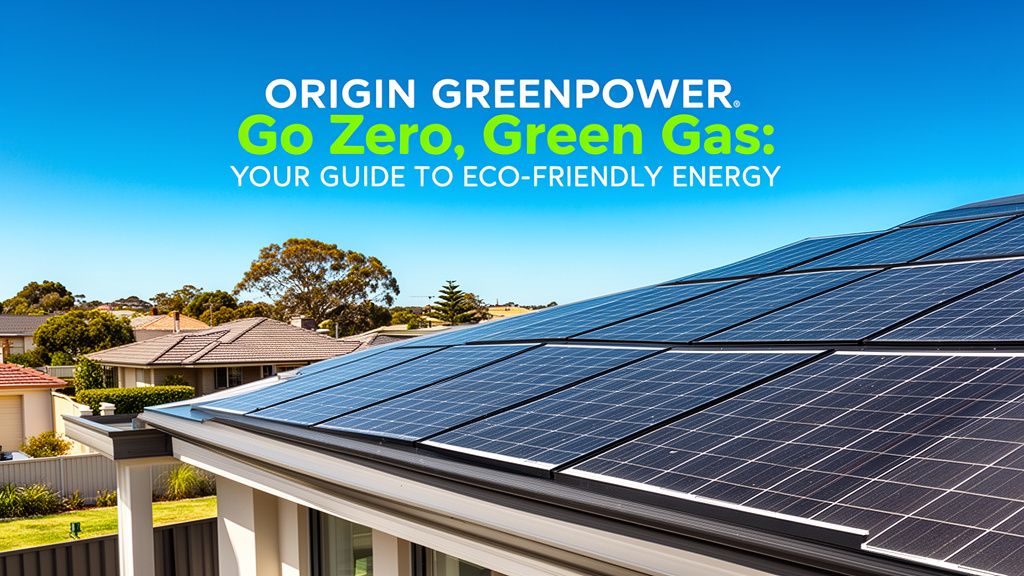
TL;DR: Three different products doing three different things. GreenPower funds new renewable generation matched to your usage. Go Zero buys carbon offsets against your electricity emissions. Green Gas does the same for gas. GreenPower is the one with government accreditation behind it, and it costs the most.
GreenPower: Funding New Renewable Generation
GreenPower is a government-accredited scheme, not an Origin product. Origin sells access to it, as do most retailers.
When you buy GreenPower, your retailer purchases renewable generation certificates on your behalf, and an equivalent amount of accredited renewable electricity is added to the grid. The accreditation is what distinguishes it: the generation has to be new and additional, not existing capacity resold.
Origin sells it in blocks. A common structure is 50kWh blocks at $1.50 each, which works out at 3c/kWh on the matched portion.
For a Sydney household using 6,000 kWh a year, matching 100% of consumption adds roughly $180 to the annual bill.
How It Differs From Having Solar
Rooftop solar generates electricity at your house. It cuts your imports directly, exports the surplus for a feed-in credit, and reduces your bill.
GreenPower generates nothing at your property. It is a financial mechanism that funds large-scale renewable generation elsewhere, and it increases your bill rather than reducing it.
That is not a criticism, it is the point. Solar gives you cheaper power and lower emissions from your own consumption. GreenPower funds additional capacity on the grid that would not otherwise be built.
Plenty of households with solar panels buy GreenPower for the grid power they still import, which gets them to 100% renewable across the whole household.
Whether It Is Worth It
The honest case for GreenPower is that the accreditation is real and the additionality requirement means your money funds new capacity rather than relabelling existing generation.
The honest case against is that at 3c/kWh on top of your usage rate, the same money spent on load shifting, insulation, or the deposit on a battery reduces emissions and reduces your bill at the same time.
If you have already done the cheaper things, GreenPower is a reasonable next step. If you have not, it is an expensive first one.
Go Zero: Offsetting Electricity Emissions
Go Zero is different. It does not touch what generates your electricity; it buys carbon credits to offset the emissions your consumption produced.
Origin charges around $1.50 a week for electricity, calculates the average emissions from your consumption, and purchases offsets from projects such as reforestation, land management, or renewable development overseas.
The result is a net-zero claim on your electricity, achieved by balancing rather than by changing the source.
Go Zero Against GreenPower
The distinction matters and the marketing blurs it.
GreenPower changes the supply side: more renewable generation exists because you paid for it. Go Zero changes nothing about supply and neutralises the emissions on paper through offsets bought elsewhere.
Offsets vary enormously in quality. Some projects deliver verified, permanent, additional carbon reduction. Others have been criticised for counting reductions that would have happened anyway, or for permanence that a bushfire can undo. If offset quality matters to you, ask which projects Origin is buying from and what standard certifies them.
Go Zero is cheaper than GreenPower for the same household, and that price difference reflects a genuine difference in what you are buying.
Green Gas: Offsetting Gas Emissions
The same offsetting mechanism applied to natural gas, at around $1.50 a week.
Gas is a fossil fuel and burning it releases emissions that no accreditation scheme can make renewable, so offsetting is the only mechanism available short of not using gas. Origin buys carbon credits against the average emissions of your gas consumption.
The same caveats about offset quality apply, and more strongly, because there is no supply-side alternative to compare against.
The Alternative Worth Considering
Before signing up for Green Gas indefinitely, it is worth pricing the electric alternatives.
A heat pump hot water system, an induction cooktop and a reverse-cycle system running on solar generation remove the gas emissions rather than offsetting them, and remove the gas daily supply charge as well. On a household with a decent array, that often costs less over a decade than paying to offset gas you keep burning.
Green Gas makes sense as an interim measure while you still have gas appliances with life left in them. It is a poor permanent answer.
Combining Them
A household with solar might buy GreenPower for residual grid imports and Green Gas for whatever gas remains. A household without solar might take GreenPower and Go Zero together, funding new generation and offsetting what remains.
The order that actually reduces emissions per dollar: cut consumption first, then generate your own, then electrify what runs on gas, then buy accredited GreenPower for what is left, then offset the remainder.
Starting at the offset end is easier and does the least.
Key Takeaways
- GreenPower is government-accredited and funds new renewable generation matched to your usage, at roughly 3c/kWh or $1.50 per 50kWh block.
- Matching 100% of a 6,000 kWh household adds around $180 a year.
- Go Zero and Green Gas buy carbon offsets rather than changing what generates your power, at about $1.50 a week each.
- Offset quality varies. Ask which projects and which certification standard before buying on that basis.
- Do the cheaper things first: reduce consumption, install solar, electrify gas appliances, then buy GreenPower for the remainder.
Read More
For a complete overview, check out our master guide: Read the Full Guide Here.