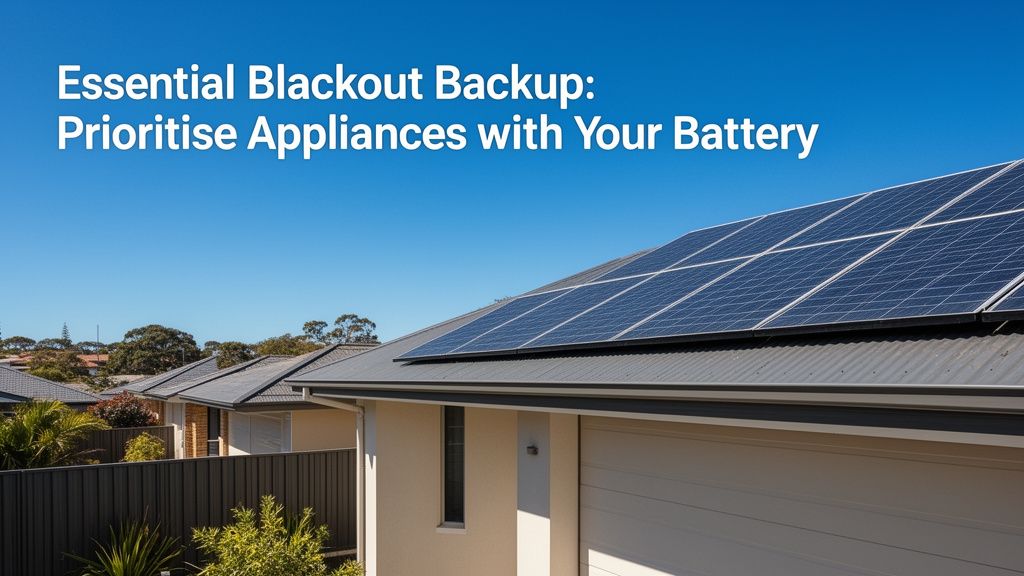
TL;DR: When planning for blackouts with a solar battery, prioritise critical loads like refrigeration, lighting, communication devices, and essential medical equipment. High-power appliances should generally be avoided to maximise battery duration, focusing instead on maintaining core household functions during grid outages.
What are the Absolute Must-Have Appliances to Back Up During a Blackout?
The absolute must-have appliances for battery backup during a blackout primarily revolve around safety, food preservation, and communication. When the grid goes down, your solar battery becomes your lifeline, and intelligently choosing what to power ensures you get the most out of its stored energy. First and foremost, keeping your fridge and freezer running is critical to prevent spoilage of hundreds of dollars worth of groceries. Beyond that, essential lighting for navigating your home safely after dark, and the ability to charge communication devices like phones and laptops, are essential for staying informed and connected during an emergency. For households with specific needs, powering essential medical equipment, such as CPAP machines or nebulisers, moves to the top of the priority list, as these can be non-negotiable for health and wellbeing. These core appliances typically draw moderate power, making them ideal candidates for backup, allowing your battery to sustain them for extended periods compared to high-drain items.
Keeping Your Fridge and Freezer Running
Preventing food spoilage is often the highest priority for many Australian households during a blackout. A standard fridge-freezer unit typically cycles on and off, drawing between 100-200 watts when running, and consuming around 1-2 kilowatt-hours (kWh) over a 24-hour period. Prioritising this appliance ensures your food remains safe and edible, saving you the cost and inconvenience of restocking. To maximise efficiency, keep the doors closed as much as possible and consider placing an esky with ice or frozen water bottles inside if a prolonged outage is expected. A dedicated circuit for your fridge and freezer ensures they are the first things to come back online with battery power.
Essential Lighting and Communication Devices
Maintaining basic visibility and connectivity is important for comfort and safety during an outage. Modern LED lighting is incredibly efficient, with a typical globe drawing only 5-15 watts. A few strategically placed LED lights can illuminate key areas without significantly impacting battery life. Similarly, charging your mobile phone, laptop, or tablet uses relatively little power (10-60 watts for a charger). Being able to communicate with family, access emergency information, or simply distract the kids with a fully charged device provides immense peace of mind. Investing in a power board with surge protection for your essential charging hub is a sensible addition to your blackout kit.
How Does Appliance Power Consumption Affect Your Battery's Runtime?
Appliance power consumption directly dictates your battery's runtime by draining its stored energy faster or slower, depending on the wattage drawn. Understanding the relationship between your appliances' power needs (measured in Watts) and your battery's capacity (measured in kilowatt-hours, or kWh) is fundamental to effective blackout planning. A battery with a 10 kWh capacity, for instance, can theoretically provide 10,000 Watts of power for one hour, or 100 Watts for 100 hours. The more Watts your selected appliances draw simultaneously, the quicker your battery will be depleted. Australian solar battery systems typically range from 5 kWh to 20 kWh, with costs for a 10 kWh installed system often sitting between $10,000 and $15,000, varying by brand and installation complexity. Your goal is to match your critical load requirements with a battery system that offers sufficient capacity to last through typical outage durations in your area.
Understanding Watts, Kilowatt-Hours, and Battery Capacity
To effectively manage your battery, it is important to grasp the basics: Watts (W) measure the instantaneous power an appliance uses, while kilowatt-hours (kWh) measure the total energy consumed over time. Your solar battery's capacity is rated in kWh, for example, a 10 kWh battery can supply 10,000 Wh. If you run an appliance that draws 500W, it will consume 0.5 kWh every hour (500W / 1000 = 0.5 kW; 0.5 kW x 1 hour = 0.5 kWh). By summing the wattage of all essential appliances you plan to run, you can estimate your total hourly consumption and then divide your battery's capacity by this sum to get a rough idea of its runtime.
Estimating Your Battery Needs for Different Blackout Scenarios
Accurately estimating your battery needs involves a simple audit of your essential loads and a realistic assessment of potential blackout durations. Start by listing all appliances you deem critical (fridge, lights, phone chargers, medical devices) and find their wattage ratings (often on a label or in the manual). Sum these wattages to get your total critical load in Watts. Then, multiply this total by the number of hours you wish to have backup for, a common target is 24-48 hours. For instance, if your essential loads total 300W, and you want 24 hours of backup, you will need at least 7.2 kWh (300W x 24h = 7200 Wh = 7.2 kWh) of usable battery capacity. Always factor in a buffer for efficiency losses and unexpected usage.
Should High-Power Appliances Be Excluded from Your Blackout Backup Plan?
High-power appliances, such as electric ovens, air conditioners, and kettles, should generally be excluded from typical blackout backup plans to preserve battery life for essential functions. These appliances draw significant amounts of power, often measured in thousands of watts, which can deplete a standard home battery in a matter of minutes or a few hours. For example, a single electric kettle can pull 2,000-3,000 watts, while a reverse cycle air conditioner might demand 2,000-5,000 watts. Including such items would necessitate a much larger, and significantly more expensive, battery system, often making it impractical for the average Australian household's budget and typical outage frequency. It is far more strategic to rely on alternatives like gas barbecues or cool boxes for cooking and food preservation, and to manage comfort through passive means like opening windows or using blankets, rather than attempting to power energy-intensive devices.
The Rapid Drain of Heating and Cooling
Appliances that generate heat or drive compressors, like electric ovens, cooktops, dishwashers, clothes dryers, and air conditioners, are notoriously power-hungry. Running a single electric oven for an hour can easily consume 2-3 kWh, which is a significant chunk out of a 10 kWh battery. Attempting to power an air conditioner or electric heater during a heatwave or cold snap would deplete most home batteries in under an hour or two, leaving nothing for your fridge or lights. Prioritising these items usually results in a very short, ineffective blackout backup and a much higher upfront investment in battery storage.
Balancing Comfort with Practicality and Cost
While it might be tempting to power all your creature comforts, a realistic blackout plan involves a trade-off between desired comfort and the practical limitations of battery capacity and cost. Investing in a battery system large enough to power high-demand appliances for any meaningful duration can easily push the total cost into the $20,000 - $30,000 range or even higher. For most Australian homes, this expenditure is better allocated to ensuring basic necessities are covered for an extended period, relying on temporary, non-electric solutions for high-drain tasks. Consider if an expensive battery to run an AC for a few hours is a better investment than alternative solutions like portable fans or smart home design for passive cooling.
Key Takeaways
- Prioritise critical appliances like fridges, essential lighting, and communication chargers to maximise battery life during blackouts.
- Understand appliance wattage (W) and your battery's capacity (kWh) to estimate how long your essential loads can run.
- Exclude high-power appliances (ovens, air conditioners) from backup plans to prevent rapid battery depletion and manage costs.
- Conduct an appliance audit to calculate your specific essential power needs and size your battery accordingly for typical outage durations.
- Focus on strategic energy management and non-electric alternatives for high-drain tasks during a grid outage.
