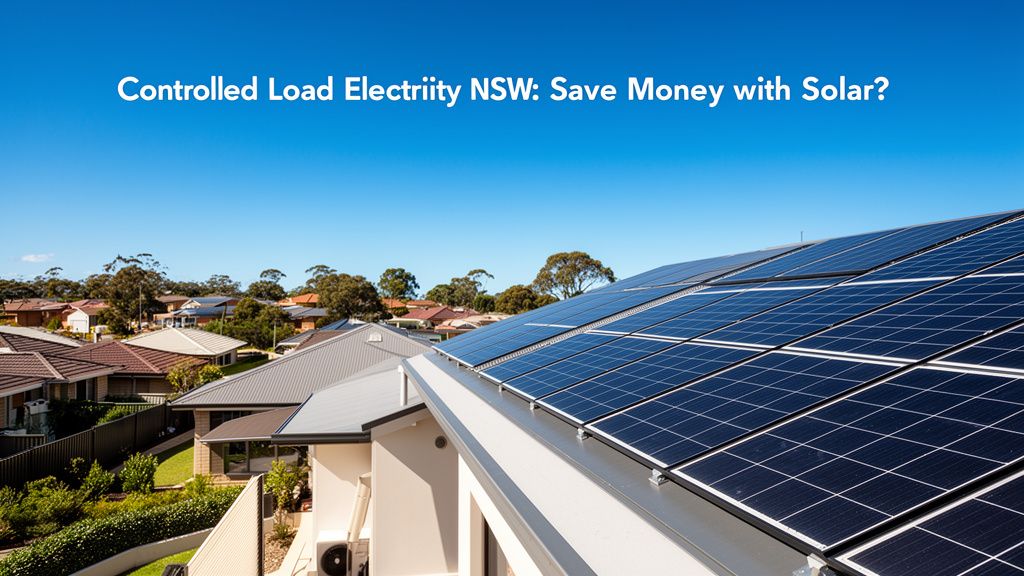
TL;DR: Controlled load gives you a cheap rate on hot water and similar heavy appliances, and for a house without solar it is close to a free win. With solar it gets more interesting, because your own generation costs nothing at all and heating water at midday can beat any overnight tariff.
What is Controlled Load Electricity and How Does it Work in NSW?
Controlled load is a separate circuit for large appliances that do not need power on demand, metered on its own and charged at a discounted rate. Your distributor, Ausgrid, Endeavour Energy or Essential Energy depending on where you live, switches that circuit on and off remotely, usually overnight when demand is low. You get a cheaper rate; they get to move a chunk of load away from the evening peak.
How to Identify Your Controlled Load
Check your bill. It appears as its own line, labelled Controlled Load 1 or Controlled Load 2, and there will be a separate meter or a distinct section in the meter box. Controlled Load 1 usually runs a standard electric storage hot water system for 8-12 hours overnight. Controlled Load 2 covers things like underfloor heating, at a cheaper rate again but with a shorter window, often 4-6 hours. Know which you have, because it sets when your appliance can actually run.
How Do Controlled Load Tariffs Compare to General Usage in NSW?
The gap is large. General usage runs around 28-35 cents per kilowatt-hour (c/kWh), while controlled load can be as low as 12-18 c/kWh. That is the whole appeal: the same hot water for roughly half the price. Rates vary by retailer and plan, so compare before assuming yours is competitive.
Typical Controlled Load Rates vs. General Supply
On a typical NSW bill, peak general supply runs upwards of 30 c/kWh and off-peak general around 20-25 c/kWh. Controlled Load 1 might be 14 c/kWh, and Controlled Load 2 as low as 10-12 c/kWh. Put that against a 250-litre electric hot water system using 5-10 kWh a day and the difference is real money over a year.
Can Controlled Load Truly Save You Money with Solar in NSW?
With no solar, controlled load almost always wins. Once you have solar panels it competes against something cheaper still: your own generation, which costs you nothing. If your array is producing a surplus at midday, heating the water then beats waiting for a 14 c/kWh window at 1 am, because free beats cheap.
The Solar vs. Controlled Load Dilemma
The conflict is one of timing. Controlled load runs when the sun is down. If your feed-in tariff is 5-8 c/kWh and your controlled load rate is 14 c/kWh, exporting surplus power overnight and buying it back is a losing trade twice over. A hot water diverter fixes this: it dumps excess solar into the tank during the day, and the controlled load circuit simply never fires.
When Controlled Load Makes Sense with Solar
It still earns its place when you do not have surplus to spare. A smaller array, or high daytime consumption that soaks up everything you generate, means the hot water will be heated from the grid regardless. Paying 14 c/kWh instead of 30 c/kWh for that is worth having. Same for a large tank or heavy heating demand that a day's surplus could not cover anyway.
What Appliances Are Best Suited for Controlled Load in NSW?
The right candidate uses a lot of power, stores what it makes, and does not care when it runs. Electric storage hot water is the textbook case: heat a tank overnight and the water is still hot at dinner time the next day. That is exactly the demand-shifting the tariff exists to reward.
Common Controlled Load Appliances
Beyond hot water, slab heating works well because the concrete holds the heat, and some pool pumps suit it, though most have their own timers. For the majority of homes hot water is the only thing on the circuit. Air conditioners, ovens and fridges are all wrong for it, because they need power at unpredictable times. Have an electrician confirm both the appliance and your wiring before committing.
Key Takeaways
- Controlled load runs heavy appliances at roughly half the general supply rate, typically 12-18 c/kWh against 28-35 c/kWh.
- Electric storage hot water is the main use, heated overnight and held for the next day.
- With solar, free midday generation beats any overnight rate, so a diverter often makes controlled load redundant for hot water.
- Where your surplus cannot cover the load, controlled load is still much cheaper than general supply for that grid import.
- Work out your actual surplus before deciding. That number, not the tariff, settles it.
