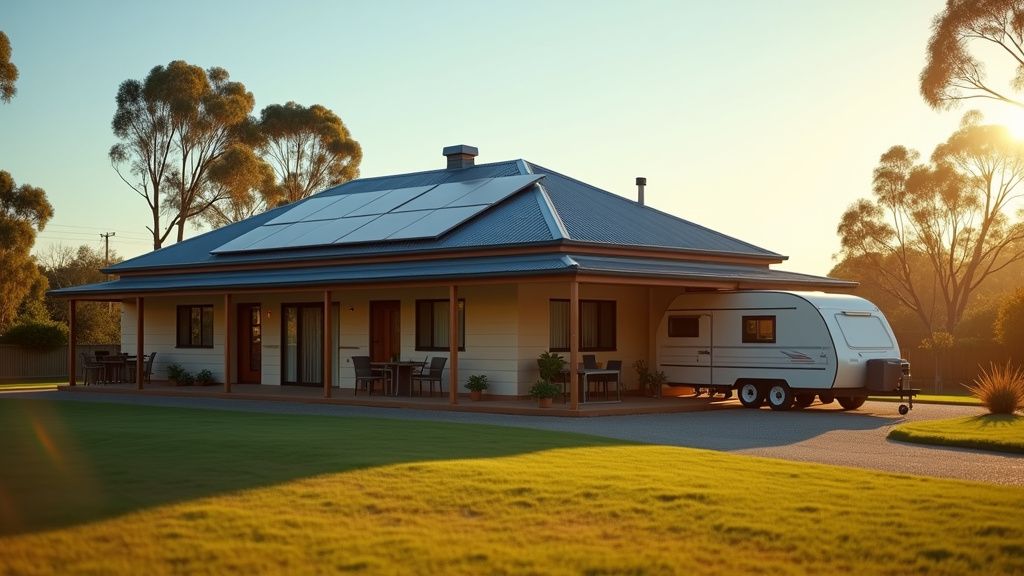
Fixed solar panels on the caravan roof force a choice every time you stop: park in the sun and cook, or park in the shade and lose your charge. A solar blanket removes that trade-off, because it goes wherever the sun is while the van stays cool.
Blankets do not replace roof panels for everyone, but for a lot of travellers they are the difference between staying out another three days and driving to a powered site. Our Complete Guide covers the smaller 120W options.
What Exactly is a Solar Blanket?
Monocrystalline cells sewn into a tough fabric or polymer backing, folding down to something you can store in a locker. Light, packable, and no frame to bang around in transit.
Why Consider a Solar Blanket for Your Caravan?
- Ultimate Portability: Folds smaller than a rigid panel of the same wattage. Fits in a locker, under a bed, or in the tow vehicle.
- Flexible Deployment: Park in the shade, put the blanket in the sun, move it through the day as the sun swings around.
- Supplementing Fixed Panels: Plenty of vans run both. The blanket covers the days when the roof panels are shaded or the weather is poor.
- Lightweight Solution: Matters if you are close to your Aggregate Trailer Mass or ball weight limits, and most vans are.
Solar Blankets vs. Other Solar Options: A Quick Comparison
- Fixed Roof Panels: Charge whenever the sun is out, with no setup. But you cannot angle them, and where you park decides what you get.
- Folding Solar Panels: Portable and angleable, but bulkier and heavier than a blanket of the same wattage.
- Solar Blankets: Portable, angleable, smallest pack size, lightest. The honest caveat is that flexible panels often produce slightly less real-world output than a rigid panel of the same rated wattage, because they run hotter against the ground and have less protective glazing.
Key Factors When Choosing Your Solar Blanket
- Wattage and Output: Add up your daily consumption first: fridge, lights, devices, anything through the inverter. Blankets run 100W to 200W. A fridge running through summer is what pushes people to 200W.
- Built-in vs. External Regulator:
- Built-in Regulator: Plug in and go, which suits a simple setup. The built-in unit is often a basic PWM type.
- External Regulator: An external MPPT regulator extracts noticeably more power in variable light than PWM does, and it matters more with lithium batteries, which want a specific charging profile. It also lets the blanket feed an existing vehicle management system.
- Durability and Construction: UV-resistant materials, tough backing, decent stitching and connectors. Reinforced eyelets so you can peg it down: an unpegged blanket in a gust becomes a kite, and they do not survive the landing.
- Portability and Pack Size: Folded dimensions and weight. Both decide whether it comes with you or stays in the shed.
- Cable Length and Connectors: Long enough to reach the battery with the blanket sitting in sun twenty metres away. Anderson plugs are the Australian standard.
- Integration with Your Existing Setup: Match the regulator to your battery chemistry, whether lead-acid, AGM or lithium. Lithium in particular wants MPPT.
Understanding Your Options
- Premium Options: Built for hard touring, with better cells, better components and construction that survives corrugations. Worth it if you are out for months.
- Advanced System Integration: Designed around lithium banks and high-performance MPPT regulators, for setups where charging efficiency is the point.
- Mid-Range Choices: Solid output and build without the premium price. Where most regular travellers land.
- Entry-Level & Supplementary: Fine as a second panel or for occasional trips. Expect shorter life and lower efficiency.
Maximising Your Solar Blanket's Performance
- Angle, Angle, Angle: Point it at the sun and move it twice a day. This makes more difference than the difference between two brands.
- Keep it Clean: Dust and leaves cost you real output. A damp cloth fixes it.
- Match Components: Regulator matched to battery chemistry, or you lose efficiency and battery life at once.
The Freedom of Flexible Power
Work out your daily watt-hours, buy enough wattage to refill that in the sun hours you actually get, and put the money into the regulator rather than the badge. Get those right and the blanket will keep you out as long as your water lasts.