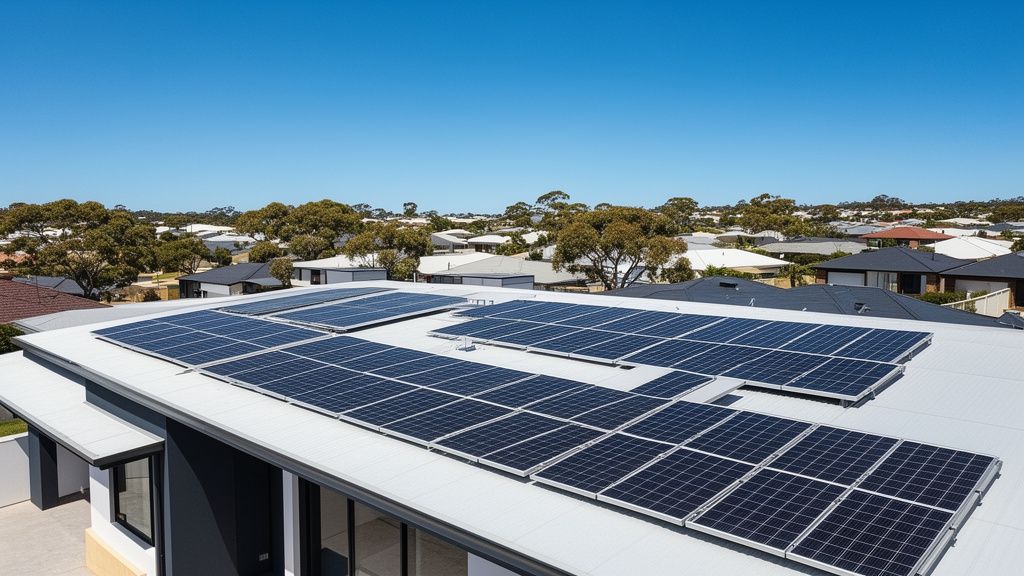
TL;DR: LFP is the change that has already happened and it is why EVs now start under $40,000 here. Solid state is the change that has not, and will reach premium cars before anything else. The development that matters most to a solar household is neither: it is bidirectional charging, which turns the car into the biggest battery you own.
What are the battery technologies actually changing?
Two, at very different stages of maturity.
LFP: already in the showroom
Lithium iron phosphate is not new, and it has taken over the affordable end of the market. BYD builds its own, Tesla uses it in entry-level models, and most sub-$50,000 EVs sold in Australia now run it.
The advantages are practical rather than exotic. No cobalt or nickel, so cheaper. Far more thermally stable, so lower fire risk. Tolerant of being charged to 100% every night, where nickel-based packs are better kept to 80% for daily use, which effectively gives back some of the range difference.
LFP's traditional weakness was energy density. Cell-to-pack construction, which removes the module layer and puts cells directly into the pack structure, has recovered most of that at pack level. Ranges of 400 to 500 km are now normal on LFP, which covers almost all Australian driving.
The remaining weaknesses are real: slower peak charging and reduced capacity in cold weather. Both matter less in Brisbane than in Canberra.
Solid state: not yet
Replacing the liquid electrolyte with a solid one promises higher energy density, faster charging and better safety. Claimed figures run to 1000 km of range and useful charge in under 15 minutes.
Those numbers come from laboratories and pilot lines, not production. Manufacturing solid-state cells at volume needs new processes, new materials handling and new quality control, and the first commercial output will go to premium vehicles where the margin absorbs the cost.
Treat announcements accordingly. A breakthrough in a laboratory and a car you can buy are separated by years of scale-up, cost reduction and field validation.
What will this mean for range and charging in Australia?
Range is close to solved for most people and charging is the real constraint.
Range
Current premium EVs already reach 600 to 800 km. Sydney to Melbourne is around 870 km, so that trip is one stop rather than three.
Mid-range LFP cars at 400 to 500 km cover a week of commuting on a single charge and handle inter-city runs with one stop. For a household with off-street parking, range anxiety is largely a solved problem and has been for a couple of years.
Where it still bites is remote driving. Charging infrastructure across regional Australia is thinner than range figures alone suggest, and a 500km car on a route with 400km between chargers is a different proposition to the same car in a capital city.
Charging speed
Next-generation cells are designed to accept higher input, with claims of 200 to 300 km of range added in 10 to 15 minutes at ultra-rapid chargers.
The caveat is that this requires an ultra-rapid charger to be present and working. Peak charge rates quoted by manufacturers assume ideal battery temperature and state of charge, and real-world sessions are usually slower. A 10 to 80% charge is the meaningful benchmark rather than a peak figure, because charging slows sharply above 80% on every chemistry.
For daily use it barely matters. If you charge at home overnight, the car is full every morning and public charging speed is a road-trip question rather than a daily one.
Will EVs get cheaper in Australia?
They already have, and battery cost is the main reason.
The pack is the single largest component cost in an EV. LFP removed the two most expensive and most price-volatile inputs, and cell-to-pack construction removed manufacturing steps. Vertically integrated manufacturers that build their own cells removed a supplier margin as well.
The result is EVs entering the sub-$40,000 bracket here, including the MG4 and BYD Dolphin. That is the price band where an EV competes with a mid-spec petrol hatch rather than with a statement purchase.
Running costs widen the gap further. Charging at home on solar costs a fraction of petrol, and there is far less to service.
What cheaper cells do not fix
Australian EV prices are not set by battery cost alone. Shipping, a small right-hand-drive market, luxury car tax thresholds and dealer margins all sit on top, which is why the same model can cost considerably more here than in its home market.
Cheaper cells make cheaper cars possible. They do not guarantee them.
Battery life and replacement
Modern packs are engineered well past 300,000 km, and warranties of eight to ten years with a capacity floor are now standard.
That has largely retired the fear of a five-figure battery replacement, and it shows in resale values. An LFP car in particular holds closer to its original range at five years than a nickel-based car of the same age, because LFP degrades more slowly under daily full charging.
How do EVs integrate with home solar?
This is where the interesting development sits for anyone with a rooftop array, and it is not about the cells at all.
Vehicle to home
A typical EV pack holds three to five times what a dedicated battery storage unit holds. With vehicle-to-home capability, that capacity becomes available to the house.
Charge the car from your midday surplus instead of exporting it at 5 to 8 cents. Run the house from the car through the evening peak, when grid power costs 40 to 50 cents. The arbitrage is the same as a home battery's and the capacity is far larger.
It also provides genuine blackout backup. A car with 60kWh in it can carry a household's essential loads for days rather than hours, which matters at the end of a rural feeder.
Vehicle to grid
The same hardware pointed outward. Feed the grid at peak demand and earn credits from your retailer.
Aggregate enough vehicles and you have distributed storage that stabilises the grid and defers new infrastructure. That is a genuinely useful thing and it is why network operators are interested.
Read the terms before signing up to any of it. V2G cycles the pack harder than driving does, and warranties expire at a stated throughput or cycle count. LFP's high cycle life makes it far better suited to this than nickel chemistry, which is a practical reason to prefer LFP if bidirectional use is part of your plan.
The obstacles
Bidirectional charging in Australia is limited less by the cars than by everything around them. Approved bidirectional chargers are expensive and few, network connection rules vary by state, and only some vehicles support export at all.
If this is why you are buying, confirm three things before you commit: that the specific model supports V2H or V2G, that a compatible charger is approved for sale here, and that your distributor permits the connection.
Key Takeaways
- LFP has already changed the market, bringing EVs under $40,000 here with 400 to 500 km of range and cycle life that removes replacement anxiety.
- Solid state will reach premium models first and is years from affecting what most people buy.
- Premium EVs now cover 600-800km on a charge, so range is largely solved in the capitals; regional charging infrastructure, not battery capacity, is the remaining constraint.
- V2H turns the car into a battery three to five times the size of a home unit, arbitraging cheap midday solar against expensive evening grid power.
- Before buying for bidirectional use, confirm the model supports it, an approved charger exists here, and your network allows the connection.