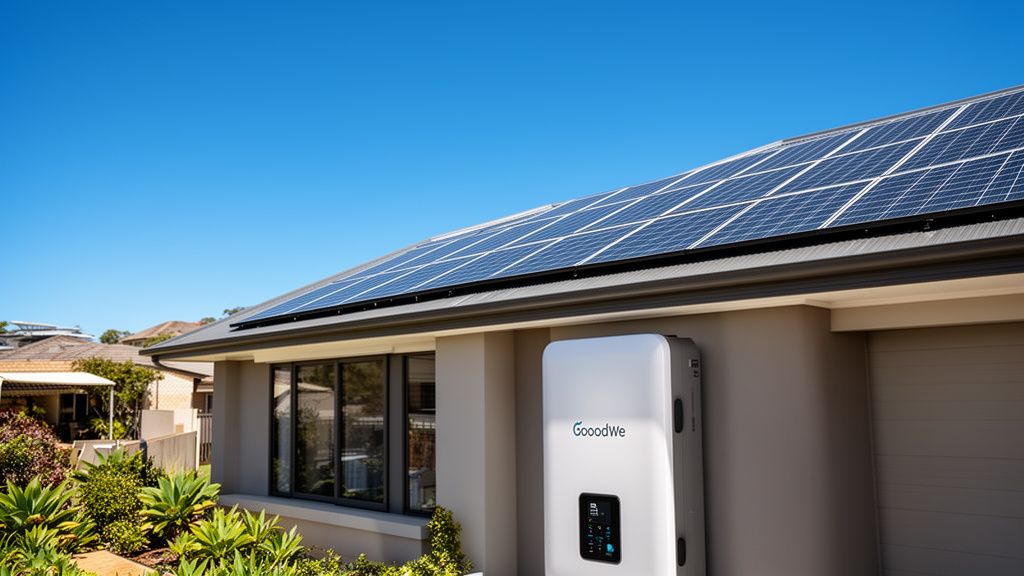
TL;DR: The GoodWe ESA series can back up a whole house rather than a handful of essential circuits, but only if the inverter's amp rating covers your simultaneous load and its surge rating covers motor startup. A 10kW unit supplies around 43A at 230V. Installed, expect $15,000 to $30,000 depending on inverter size and battery capacity.
Whole-Home Backup Against Essential-Circuit Backup
Most battery installations back up a small essential loads panel: fridge, lights, router, a few power points. It is cheaper, and it makes a modest battery last a long time.
Whole-home backup keeps every circuit live. Nothing is switched out, nothing needs explaining to the rest of the household during an outage, and you are not walking to a different room to boil the kettle.
The catch is that the inverter now has to supply whatever the house happens to demand at the moment the grid drops, including the loads an essential-circuit design deliberately excludes. That is a sizing problem, and getting it wrong produces a system that trips out under load rather than one that fails to switch over.
How the Transfer Works
When the grid fails, the ESA disconnects the property, forms an island, and restarts from battery and solar. The transfer switch operates in milliseconds, so clocks do not reset and computers stay up.
That speed matters more on whole-home backup than on an essential circuit, because more sensitive equipment is on the line. It also matters in bushfire-prone and storm-exposed areas where the grid drops and returns repeatedly over a few hours, and each transition is a chance for something to trip.
Once islanded, your solar panels restart and charge the battery, so an outage in daylight is a very different proposition to one at 2am.
What the ESA Range Covers
Single-phase hybrid inverters, commonly 5kW to 10kW, with DC coupling to the array and compatibility across a range of high-voltage batteries including GoodWe's own Lynx Home F series.
DC coupling means the solar DC feeds the inverter directly and one conversion handles house supply, battery charging and export. It is more efficient than AC coupling and it is the right choice for a new installation.
Retrofitting to Existing Solar
An ESA can be added to an existing AC-coupled system with extra hardware, and that route is common when the original array is only a few years old and there is no case for replacing it.
The efficiency penalty is real but modest. What matters more is whether the existing array is large enough to recharge the battery while the house is drawing from it, because on whole-home backup the house draw is considerably higher than on an essential circuit. A 5kW array supporting a whole-home backup design in winter will often fail to keep up.
Amp Ratings Are the Constraint People Miss
Battery storage capacity in kilowatt-hours tells you how long the battery lasts. Amps tell you what you can run at once. They are different questions and only the first one appears in most marketing.
A 10kW ESA inverter supplies roughly 43A at 230V. That covers a normal Australian household running several appliances simultaneously. It does not cover everything the house could theoretically draw at once, and on whole-home backup nothing stops the household trying.
Continuous Against Surge
Continuous rating is what the inverter delivers indefinitely. Surge rating is what it delivers for a few seconds.
The distinction exists because induction motors draw several times their running current at startup. A fridge compressor, a washing machine, a bore pump and an air conditioner all spike hard for a moment and then settle. An inverter sized only on continuous draw will trip when two of them start together.
GoodWe ESA inverters carry generous surge headroom for exactly this reason, which is what makes whole-home backup workable rather than theoretical. Ask your installer for both figures, and ask specifically about the largest motor load in the house. A bore pump or a pool pump on a rural property is usually the number that decides the inverter size.
The Loads That Break the Budget
Three things drive the required amp rating higher than people expect: ducted air conditioning, electric hot water, and EV charging.
Any one of these can be worth more than every other circuit combined. If you have all three, whole-home backup at a sensible inverter size may not be achievable, and the honest answer is a hybrid design that backs up everything except those loads. That is a smaller compromise than it sounds, and it is a great deal cheaper than sizing an inverter around a 7kW car charger.
Sizing the System
Two separate calculations: inverter size from peak simultaneous demand, and battery capacity from how long you need to last.
Start with a load audit. List every circuit, its running wattage, and its startup surge where it has a motor. Your switchboard schedule and appliance plates give you most of it.
A typical family might land on an 8kW ESA inverter for the power side and 10 to 20kWh of battery for the duration, which carries a whole house through an overnight outage with a margin.
Working Out the Battery
Sum the continuous draw of everything you expect to run, then multiply by the hours you need.
At 2.5kW average draw across 8 hours, you need at least 20kWh of usable capacity. Add a buffer, because usable capacity is lower than nameplate, cold weather reduces available output, and cells lose capacity over the years.
GoodWe's Lynx Home F modules stack from 6.6kWh to 19.8kWh per tower, so the capacity can be matched fairly closely to the number you calculate rather than rounded up to whatever the next product size happens to be.
Cost and Compliance
Installed, a whole-home ESA system typically runs $15,000 to $30,000 depending on inverter size, battery capacity and how much switchboard work the job needs.
Use a Clean Energy Council accredited installer. That is a licensing requirement, it governs rebate eligibility and warranty validity, and the design work here is not trivial: AS/NZS 3000 compliance, network connection approval, and a load audit that has to be right the first time because the inverter cannot be resized afterwards without replacing it.
Key Takeaways
- Whole-home backup keeps every circuit live, which shifts the design constraint from battery capacity to inverter amp rating.
- ESA inverters run 5kW to 10kW single-phase, DC-coupled, with a 10kW unit supplying around 43A at 230V.
- Continuous rating decides what runs; surge rating decides whether motors start. Ask for both, and size around your largest motor load.
- Ducted air conditioning, electric hot water and EV charging often make full whole-home backup impractical. Excluding those three is a reasonable compromise.
- Budget $15,000 to $30,000 installed, and use a CEC-accredited installer to do the load audit before anything is ordered.
