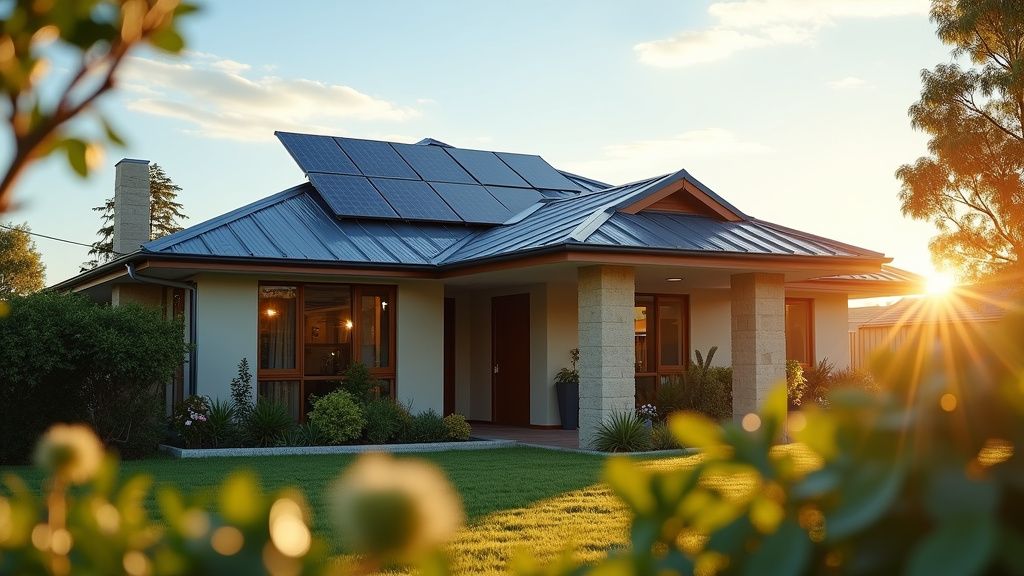
Decoding Your Rooftop's Potential: Estimating Your Home's Solar Panel Requirements
Thinking of joining the solar revolution and harnessing the power of the Aussie sun? Excellent choice! Solar panels are a fantastic way to reduce your electricity bills, shrink your carbon footprint, and increase your home's value. But how do you figure out exactly how many solar panels you need? It's not a one-size-fits-all answer, but don't worry, this guide will walk you through the process. For a deeper dive, check out our Complete Guide.
Understanding System Size: Kilowatts and Your Energy Needs
The size of a solar system is measured in kilowatts (kW), which represents its total power-generating capacity. One kilowatt equals 1000 Watts. So, a system comprised of 19 solar panels, each rated at 350 Watts, would have a total system size of 6.65 kW (19 x 350 = 6650 Watts).
The ideal system size for your home depends primarily on your energy consumption. A crucial first step is understanding how much electricity you actually use.
Step 1: Analysing Your Electricity Bill
Your electricity bill is your best friend in this process. Look for your "average daily use" in kilowatt-hours (kWh). This figure tells you how much electricity your household consumes on a typical day. It's calculated by dividing your total electricity usage during the billing period (usually 90 days) by the number of days in that period.
In Australia, the average home consumes between 11 and 23 kWh per day. If your usage falls within this range, you're pretty standard. However, factors like running air conditioning frequently, having a large family, or operating a home business can significantly increase your energy needs.
Step 2: Calculating the Right System Size
Once you know your average daily electricity consumption, you can begin to estimate the solar system size you need. Keep in mind this is an estimation and consulting with a professional installer is highly recommended.
As a general rule of thumb:
- Small households (low electricity consumption): If your average daily use is on the lower end (around 10-15 kWh), a 3-5 kW system might be sufficient.
- Medium-sized households (average electricity consumption): For households using between 15-20 kWh daily, a 5-7 kW system is often a good starting point.
- Large households (high electricity consumption): If you consume upwards of 20 kWh per day, you'll likely need a larger system, possibly 7 kW or more.
These are just rough estimates. Factors like roof orientation (north-facing is ideal in Australia), shading from trees or buildings, and your energy usage patterns will all influence the optimal system size.
Step 3: Considering Roof Space and Inverter Size
Two practical considerations can affect your final solar panel requirements: available roof space and inverter size.
- Roof Space: Solar panels aren't tiny. A standard residential solar panel is around 1.7 square metres in area. A common 6.6 kW system can take up roughly 29-32 square metres of roof space. Before you get too excited about a massive system, make sure your roof has enough clear, unshaded area.
- Inverter Size: The inverter is a critical component that converts the direct current (DC) electricity generated by your solar panels into alternating current (AC) electricity that your home can use. In many systems, the inverter is slightly smaller than the total panel output. For example, a 6.6 kW solar panel array might be paired with a 5 kW inverter. This is because panels rarely operate at their full rated capacity. Choosing the right inverter for your panels is important, and this should be discussed with your solar installer.
Step 4: Getting Professional Advice
While online tools and general guidelines can provide a good starting point, the best way to determine your exact solar panel requirements is to consult with a qualified solar installer. They can assess your specific energy needs, roof conditions, and budget to recommend the optimal system size and design.
- Get Multiple Quotes: Contact several reputable installers in your area and compare their quotes.
- Ask Questions: Don't be afraid to ask questions about panel efficiency, inverter specifications, and installation costs.
- Understand the Assumptions: Make sure you understand the assumptions used in their calculations, such as solar irradiance levels and shading factors.
Government Rebates and Incentives
Don't forget to factor in Australian Government rebates and incentives, which can significantly reduce the upfront cost of your solar system. Your installer can help you navigate these options.
Embrace the Sun!
Estimating your home's solar panel requirements involves a bit of research and calculation, but it's a worthwhile investment. By understanding your energy consumption, considering roof space, and seeking professional advice, you can confidently choose a solar system that meets your needs and helps you enjoy the many benefits of clean, renewable energy. So go ahead, take that first step towards a brighter, more sustainable future!
