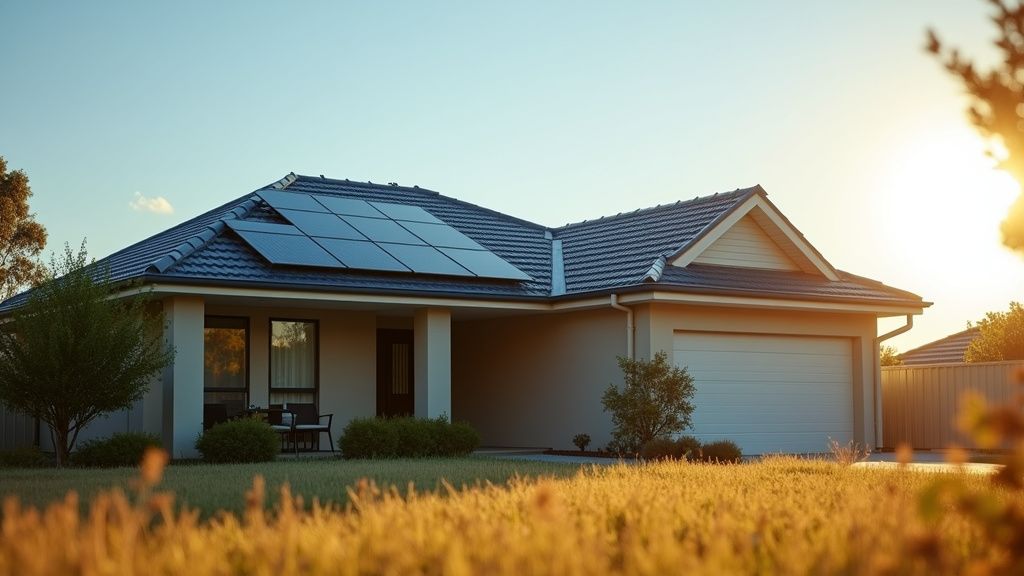
SolarInsights: Cracking the Code – How Many Solar Panels Do You Need to Kiss Your Electricity Bill Goodbye?
Thinking about joining the solar revolution and sticking it to those ever-increasing electricity bills? Excellent choice, mate! Solar power is a fantastic way to save money, reduce your carbon footprint, and boost your home's value. But one of the first questions everyone asks is: "How many solar panels do I actually need?".
It's not a one-size-fits-all answer, unfortunately. Figuring out the ideal number of panels for your Aussie home involves a bit of maths and consideration of your individual energy needs and circumstances. Let's break it down.
1. Know Your Energy Appetite:
The foundation of your solar panel calculation is your electricity consumption. Dig out your latest electricity bill and find your "average daily use" in kilowatt-hours (kWh). This tells you how much juice your household typically consumes each day. Australian homes, on average, use between 11 and 23 kWh per day. If your bill shows something wildly different, that's a crucial starting point.
2. System Size Matters (kW, Not Just Panels):
Solar systems are measured in kilowatts (kW), which represents their total power-generating capacity. This depends on two things: the number of panels and the individual wattage of each panel. For instance, a system with 19 panels, each rated at 350 Watts, would be a 6.65 kW system (19 x 350 = 6650 Watts = 6.65 kW).
3. Roof Space Realities:
Before you get too carried away, consider your available roof space. Solar panels aren't exactly tiny. A single residential panel usually takes up around 1.7 square metres. That common 6.6 kW system we just mentioned? It needs roughly 29-32 square metres of roof space, depending on the specific panels. You can arrange panels in either portrait or landscape orientation to maximise the use of your roof.
4. The Magic Calculation (Simplified):
Okay, let's get down to a rough calculation. This is a simplified estimate, and professional advice is always recommended.
-
Estimate your daily energy needs (kWh): As found on your bill.
-
Consider sunlight hours: Australia boasts plenty of sunshine, but the effective sunlight hours vary depending on your location and the time of year. Let's assume an average of 4-5 peak sun hours per day.
-
Calculate the required system size: Divide your daily energy needs (kWh) by your average peak sun hours to get a rough estimate of the kW system size you need.
- Example: If you use 15 kWh per day and have 4 peak sun hours, you'd need a system of roughly 3.75 kW (15 kWh / 4 hours = 3.75 kW).
-
Determine the number of panels: Divide the system size (in Watts) by the wattage of the panels you're considering.
- Example: If you want a 3.75 kW system (3750 Watts) and are looking at 300-Watt panels, you'd need about 12-13 panels (3750 Watts / 300 Watts = 12.5).
5. Inverter Considerations:
The inverter is the brains of your solar system, converting the DC electricity from your panels into usable AC electricity for your home. Often, the inverter is sized slightly smaller than the total panel output. This is because panels rarely operate at their maximum capacity. A 6.6 kW system might be paired with a 5 kW inverter. This can be a cost-effective approach.
Important note: If your system size (total rated solar panel output) exceeds the inverter manufacturer's specifications, you might miss out on the Australian Government's Small-scale Renewable Energy Scheme rebate (more on that below!).
6. Don't Forget the Rebates (The Small-scale Renewable Energy Scheme):
The Australian government's Small-scale Renewable Energy Scheme (SRES) provides financial incentives for installing solar panels. This rebate significantly reduces the upfront cost of your system. The exact amount depends on your location and the system size.
7. Get Professional Advice:
While the above calculation gives you a ballpark figure, it's crucial to consult with a qualified solar retailer or installer. They can assess your specific circumstances, roof orientation, shading issues, and energy usage patterns to recommend the optimal system size and design for your home. They'll use specialised software to provide accurate estimates of savings and payback periods. Don't be afraid to ask questions about the assumptions behind their calculations.
A Note on Accuracy:
Be wary of overly optimistic savings projections. Solar system performance depends on various factors, including weather conditions, panel quality, and system maintenance.
In conclusion:
Figuring out the right number of solar panels isn't an exact science, but with a little research and professional guidance, you can determine the ideal system size to slash your electricity bills and embrace a cleaner, greener future. Happy solar shopping!
