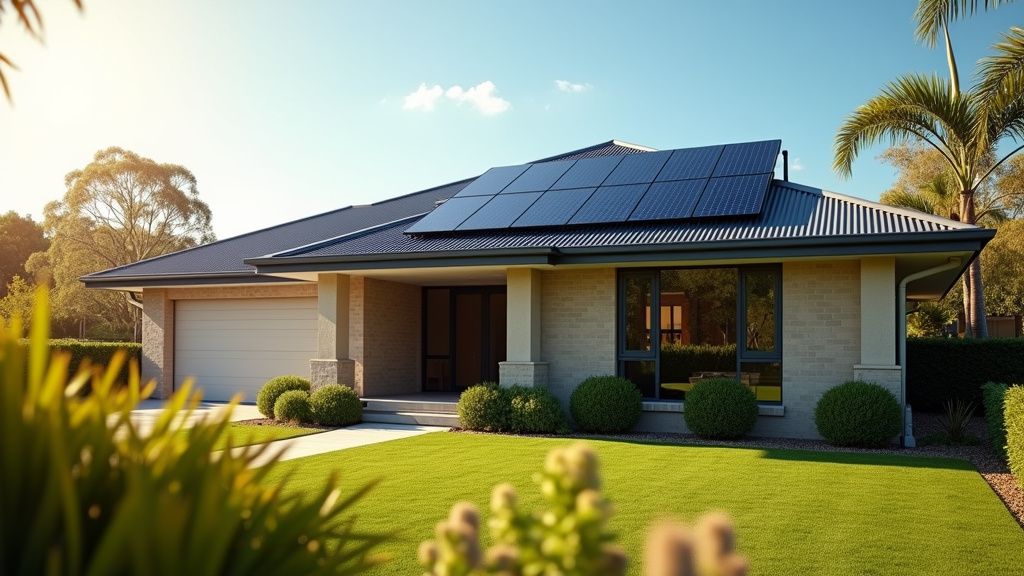
Size Matters: Understanding Solar Panel Dimensions for Aussie Homes
G'day solar enthusiasts! Here at SolarInsights, we're dedicated to helping you navigate the world of solar power and make informed decisions for your home or business. One question that pops up time and time again is: "How big are solar panels, and why does it matter?"
The answer isn't as simple as quoting a single measurement. Solar panel size isn't a one-size-fits-all deal. It's a factor that significantly impacts how much power your solar system can generate, and how well it fits onto your roof. Let's break it down.
Why Panel Size Matters:
Think of your roof as a limited resource. The dimensions of your solar panels directly influence how many you can physically fit onto that space. And the number of panels, in turn, dictates the total electricity your system can produce. It's a domino effect!
Understanding the Numbers: Dimensions & Wattage
When we talk about solar panel size, we're generally referring to two key things:
- Physical Dimensions (Height x Width): Measured in metres (m), this tells you the actual area each panel occupies on your roof.
- Power Output (Wattage - W): This indicates how much electricity the panel can generate under optimal conditions.
Typical Panel Sizes – Residential vs. Commercial
You'll generally find two main size categories:
-
Residential Solar Panels: These are the most common for Aussie homes. They typically contain 60 solar cells (or 120 "half-cut" cells, which we'll get to later). A common size for these panels is around 1.6m to 1.7m tall and about 1.0m wide. Power output ranges from approximately 350W to 500W. You'll commonly find panels rated around 330W.
-
Commercial Solar Panels: Designed for larger roofs, these panels often feature 72 solar cells (or 144 "half-cut" cells). Expect dimensions of roughly 2.1m tall by 1.1m wide, making them about 30% larger than their residential counterparts. While primarily for commercial setups, they can be used on residential roofs if space permits. However, the spacing of the supports underneath your roof (purlins) sometimes makes the smaller 60-cell panels a better fit for residential installs as you can often fit an extra row of panels.
Half-Cut Cells: A Modern Twist
You might hear about "half-cut" cell technology. Instead of using full-sized solar cells, these panels use cells that have been cut in half. A 120 half-cell panel, is equivalent in size to a 60-cell panel; and a 144 half-cell panel is equivalent in size to a 72-cell panel. Why do this? Cutting the cells in half reduces electrical resistance, which can lead to a slight boost in overall panel efficiency. They're becoming increasingly common in newer solar panel models.
Wattage and Panel Numbers: Sizing Your System
The wattage of your panels is crucial for determining how many you need to meet your energy requirements. A higher wattage doesn't automatically mean a "better" panel; it just means it produces more power.
As a general rule:
- To generate 1kW of power, you'll need around three 350W panels or two 500W panels.
- A typical 6.6kW residential system might use 18 x 350W panels or 13 x 500W panels.
Important Considerations Beyond Size
While panel dimensions are important, don't forget these factors:
- Efficiency: Check the efficiency rating on the panel's datasheet. This tells you how well the panel converts sunlight into electricity. A more efficient panel will generate more power from the same surface area.
- Roof Space: Ultimately, the amount of available roof space will limit how many panels you can install, and this will impact the total electricity your system can generate.
- Installation and Maintenance: Remember to factor in space for installers to access and maintain the panels.
How Much Roof Space Do You Need?
To give you a general idea, here's a rough guide to roof space requirements for different system sizes using standard 1.7m2 solar panels (approximately 330W), including space for access and maintenance:
- 3kW System: Approximately 18m2
- 5kW System: Approximately 30m2
- 6.6kW System: Approximately 40m2
- 10kW System: Approximately 60m2
The Takeaway
Choosing the right solar panels involves balancing physical size, power output, and overall efficiency. By understanding these factors, you can work with your solar installer to design a system that perfectly fits your needs and maximises your energy savings. Happy solar-ing, Aussies!
