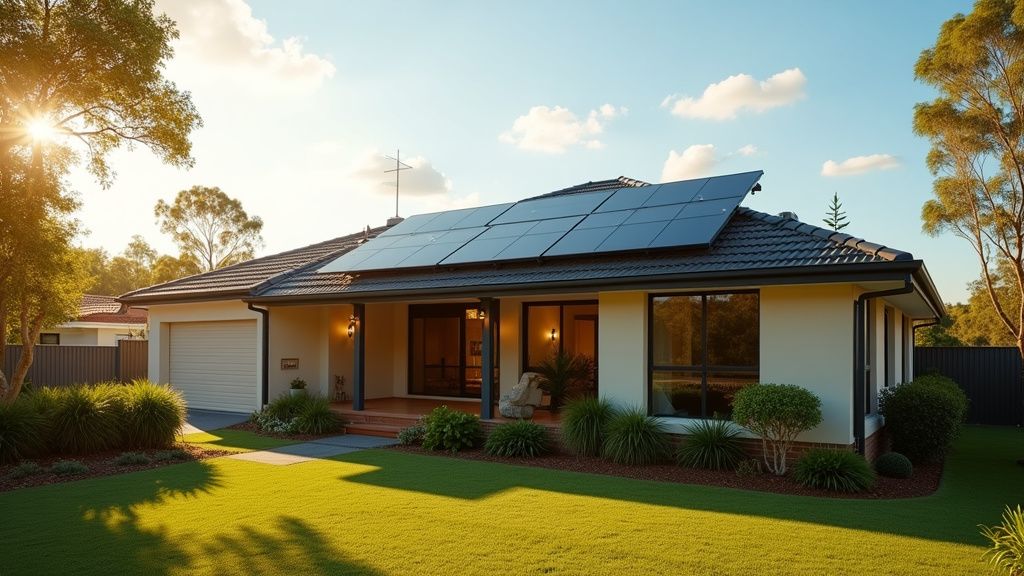
Is Home Solar Energy Worth It in 2025? An Aussie Perspective
Thinking about going solar in 2025? You're not alone! With electricity prices constantly on the rise, more and more Aussies are looking to the sun for a cheaper and cleaner energy source. But is it really worth the investment? Let's break it down.
Before we dive in, if you're looking for even more detailed information, check out our Complete Guide.
The Feed-In Tariff Myth
For years, the primary motivator for many solar adopters was the feed-in tariff (FiT). This is the payment you receive from your energy retailer for any excess electricity your solar panels generate that's fed back into the grid. Back in the late 2000s, when solar panels were much more expensive, government-backed FiTs were generous, sometimes as high as 60 cents per kilowatt-hour (kWh). These schemes were designed to boost solar uptake and did a great job. In fact, Australia reached over 4 million solar installations by late 2024!
However, those high-paying government schemes are largely a thing of the past. Today, market-based FiTs offered by retailers are significantly lower, generally ranging from a measly 1c to 15c per kWh, depending on your location and provider. Some states, like Victoria, have seen dramatic reductions. For example, the Victorian Essential Services Commission set the 2025-26 rate at just 0.04 cents/kWh, a staggering decrease from previous rates.
Why the Drop in Feed-In Tariffs?
The decline in FiTs is driven by changes in the wholesale electricity market. As more homes and businesses installed solar, more solar energy flooded the grid during daylight hours. Simultaneously, more people started using the solar power they generated themselves, reducing their reliance on grid electricity during the day. This increased supply and decreased demand drove down daytime wholesale electricity prices, which in turn lowered the feed-in tariffs offered by retailers, as they're often linked to these market prices.
The Real Value: Using Your Own Solar Power
Here's the crucial point: the biggest value of solar isn't selling electricity back to the grid; it's using the electricity you generate. Think of it this way: every kWh of solar electricity you use directly means you don't have to buy that kWh from your energy retailer, which could cost you anywhere from 25 to 45 cents.
Let's revisit that Victorian example. If your solar system generates 1 kWh and you send it back to the grid, you earn a paltry 0.04 cents. But if you use that 1 kWh, you avoid paying around 26 cents to your energy company. That's a much bigger saving!
For an average Victorian household using around 5,000 kWh annually, maximising self-consumption could translate to savings of around $1,300 per year.
Making the Most of Your Solar System
So, how do you maximise the value of your solar investment in 2025?
- Time Your Usage: Shift your energy-intensive activities, like running the washing machine, dishwasher, or air conditioner, to daylight hours when your solar panels are generating the most power.
- Consider Battery Storage: A home battery allows you to store excess solar energy generated during the day and use it at night, further reducing your reliance on the grid. While batteries add to the upfront cost, they can significantly increase your self-consumption and overall savings.
- Smart Home Integration: Smart home devices can automatically optimize your energy consumption, ensuring appliances run during peak solar production times.
The Verdict: Is Solar Worth It?
Despite the lower feed-in tariffs, investing in a home solar system in 2025 remains a smart move, for several reasons:
- Decreased Installation Costs: The price of solar panels has plummeted in recent years, making solar energy more affordable than ever and shortening the payback period. Government rebates and incentives, such as those offered under the Small-scale Renewable Energy Scheme, can further reduce the upfront cost.
- Significant Savings on Electricity Bills: By generating your own power, you'll dramatically reduce your dependence on the grid, resulting in substantial savings on your electricity bills, particularly as grid electricity prices continue to climb.
- Environmental Benefits: Investing in solar contributes to a cleaner environment by reducing your carbon footprint.
- Increased Property Value: Solar panels can increase the resale value of your home. Surveys indicate that a significant percentage of potential buyers and renters prefer properties with solar panels already installed.
- Protection Against Rising Energy Costs: Generating your own electricity provides a buffer against volatile and increasing energy prices.
In Conclusion
While the economics of solar have shifted with the decline in feed-in tariffs, home solar energy is still absolutely worth considering in 2025. The key is to focus on maximizing your self-consumption of solar power, rather than relying on selling excess energy back to the grid. By strategically managing your energy usage, considering battery storage, and taking advantage of available incentives, you can reap significant financial and environmental benefits from going solar. So, take a look at your energy bills, research your options, and see if solar is right for you. The sun is shining – time to harness its power!
